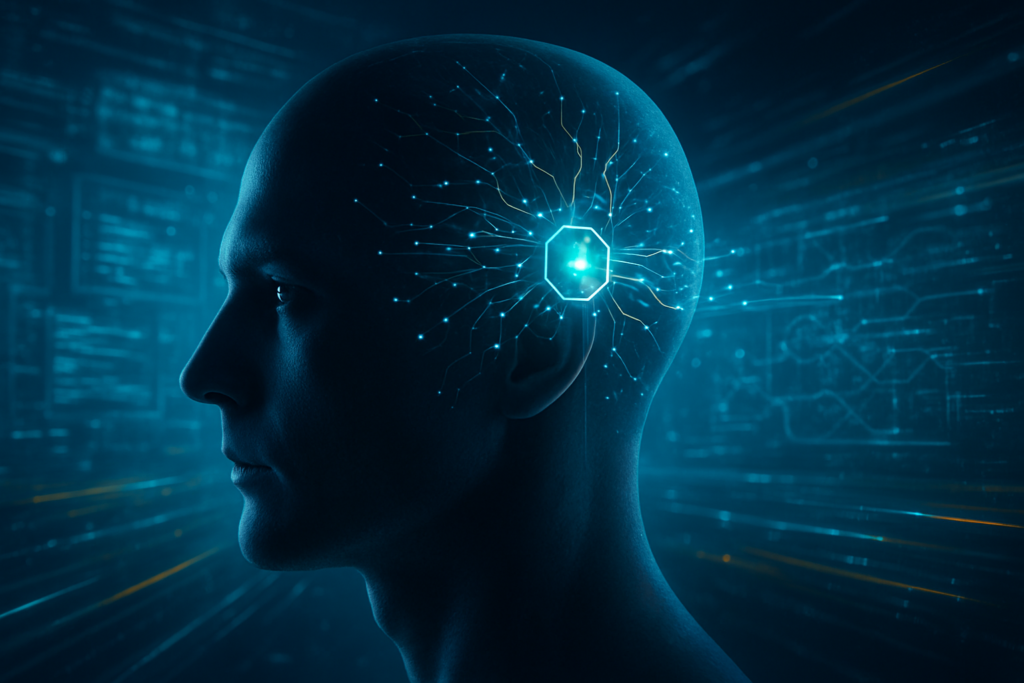
The boundary between human intent and digital action has reached a historic tipping point. As of early 2026, the integration of advanced artificial intelligence into Brain-Computer Interfaces (BCIs) has transformed what was once a slow, stuttering communication method for the paralyzed into a fluid, near-natural experience. By leveraging Transformer-based foundation models—the same architecture that powered the generative AI revolution—companies and researchers have successfully decoded neural signals at speeds that rival physical typing, effectively restoring "digital agency" to those with severe motor impairments.
This breakthrough represents a fundamental shift in neural engineering. For years, the bottleneck for BCIs was not just the hardware, but the "translation" problem: how to interpret the chaotic electrical storms of the brain into clean digital commands. With the arrival of 2026, the industry has moved past simple linear decoders to sophisticated hybrid AI models that can filter noise and predict intent in real-time. The result is a generation of devices that no longer feel like external tools, but like extensions of the user’s own nervous system.
The Transformer Revolution in Neural Decoding
The technical leap observed over the last 24 months is largely attributed to the adoption of Artifact Removal Transformers (ART) and hybrid Deep Learning architectures. Previously, BCIs relied on Recurrent Neural Networks (RNNs) that often struggled with "neural drift"—the way brain signals change slightly over time or when a patient shifts their focus. The new Transformer-based decoders, however, treat neural spikes like a language, using self-attention mechanisms to understand the context of a user's intent. This has slashed system latency from over 1.5 seconds in early 2024 to less than 250 milliseconds for invasive implants today.
These AI advancements have pushed performance metrics into a new stratosphere. In clinical settings, speech-decoding BCIs have now reached a record speed of 62 words per minute (WPM), while AI-assisted handwriting decoders have achieved 90 characters per minute with 99% accuracy. A critical component of this success is the use of Self-Supervised Learning (SSL), which allows the BCI to "train" itself on the user’s brain activity throughout the day without requiring constant, exhausting calibration sessions. This "set-it-and-forget-it" capability is what has finally made BCIs viable for use outside of high-end research labs.
Furthermore, the hardware-software synergy has reached a new peak. Neuralink has recently moved toward its "scaling phase," transitioning from its initial 1,024-electrode N1 chip to a roadmap featuring over 3,000 threads. This massive increase in data bandwidth provides the AI with a higher-resolution "image" of the brain's activity, allowing for more nuanced control—such as the ability to navigate complex 3D software or play fast-paced video games with the same dexterity as a person using a physical mouse and keyboard.
A Competitive Landscape: From Startups to Tech Giants
The BCI market in 2026 is no longer a speculative venture; it is a burgeoning industry where private pioneers and public titans are clashing for dominance. While Neuralink continues to capture headlines with its high-bandwidth invasive approach, Synchron has carved out a significant lead in the non-surgical space. Synchron’s "Stentrode," which is delivered via the jugular vein, recently integrated with Apple (NASDAQ: AAPL)’s native BCI Human Interface Device (HID) profile. This allows Synchron users to control iPhones, iPads, and the Vision Pro headset directly through the operating system’s accessibility features, marking the first time a major consumer electronics ecosystem has natively supported neural input.
The infrastructure for this "neural edge" is being powered by NVIDIA (NASDAQ: NVDA), whose Holoscan and Cosmos platforms are now used to process neural data on-device to minimize latency. Meanwhile, Medtronic (NYSE: MDT) remains the commercial leader in the broader neural tech space. Its BrainSense adaptive Deep Brain Stimulation (aDBS) system is currently used by over 40,000 patients worldwide to manage Parkinson’s disease, representing the first true "mass-market" application of closed-loop AI in the human brain.
The entry of Meta Platforms (NASDAQ: META) into the non-invasive sector has also shifted the competitive dynamic. Meta’s neural wristband, which uses electromyography (EMG) to decode motor intent at the wrist, has begun shipping to developers alongside its Orion AR glasses. While not a "brain" interface in the cortical sense, Meta’s AI decoders utilize the same underlying technology to turn subtle muscle twitches into digital actions, creating a "low-friction" alternative for consumers who are not yet ready for surgical implants.
The Broader Significance: Restoring Humanity and Redefining Limits
Beyond the technical and commercial milestones, the rise of AI-powered BCIs represents a profound humanitarian breakthrough. For individuals living with ALS, spinal cord injuries, or locked-in syndrome, the ability to communicate at near-natural speeds is more than a convenience—it is a restoration of their humanity. The shift from "searching for a letter on a grid" to "thinking a sentence into existence" changes the fundamental experience of disability, moving the needle from survival to active participation in society.
However, this rapid progress brings significant ethical and privacy concerns to the forefront. As AI models become more adept at decoding "intent," the line between a conscious command and a private thought begins to blur. The concept of "Neurorights" has become a major topic of debate in 2026, with advocates calling for strict regulations on how neural data is stored and whether companies can use "brain-prints" for targeted advertising or emotional surveillance. The industry is currently at a crossroads, attempting to balance the life-changing benefits of the technology with the unprecedented intimacy of the data it collects.
Comparisons are already being drawn between the current BCI explosion and the early days of the smartphone. Just as the iPhone (NASDAQ: AAPL) turned a communication tool into a universal interface for human life, the AI-BCI is evolving from a medical prosthetic into a potential "universal remote" for the digital world. The difference, of course, is that this interface resides within the user, creating a level of integration between human and machine that was once the exclusive domain of science fiction.
The Road Ahead: Blindsight and Consumer Integration
Looking toward the latter half of 2026 and beyond, the focus is shifting from motor control to sensory restoration. Neuralink’s "Blindsight" project is expected to enter expanded human trials later this year, aiming to restore vision by stimulating the visual cortex directly. If successful, the same AI decoders that currently translate brain signals into text will be used in reverse: translating camera data into "neural patterns" that the brain can perceive as images.
In the near term, we expect to see a push toward "high-volume production" of BCI implants. As surgical robots become more autonomous and the AI models become more generalized, the cost of implantation is predicted to drop significantly. Experts predict that by 2028, BCIs may begin to move beyond the clinical population into the "human augmentation" market, where users might opt for non-invasive or minimally invasive links to enhance their cognitive bandwidth or interact with complex AI agents in real-time.
The primary challenge remains the long-term stability of the interface. The human body is a hostile environment for electronics, and "gliosis"—the buildup of scar tissue around electrodes—can degrade signal quality over years. The next frontier for AI in this field will be "adaptive signal reconstruction," where models can predict what a signal should look like even as the hardware's physical connection to the brain fluctuates.
A New Chapter in Human Evolution
The developments of early 2026 have cemented the BCI as one of the most significant milestones in the history of artificial intelligence. We have moved past the era where AI was merely a tool used by humans; we are entering an era where AI acts as the bridge between the human mind and the digital universe. The ability to decode neural signals at near-natural speeds is not just a medical victory; it is the beginning of a new chapter in human-computer interaction.
As we look forward, the key metrics to watch will be the "word per minute" parity with physical speech (roughly 150 WPM) and the regulatory response to neural data privacy. For now, the success of companies like Neuralink and Synchron, backed by the computational might of NVIDIA and the ecosystem reach of Apple, suggests that the "Silicon Mind" is no longer a dream—it is a functioning, rapidly accelerating reality.
This content is intended for informational purposes only and represents analysis of current AI developments.
TokenRing AI delivers enterprise-grade solutions for multi-agent AI workflow orchestration, AI-powered development tools, and seamless remote collaboration platforms.
For more information, visit https://www.tokenring.ai/.