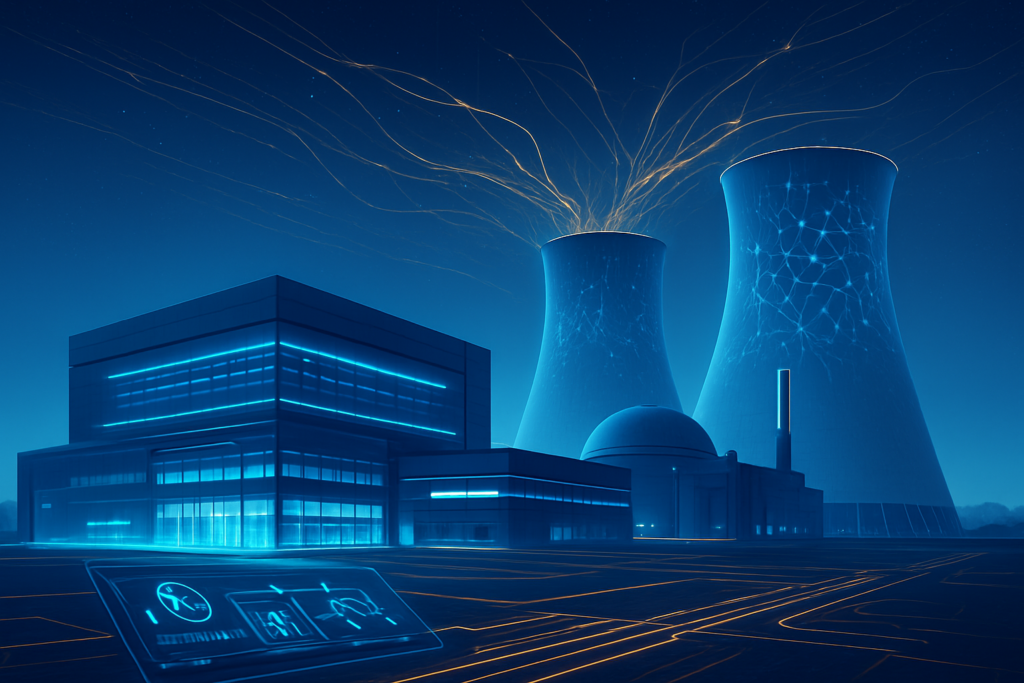
The rapid ascent of generative artificial intelligence has triggered an unprecedented surge in electricity demand, forcing the world’s largest technology companies to abandon traditional energy procurement strategies in favor of a "Nuclear Renaissance." As of early 2026, the tech industry has pivoted from being mere consumers of renewable energy to becoming the primary financiers of a new atomic age. This shift is driven by the insatiable power requirements of massive AI model training clusters, which demand gigawatt-scale, carbon-free, 24/7 "firm" power that wind and solar alone cannot reliably provide.
This movement represents a fundamental decoupling of Big Tech from the public utility grid. Faced with aging infrastructure and five-to-seven-year wait times for new grid connections, companies like Microsoft (NASDAQ: MSFT), Amazon (NASDAQ: AMZN), and Google (NASDAQ: GOOGL) have adopted a "Bring Your Own Generation" (BYOG) strategy. By co-locating data centers directly at nuclear power sites or financing the restart of decommissioned reactors, these giants are bypassing traditional bottlenecks to ensure their AI dominance isn't throttled by a lack of electrons.
The Resurrection of Three Mile Island and the Rise of Nuclear-Powered Data Centers
The most symbolic milestone in this transition is the rebirth of the Crane Clean Energy Center, formerly known as Three Mile Island Unit 1. In a historic deal with Constellation Energy (NASDAQ: CEG), Microsoft has secured 100% of the plant’s 835-megawatt output for the next 20 years. As of January 2026, the facility is roughly 80% staffed, with technical refurbishments of the steam generators and turbines nearing completion. Initially slated for a 2028 restart, expedited regulatory pathways have put the plant on track to begin delivering power to Microsoft’s Mid-Atlantic data centers by early 2027. This marks the first time a retired American nuclear plant has been brought back to life specifically to serve a single corporate customer.
While Microsoft focuses on restarts, Amazon has pursued a "behind-the-meter" strategy at the Susquehanna Steam Electric Station in Pennsylvania. Through a deal with Talen Energy (NASDAQ: TLN), Amazon acquired the Cumulus data center campus, which is physically connected to the nuclear plant. This allows Amazon to draw up to 960 megawatts of power without relying on the public transmission grid. Although the project faced significant legal challenges at the Federal Energy Regulatory Commission (FERC) throughout 2024 and 2025—with critics arguing that "co-located" data centers "free-ride" on the grid—a pivotal 5th U.S. Circuit Court ruling and new FERC rulemaking (RM26-4-000) in late 2025 have cleared a legal path for these "behind-the-fence" configurations to proceed.
Google has taken a more diversified approach by betting on the future of Small Modular Reactors (SMRs). In a landmark partnership with Kairos Power, Google is financing the deployment of a fleet of fluoride salt-cooled high-temperature reactors totaling 500 megawatts. Unlike traditional large-scale reactors, these SMRs are designed to be factory-built and deployed closer to load centers. To bridge the gap until these reactors come online in 2030, Google also finalized a $4.75 billion acquisition of Intersect Power in late 2025. This allows Google to build "Energy Parks"—massive co-located sites featuring solar, wind, and battery storage that provide immediate, albeit variable, power while the nuclear baseload is under construction.
Strategic Dominance and the BYOG Advantage
The shift toward nuclear energy is not merely an environmental choice; it is a strategic necessity for market positioning. In the high-stakes arms race between OpenAI, Google, and Meta, the ability to scale compute capacity is the primary bottleneck. Companies that can secure their own dedicated power sources—the "Bring Your Own Generation" model—gain a massive competitive advantage. By bypassing the 2-terawatt backlog in the U.S. interconnection queue, these firms can bring new AI clusters online years faster than competitors who remain tethered to the public utility process.
For energy providers like Constellation Energy and Talen Energy, the AI boom has transformed nuclear plants from aging liabilities into the most valuable assets in the energy sector. The premium prices paid by Big Tech for "firm" carbon-free energy have sent valuations for nuclear-heavy utilities to record highs. This has also triggered a consolidation wave, as tech giants seek to lock up the remaining available nuclear capacity in the United States. Analysts suggest that we are entering an era of "vertical energy integration," where the line between a technology company and a power utility becomes increasingly blurred.
A New Paradigm for the Global Energy Landscape
The "Nuclear Renaissance" fueled by AI has broader implications for society and the global energy landscape. The move toward "Nuclear-AI Special Economic Zones"—a concept formalized by a 2025 Executive Order—allows for the creation of high-density compute hubs on federal land, such as those near the Idaho National Lab. These zones benefit from streamlined permitting and dedicated nuclear power, creating a blueprint for how future industrial sectors might solve the energy trilemma of reliability, affordability, and sustainability.
However, this trend has sparked concerns regarding energy equity. As Big Tech "hoards" clean energy capacity, there are growing fears that everyday ratepayers will be left with a grid that is more reliant on older, fossil-fuel-based plants, or that they will bear the costs of grid upgrades that primarily benefit data centers. The late 2025 FERC "Large Load" rulemaking was a direct response to these concerns, attempting to standardize how data centers pay for their share of the transmission system while still encouraging the "BYOG" innovation that the AI economy requires.
The Road to 2030: SMRs and Regulatory Evolution
Looking ahead, the next phase of the nuclear-AI alliance will be defined by the commercialization of SMRs and the implementation of the ADVANCE Act. The Nuclear Regulatory Commission (NRC) is currently under a strict 18-month mandate to review new reactor applications, a move intended to accelerate the deployment of the Kairos Power reactors and other advanced designs. Experts predict that by 2030, the first wave of SMRs will begin powering data centers in regions where the traditional grid has reached its physical limits.
We also expect to see the "BYOG" strategy expand beyond nuclear to include advanced geothermal and fusion energy research. Microsoft and Google have already made "off-take" agreements with fusion startups, signaling that their appetite for power will only grow as AI models evolve from text-based assistants to autonomous agents capable of complex scientific reasoning. The challenge will remain the physical construction of these assets; while software scales at the speed of light, pouring concrete and forging reactor vessels still operates on the timeline of heavy industry.
Conclusion: Atomic Intelligence
The convergence of artificial intelligence and nuclear energy marks a definitive chapter in industrial history. We have moved past the era of "greenwashing" and into an era of "hard infrastructure" where the success of the world's most advanced software depends on the most reliable form of 20th-century hardware. The deals struck by Microsoft, Amazon, and Google in the past 18 months have effectively underwritten the future of the American nuclear industry, providing the capital and demand needed to modernize a sector that had been stagnant for decades.
As we move through 2026, the industry will be watching the April 30th FERC deadline for final "Large Load" rules and the progress of the Crane Clean Energy Center's restart. These milestones will determine whether the "Nuclear Renaissance" can keep pace with the "AI Revolution." For now, the message from Big Tech is clear: the future of intelligence is atomic, and those who do not bring their own power may find themselves left in the dark.
This content is intended for informational purposes only and represents analysis of current AI developments.
TokenRing AI delivers enterprise-grade solutions for multi-agent AI workflow orchestration, AI-powered development tools, and seamless remote collaboration platforms.
For more information, visit https://www.tokenring.ai/.