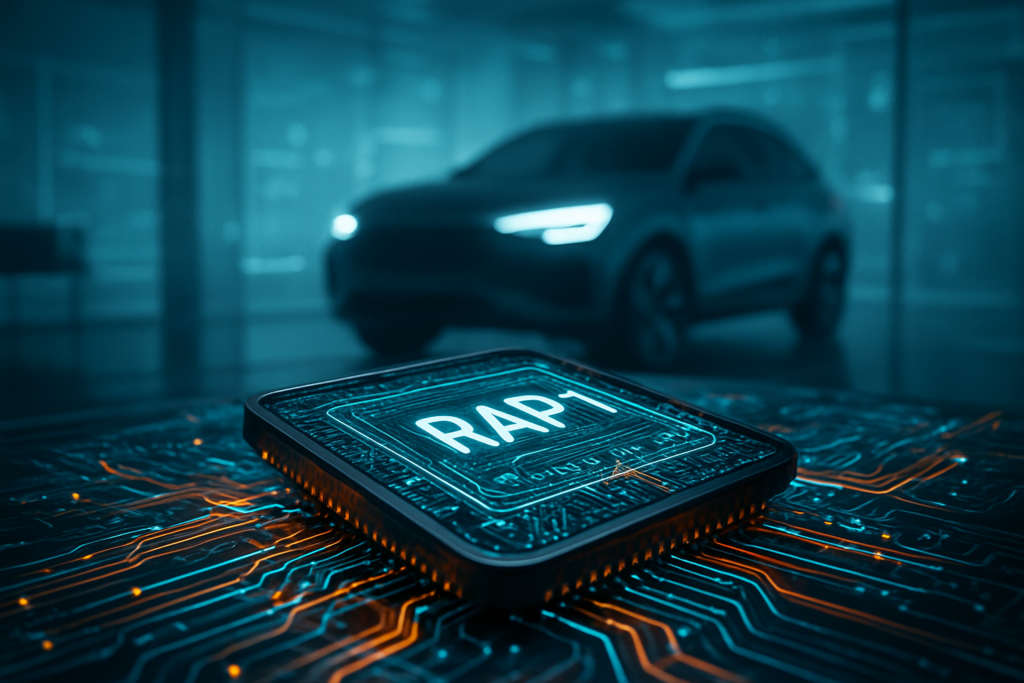
In a move that signals a paradigm shift for the electric vehicle (EV) industry, Rivian Automotive, Inc. (NASDAQ: RIVN) has officially declared its "silicon independence." During its inaugural Autonomy & AI Day on December 11, 2025, the company unveiled the Rivian Autonomy Processor 1 (RAP1), its first in-house AI chip designed specifically to power the next generation of self-driving vehicles. By developing its own custom silicon, Rivian joins an elite tier of technology-first automakers like Tesla, Inc. (NASDAQ: TSLA), moving away from the off-the-shelf hardware that has dominated the industry for years.
The introduction of the RAP1 chip is more than just a hardware upgrade; it is a strategic maneuver to decouple Rivian’s future from the supply chains and profit margins of external chipmakers. The new processor will serve as the heart of Rivian’s third-generation Autonomous Computing Module (ACM3), replacing the NVIDIA Corporation (NASDAQ: NVDA) DRIVE Orin systems currently found in its second-generation R1T and R1S models. With this transition, Rivian aims to achieve a level of vertical integration that promises not only superior performance but also significantly improved unit economics as it scales production of its upcoming R2 and R3 vehicle platforms.
Technical Specifications and the Leap to 1,600 TOPS
The RAP1 is a technical powerhouse, manufactured on the cutting-edge 5nm process node by Taiwan Semiconductor Manufacturing Company (NYSE: TSM). While the previous NVIDIA-based system delivered approximately 500 Trillion Operations Per Second (TOPS), the new ACM3 module, powered by dual RAP1 chips, reaches a staggering 1,600 sparse TOPS. This represents a 4x leap in raw AI processing power, specifically optimized for the complex neural networks required for real-time spatial awareness. The chip architecture utilizes 14 Armv9 Cortex-A720AE cores and a proprietary "RivLink" low-latency interconnect, allowing the system to process over 5 billion pixels per second from the vehicle’s sensor suite.
This custom architecture differs fundamentally from previous approaches by prioritizing "sparse" computing—a method that ignores irrelevant data in a scene to focus processing power on critical objects like pedestrians and moving vehicles. Unlike the more generalized NVIDIA DRIVE Orin, which is designed to be compatible with a wide range of manufacturers, the RAP1 is "application-specific," meaning every transistor is tuned for Rivian’s specific "Large Driving Model" (LDM). This foundation model utilizes Group-Relative Policy Optimization (GRPO) to distill driving strategies from millions of miles of real-world data, a technique that Rivian claims allows for more human-like decision-making in complex urban environments.
Initial reactions from the AI research community have been overwhelmingly positive, with many experts noting that Rivian’s move toward custom silicon is the only viable path to achieving Level 4 autonomy. "General-purpose GPUs are excellent for development, but they carry 'silicon tax' in the form of unused features and higher power draw," noted one senior analyst at the Silicon Valley AI Summit. By stripping away the overhead of a multi-client chip like NVIDIA's, Rivian has reportedly reduced its compute-related Bill of Materials (BOM) by 30%, a crucial factor for the company’s path to profitability.
Market Implications: A Challenge to NVIDIA and Tesla
The competitive implications of the RAP1 announcement are far-reaching, particularly for NVIDIA. While NVIDIA remains the undisputed king of data center AI, Rivian’s departure highlights a growing trend of "silicon sovereignty" among high-end EV makers. As more manufacturers seek to differentiate through software, NVIDIA faces the risk of losing its foothold in the premium automotive edge-computing market. However, the blow is softened by the fact that Rivian continues to use thousands of NVIDIA H100 and H200 GPUs in its back-end data centers to train the very models that the RAP1 executes on the road.
For Tesla, the RAP1 represents the first credible threat to its Full Self-Driving (FSD) hardware supremacy. Rivian is positioning its ACM3 as a more robust alternative to Tesla’s vision-only approach by re-integrating high-resolution LiDAR and imaging radar alongside its cameras. This "belt and suspenders" philosophy, powered by the massive throughput of the RAP1, aims to win over safety-conscious consumers who may be skeptical of pure-vision systems. Furthermore, Rivian’s $5.8 billion joint venture with Volkswagen Group (OTC: VWAGY) suggests that this custom silicon could eventually find its way into Porsche or Audi models, giving Rivian a massive strategic advantage as a hardware-and-software supplier to the broader industry.
The Broader AI Landscape: Vertical Integration as the New Standard
The emergence of the RAP1 fits into a broader global trend where the line between "car company" and "AI lab" is increasingly blurred. We are entering an era where the value of a vehicle is determined more by its silicon and software stack than by its motor or battery. Rivian’s move mirrors the "Apple-ification" of the automotive industry—a strategy pioneered by Apple Inc. (NASDAQ: AAPL) in the smartphone market—where controlling the hardware, the operating system, and the application layer results in a seamless, highly optimized user experience.
However, this shift toward custom silicon is not without its risks. The development costs for a 5nm chip are astronomical, often exceeding hundreds of millions of dollars. By taking this in-house, Rivian is betting that its future volume, particularly with the R2 SUV, will be high enough to amortize these costs. There are also concerns regarding the "walled garden" effect; as automakers move to proprietary chips, the industry moves further away from standardization, potentially complicating future regulatory efforts to establish universal safety benchmarks for autonomous driving.
Future Horizons: The Path to Level 4 Autonomy
Looking ahead, the first real-world test for the RAP1 will come in late 2026 with the launch of the Rivian R2. This vehicle will be the first to ship with the ACM3 computer as standard equipment, targeting true Level 3 and eventually Level 4 "eyes-off" autonomy on mapped highways. In the near term, Rivian plans to launch an "Autonomy+" subscription service in early 2026, which will offer "Universal Hands-Free" driving to existing second-generation owners, though the full Level 4 capabilities will be reserved for the RAP1-powered Gen 3 hardware.
The long-term potential for this technology extends beyond passenger vehicles. Experts predict that Rivian could license its ACM3 platform to other industries, such as autonomous delivery robotics or even maritime applications. The primary challenge remaining is the regulatory hurdle; while the hardware is now capable of Level 4 autonomy, the legal framework for "eyes-off" driving in the United States remains a patchwork of state-by-state approvals. Rivian will need to prove through billions of simulated and real-world miles that the RAP1-powered system is significantly safer than a human driver.
Conclusion: A New Era for Rivian
Rivian’s unveiling of the RAP1 AI chip marks a definitive moment in the company’s history, transforming it from a niche EV maker into a formidable player in the global AI landscape. By delivering 1,600 TOPS of performance and slashing costs by 30%, Rivian has demonstrated that it has the technical maturity to compete with both legacy tech giants and established automotive leaders. The move secures Rivian’s place in the "Silicon Club," alongside Tesla and Apple, as a company capable of defining its own technological destiny.
As we move into 2026, the industry will be watching closely to see if the RAP1 can deliver on its promise of Level 4 autonomy. The success of this chip will likely determine the fate of the R2 platform and Rivian’s long-term viability as a profitable, independent automaker. For now, the message is clear: the future of the intelligent vehicle will not be bought off the shelf—it will be built from the silicon up.
This content is intended for informational purposes only and represents analysis of current AI developments.
TokenRing AI delivers enterprise-grade solutions for multi-agent AI workflow orchestration, AI-powered development tools, and seamless remote collaboration platforms.
For more information, visit https://www.tokenring.ai/.