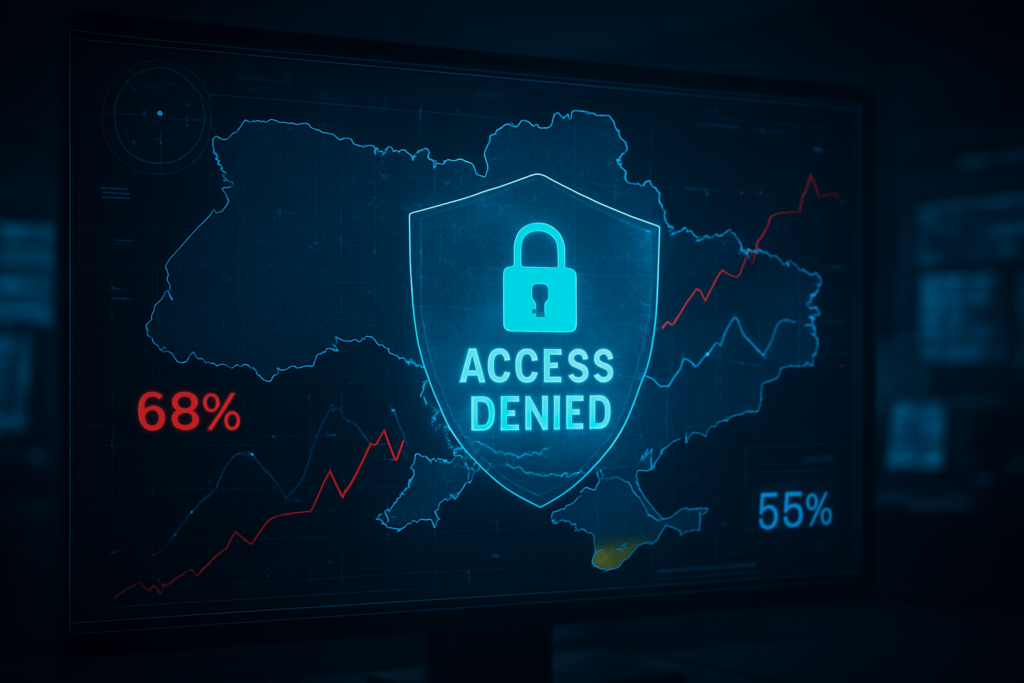
The Ukrainian government has officially moved to block access to Polymarket, the world’s largest decentralized prediction platform, marking a significant escalation in the regulatory and ethical scrutiny of geopolitical betting. The ban, finalized in mid-January 2026, comes after months of mounting tension over the platform's "war markets," which allowed global speculators to wager on the granular movements of the front lines in the ongoing Russia-Ukraine conflict. At the time of the block, internal data and local media reports suggested that over $270 million had been wagered on war-related outcomes, with active "open interest" exceeding $140 million.
The decision was driven by a combination of unlicensed gambling concerns and a fierce moral debate over the "gamification" of human suffering. While markets regarding the likelihood of a ceasefire by late 2026 hovered around 35% just before the ban, the real controversy centered on hyper-local wagers. These included bets on the specific week a city might fall or the outcome of individual drone strikes, leading Ukrainian officials to condemn the platform as a parasitic entity that monetizes national trauma. Despite the crackdown on Polymarket, other prediction sites like Kalshi and PredictIt remain accessible to Ukrainian users for now, largely due to their more restrictive and less granular market listings.
The Market: What's Being Predicted
The markets that triggered the Ukrainian blockade were among the most liquid and controversial in Polymarket’s history. Unlike traditional political forecasting, these wagers focused on high-stakes military maneuvers and territorial control. Key contracts included "Will Russia control Pokrovsk by April 1, 2026?" and "Will Ukraine recapture Crimea before 2027?" These markets frequently saw millions of dollars in daily volume, with liquidity often exceeding that of major U.S. political races. The granularity reached a point where traders were essentially betting on the success or failure of specific tactical operations.
Resolution criteria for these markets were often tied to reporting from established news organizations and conflict mappers. However, the reliance on real-time data created a volatile environment where odds could shift by 20% or more in a single hour based on unverified social media footage or telegram reports. For instance, the probability of a Russian breakthrough in the Donbas region spiked dramatically in late 2025 following a series of disputed map updates, leading to massive sell-offs and liquidations for those betting on Ukrainian defensive stability.
The platform's decentralized nature made it difficult for any single authority to regulate the flow of capital, but the Ukrainian National Commission for the State Regulation of Electronic Communications (NKEK) eventually moved to block the domain under Resolution No. 695. The official justification cited Polymarket’s failure to obtain a local gambling license, a requirement for any entity offering financial predictions to Ukrainian citizens. However, the $270 million in cumulative war bets made it clear that the "war market" phenomenon had become a security and morale concern for the state.
Why Traders Are Betting
The influx of capital into Ukraine-related prediction markets was driven by a mix of institutional hedging, retail speculation, and the rise of "OSINT" (Open Source Intelligence) traders. Many sophisticated participants argued that prediction markets provided a more accurate "truth signal" than state-run media or biased news outlets. By putting money on the line, traders were incentivized to sift through propaganda to find factual battlefield developments. This led to a subculture of "war-room" traders who monitored satellite imagery and battlefield APIs to gain an edge, often moving the market hours before official government statements were released.
However, this hunt for an information edge led to significant scandals. In late 2025, a controversy erupted when it was discovered that a third-party tool had synced the API of DeepState, a prominent Ukrainian defense monitoring group, directly into Polymarket’s trading interface. DeepState leadership expressed outrage, accusing speculators of "vulture-like behavior." Even more damaging was the "ISW Map Scandal," where an unauthorized edit to a map by the Institute for the Study of War led to a $1.3 million payout on a Polymarket contract that resolved based on what was later revealed to be a data error. These incidents reinforced the Ukrainian government’s view that these markets were not just unethical but prone to manipulation.
Beyond the ethics, many international traders used these markets as a hedge against global economic instability. Large-scale bets on the duration of the war were often paired with positions in energy commodities or defense contractors like Lockheed Martin (NYSE: LMT) and Northrop Grumman (NYSE: NOC). For these investors, Polymarket served as a high-leverage instrument to protect portfolios against the macro-economic shocks caused by the conflict's expansion or contraction.
Broader Context and Implications
The Ukrainian ban on Polymarket represents a pivotal moment for the prediction market industry, highlighting the tension between the "free flow of information" and the ethical boundaries of speculative betting. Historically, prediction markets have been praised for their accuracy in forecasting elections and economic shifts. However, the "war bet" phenomenon has tested the limits of what society is willing to tolerate as a tradable asset. The $270 million figure has sparked debates in Washington and Brussels about whether war-related contracts should be categorized as "public interest" tools or predatory gambling.
This regulatory crackdown isn't happening in a vacuum. Major tech platforms and search engines, including Alphabet Inc. (NASDAQ: GOOGL), have faced pressure to de-rank or restrict access to "conflict-betting" sites that do not adhere to local licensing laws. In Ukraine, the selective nature of the ban—blocking Polymarket while leaving Kalshi and PredictIt alone—suggests that granularity and data sourcing are the primary triggers for government intervention. Kalshi, which is regulated by the CFTC in the United States, typically avoids the highly specific battlefield contracts that Polymarket’s decentralized model allowed.
Furthermore, the ban highlights the growing divide between regulated, centralized exchanges and decentralized, offshore platforms. While Polymarket has grown into a billion-dollar ecosystem, its lack of a physical headquarters or a traditional corporate structure makes it a difficult target for enforcement beyond IP blocking. For the broader gambling industry, including giants like Flutter Entertainment (NYSE: FLTR), the rise of these high-stakes geopolitical markets represents both a threat and a potential new frontier for regulated products, provided they can navigate the ethical minefield.
What to Watch Next
As we move further into 2026, the primary question is whether other nations involved in or affected by the conflict will follow Ukraine's lead. If European regulators decide to label "war bets" as a violation of humanitarian ethics or a security risk, Polymarket could face a cascading series of bans across the continent. Traders should monitor the upcoming NKEK reviews and potential appeals from decentralized autonomous organizations (DAOs) associated with the platform, though the likelihood of a reversal in the current wartime climate remains slim.
Another key factor to watch is the movement of liquidity. With Polymarket blocked in Ukraine, will the $140 million in open interest migrate to more "sanitized" platforms, or will it move further underground into smaller, less transparent crypto-betting sites? The "ceasefire" markets, currently sitting at a 35% probability for a 2026 resolution, will likely remain a focal point for global traders, serving as a proxy for diplomatic progress. Any major shift in these odds will likely precede actual news from peace summits or frontline breakthroughs.
Finally, the role of data providers will be under the microscope. Following the ISW and DeepState controversies, expect new "Terms of Service" from OSINT organizations to specifically prohibit the use of their data for financial betting. This could lead to a "data blackout" for prediction markets, forcing them to rely on more traditional—and potentially slower—news sources, which would fundamentally change the speed and volatility of the markets.
Bottom Line
The blockade of Polymarket in Ukraine serves as a stark reminder that even the most innovative financial tools are subject to the realities of national security and public sentiment. While prediction markets have proven their utility as powerful forecasting engines, the $270 million in "war bets" pushed the envelope further than the Ukrainian state was willing to tolerate. The "truth signal" provided by these markets was ultimately outweighed by the ethical outcry over speculators profiting from the destruction of cities and the loss of life.
For the prediction market industry, this is a moment of reckoning. The success of regulated platforms like Kalshi in avoiding the ban suggests that a path forward exists through cooperation with regulators and a more curated approach to sensitive markets. However, for those who value the permissionless, "bet on anything" ethos of decentralized finance, the Ukrainian ban is a significant blow that could signal the beginning of a much wider regulatory crackdown on offshore geopolitical betting.
As the conflict continues, the odds will keep shifting, but the venue for those bets is becoming increasingly fragmented. Whether prediction markets can survive this ethical crisis and remain a trusted tool for public sentiment remains to be seen, but the "war bet" era has undeniably changed the landscape of digital speculation forever.
This article is for informational purposes only and does not constitute financial or betting advice. Prediction market participation may be subject to legal restrictions in your jurisdiction.
PredictStreet focuses on covering the latest developments in prediction markets.
Visit the PredictStreet website at https://www.predictstreet.ai/.