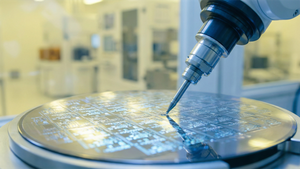
KLA Corporation (NASDAQ: KLAC) stands as a foundational and increasingly critical player in the global semiconductor industry. Headquartered in Milpitas, California, KLA is a leading global supplier of process control and yield management solutions for the semiconductor and related nanoelectronics industries. As of December 15, 2025, the company's specialized focus has positioned it as an indispensable "unseen architect" enabling the advanced manufacturing of complex microchips, especially those driving the artificial intelligence (AI) revolution.
KLA's product portfolio includes advanced defect inspection systems, metrology tools for critical dimension and film thickness measurement, and sophisticated software for process control and data analysis. These solutions are vital across all phases of chip production, from research and development to high-volume manufacturing of wafers, reticles, integrated circuits (ICs), and packaging. For the fiscal year ended June 30, 2025, KLA reported robust revenues of $12.16 billion and a net income of $4.06 billion.
The company is significantly in focus due to its role as a "critical enabler" of the AI revolution, with its tools essential for manufacturing high-performance AI accelerators. The increasing complexity of advanced packaging techniques, such as 2.5D/3D stacking and chiplet architectures, also drives demand for KLA's solutions. KLA holds a dominant market share, exceeding 50% in the semiconductor process control segment, sustained by high barriers to entry and significant R&D investments. Its strong financial performance and "customer neutrality," serving virtually all major chip manufacturers, further reinforce its indispensable position in driving the future of the AI and tech industries.
2. Historical Background
KLA Corporation's rich history is rooted in the parallel innovations of KLA Instruments and Tencor Instruments, two pioneering companies that eventually merged to form a powerhouse in process control and yield management.
KLA Instruments was founded in 1975 by Kenneth L. Levy and Robert R. Anderson. They recognized the critical need for automated inspection tools in the rapidly expanding semiconductor industry. A significant early milestone was the 1978 introduction of an automated inspection system, RAPID, which drastically reduced photomask inspection time. KLA Instruments went public in 1980 and expanded into patterned wafer inspection and wafer metrology.
Tencor Instruments, established in 1976 by Karel Urbanek, focused on precise measurements of semiconductor film layer thickness. Just seven months after its founding, Tencor introduced its Alpha-Step stylus surface profiler. In 1984, the company launched its Surfscan product, a laser-scanning particle and contamination defect detection system that quickly became an industry standard. Tencor went public in 1993 and acquired Prometrix in 1994, broadening its yield management offerings.
The strategic merger of KLA Instruments and Tencor Instruments occurred in April 1997, forming KLA-Tencor Corporation. This $1.3 billion stock swap combined KLA Instruments' defect inspection expertise with Tencor Instruments' metrology solutions, creating a comprehensive provider of process control and yield management products.
Since the merger, KLA-Tencor (rebranded to KLA Corporation in January 2019) has expanded through strategic acquisitions, including Orbotech in 2019, which diversified its business beyond semiconductors into printed circuit board (PCB), flat panel display (FPD), and advanced packaging markets. The company has consistently invested heavily in R&D, focusing on automated optical inspection, e-beam inspection for EUV, metrology for advanced nodes, and AI-driven yield management software. KLA has also expanded its global footprint, establishing R&D and manufacturing centers to support its growing operations and maintain its market leadership.
3. Business Model
KLA Corporation (KLAC) operates a robust business model centered on providing critical process control and yield management solutions to the electronics industry, primarily the semiconductor sector. As of December 15, 2025, its model is strategically aligned with the escalating demands of the AI era and increasing chip complexity.
Revenue Sources: KLA's total revenue for the fiscal year ending June 30, 2025, was a record $12.16 billion, a 23.89% increase year-over-year. A significant portion, approximately 22% in fiscal year 2025, is derived from its services business, characterized by multi-year, subscription-like contracts with high renewal rates. Advanced packaging systems revenue is a rapidly growing area, projected to exceed $925 million in calendar year 2025.
Product Lines: KLA's extensive portfolio addresses all phases of wafer, reticle, IC, and packaging production:
- Inspection and Metrology Systems: Core offerings for wafer and reticle inspection, and critical measurements (dimensions, film thickness, alignment).
- Specialty Semiconductor Process Tools: Advanced deposition and etch process tools.
- Packaging and PCB Solutions: Inspection and metrology for advanced and traditional packaging, and solutions for Printed Circuit Board (PCB) manufacturing.
- Software Solutions: For run-time process control, defect identification, and yield learning.
- Emerging Technologies: Investments in AI-driven algorithms for data analysis, quantum computing detection, and Extreme Ultraviolet (EUV) lithography monitoring.
Services: KLA's services business is crucial, with over 75% of service revenue from multi-year contracts, boasting a renewal rate exceeding 95%. Services include ramp management, installation, enhancements, upgrades, lifecycle management, parts and logistics, and learning & knowledge services.
Operating Segments: KLA operates through three main segments:
- Semiconductor Process Control: The largest segment, accounting for approximately 90% of total revenue in fiscal year 2025 ($10.94 billion), encompassing wafer inspection, reticle inspection, and metrology.
- Specialty Semiconductor Process: Includes advanced deposition and etch process tools, generating $587.1 million in fiscal year 2025 (about 5% of revenue).
- PCB and Component Inspection: Solutions for printed circuit boards, display, and advanced packaging markets.
Customer Base: KLA's customers are primarily leading global technology companies and semiconductor manufacturers (e.g., TSMC, Samsung) in leading-edge foundry/logic and memory markets. Demand is driven by advancements in automotive, mobile communications, data centers, and especially AI and high-performance computing applications, positioning KLA as a critical enabler for major AI chip developers like NVIDIA, AMD, and Intel.
4. Stock Performance Overview
KLA Corporation (KLAC) has demonstrated robust stock performance across various time horizons leading up to December 15, 2025, largely reflecting its critical role in the semiconductor industry's growth, particularly in advanced process control and AI-related technologies.
1-Year Performance (December 2024 – December 2025):
Over the past year, KLAC has shown significant appreciation. As of December 11, 2025, the stock closed at $1,246.18, representing a 92.06% increase over the preceding 12 months, with a year-to-date total return for 2025 of 94.38%. The 52-week range saw a low of $551.33 on April 7, 2025, and a high of $1,284.47 on October 30, 2025, trading near its record high at $1,193.92 on December 15, 2025. Notable events include strong Q2 and Q4 FY2025 earnings, a new $5 billion share repurchase authorization, increased quarterly dividends, and a bullish wafer fab equipment outlook.
5-Year Performance (December 2020 – December 2025):
KLAC has delivered exceptional returns over the last five years, with a total return of 380.58%. A $1,000 investment five years ago would be worth approximately $4,805.78 today. This period coincides with a massive surge in demand for semiconductors across cloud computing, 5G, automotive, and particularly artificial intelligence. KLA's strategic focus on advanced packaging and AI-driven manufacturing, coupled with consistent financial outperformance and capital returns, has fueled this sustained upward momentum.
10-Year Performance (December 2015 – December 2025):
Over the last decade, KLA Corporation has been an outstanding performer, delivering a total return of approximately 2,049.49% (or 2,080.2% including reinvested dividends). A $1,000 investment ten years ago would now be worth over $21,000. This phenomenal growth is attributed to the sustained boom in the semiconductor industry, driven by technological advancements (IoT, AI, advanced mobile devices), increasing chip complexity, and KLA's continuous innovation in process diagnostics, control, and yield management. The company has maintained strong financial health, characterized by high gross margins and excellent free cash flow, supporting reinvestment and shareholder returns.
In summary, KLA Corporation's stock performance across all three timeframes as of December 15, 2025, showcases significant growth and strong returns, fundamentally linked to its critical position in the advanced semiconductor manufacturing ecosystem and its ability to capitalize on secular growth trends.
5. Financial Performance
KLA Corporation (KLAC) has demonstrated robust financial performance through its recent fiscal reports, characterized by strong earnings, significant revenue growth, healthy margins, and substantial cash flow generation as of December 15, 2025.
Latest Earnings:
- Q1 FY2026 (ended September 30, 2025): Non-GAAP diluted EPS of $8.81 (exceeding estimates of $8.47), GAAP diluted EPS of $8.16.
- Full Fiscal Year 2025 (ended June 30, 2025): GAAP net income of $4.06 billion, GAAP diluted EPS of $30.37 on total revenues of $12.16 billion.
- Q4 FY2025 (ended June 30, 2025): Non-GAAP diluted EPS of $9.38, revenue of $3.175 billion.
Revenue Growth:
- Q1 FY2026 revenue: $3.21 billion, up 13.0% year-over-year, surpassing estimates.
- Annual revenue for FY2025: $12.16 billion, a 23.89% increase from FY2024.
- Q4 FY2025 revenue: $3.175 billion, a 23.6% year-over-year increase.
- Trailing twelve months (TTM) revenue (ending September 30, 2025): $12.524 billion, up 22.11% year-over-year.
Margins:
- Net profit margin: 33.83%, placing it in the top 25% of its industry.
- Non-GAAP gross margin for Q4 FY2025: 63.2%.
- Operating margin for Q4 FY2025: 44.2%.
- Mid-2025 gross profit margin: approximately 60.91%; operating profit margin rebounded to 39.28%.
Debt:
- Total debt (as of September 30, 2025): $6.08 billion USD.
- Long-term debt (as of September 30, 2025): $5.885 billion, a 0.06% increase year-over-year.
- Debt-to-equity ratio: 1.18.
Cash Flow:
- Cash flow from operating activities for FY2025: $4.08 billion.
- Free cash flow for FY2025: $3.75 billion, with Q4 FY2025 being a record $1.06 billion.
- TTM free cash flow (ending September 30, 2025): $3.873 billion, up 22.93% year-over-year.
- KLA returned $3.05 billion in capital for FY2025, including $426 million in share repurchases and $254 million in dividends in Q4 FY2025.
Key Valuation Metrics (as of December 15, 2025):
- Market Cap: $156.87 billion.
- Trailing P/E Ratio: 37.49.
- Forward P/E Ratio: 34.61 (higher than the industry average of 23.05).
- PEG Ratio: 3.25 (above the industry average of 1.83).
- Current Ratio: 2.69; Quick Ratio: 1.88.
KLA's strong performance is largely attributed to its critical role in the AI infrastructure buildout and leadership in process control for leading-edge AI investments. Advanced packaging revenues are expected to exceed $925 million in calendar year 2025. Despite an estimated $500 million impact from China export controls for 2025, KLA remains confident in outperforming the market, driven by investments in leading-edge logic, HBM, and advanced packaging.
6. Leadership and Management
KLA Corporation (KLAC) is led by an experienced management team and governed by a Board of Directors committed to independent oversight and strategic growth, as of December 15, 2025.
CEO and Leadership Team:
Rick Wallace serves as President and CEO, a role he has held since January 2006, bringing nearly two decades of leadership to the company. His leadership has been instrumental in navigating KLA's growth and strategic direction.
The broader leadership team includes:
- Bren Higgins: Executive Vice President and CFO, overseeing finance, manufacturing, supply chain, and IT.
- Ahmad Khan: President, Semiconductor Products and Customers.
- Brian Lorig: Executive Vice President, KLA Global Services.
- Ben Tsai: Chief Technical Officer and Executive Vice President, Corporate Alliances.
- Bobby Bell: Executive Vice President, Government Affairs and Head of KLA Europe.
- Mary Beth Wilkinson: Executive Vice President, Chief Legal Officer & Corporate Secretary.
Board of Directors:
The Board of Directors separates the roles of CEO and Chairman, with Robert Calderoni serving as the independent Chairman. The Board comprises a majority of independent directors, adhering to NASDAQ standards, and includes members like Jason Conley, Tracy Embree, Jeneanne Hanley, Kevin Kennedy, Michael R. McMullen (Chair of the Compensation and Talent Committee), Victor Peng, Robert Rango, and Jamie Samath. All Board committees are comprised entirely of independent directors.
Corporate Strategy:
KLA's corporate strategy for 2025 and beyond is heavily focused on capitalizing on the AI-driven semiconductor market and increasing chip complexity. Key strategic pillars include:
- Market Outperformance: Aiming to outperform the overall Wafer Equipment (WFE) market growth.
- Advanced Packaging: Projecting significant growth in advanced packaging revenue, exceeding $850 million in 2025.
- Innovation and R&D: Committing $2.3 billion to emerging semiconductor inspection technologies through 2025, focusing on AI-driven algorithms, quantum computing detection, and EUV lithography monitoring.
- Service Business Expansion: Targeting a 12-14% CAGR through 2026 for its service business.
- Shareholder Returns: Demonstrating a strong commitment to returning value through increased dividends and significant share repurchase authorizations.
Governance Reputation:
KLA actively maintains and enhances its governance framework, evidenced by recent amendments to its By-laws to modernize practices and refine disclosure requirements. The separation of CEO and Chairman roles provides independent oversight. The company also emphasizes sustainability, corporate citizenship, and environmental responsibility, detailing progress in its Global Impact Report. While geopolitical risks are acknowledged, KLA's refreshed governance approach is seen as a positive step in its investment narrative.
7. Products, Services, and Innovations
As of December 15, 2025, KLA Corporation (KLAC) is a pivotal force in the semiconductor industry, driving advancements in AI and miniaturization through its extensive offerings, robust innovation pipeline, significant R&D, and vast patent portfolio.
Current Product and Service Offerings:
KLA provides a comprehensive suite of process control and yield management solutions, increasingly enhanced by AI:
- Defect Inspection Systems: Advanced bright-field, multi-beam, and e-beam technologies for nanoscale defect detection.
- Metrology Solutions: Systems for critical measurements like pattern dimensions, film thickness, and alignment.
- In-situ Process Monitoring: Real-time monitoring for quality and efficiency.
- Wafer and Reticle Manufacturing Solutions: Tools and software for various production stages.
- Advanced Packaging Manufacturing: Inspection and metrology for advanced packaging, with revenue projected to exceed $925 million in calendar year 2025.
- Printed Circuit Board (PCB) and IC Substrate Manufacturing: Solutions for direct imaging, inspection, and process control.
- Software Solutions: For run-time process control, defect excursion identification, and yield learning.
KLA's service business shows consistent growth, with 50 consecutive quarters of year-over-year expansion, targeting a 12-14% CAGR through 2026.
Innovation Pipelines and Research & Development (R&D) Efforts:
KLA is strategically focused on continuous innovation:
- Advanced Metrology: Enhancing offerings for 2nm nodes and beyond.
- AI-Driven Inspection: Expanding defect inspection with AI-driven algorithms for faster data analysis and improved detection.
- Emerging Technologies: Developing solutions for quantum computing detection and EUV lithography monitoring.
- Global R&D Expansion: Opened a new R&D and manufacturing center in Wales in May 2025, and in advanced discussions for a new R&D center in Chennai, India, to pioneer research in defect-detection algorithms and quantum computing.
- Financial Commitment: R&D expenses were $342 million in Q2 FY2025, demonstrating ongoing investment.
Patents:
KLA holds an extensive patent portfolio, crucial for its technological leadership. As of June 30, 2025, it owned over 8,500 active patents globally and had more than 3,500 U.S. and foreign patent applications pending. Recent patent grants in November 2025 cover areas like deep learning-based mode selection for inspection, single cell in-die metrology targets, and systems for optimizing through silicon via overlay.
Competitive Edge:
KLA's competitive edge is solidified by its indispensable role in the semiconductor ecosystem:
- Market Dominance: Over 60% market share in the metrology and inspection segment.
- Enabling AI: Considered a "crucial enabler" of the AI revolution, essential for manufacturing advanced AI semiconductors.
- Technological Indispensability: Its tools become more critical as chips advance to 2nm and beyond.
- Outperformance in WFE: Forecast to outperform the broader WFE market with a 7.5% CAGR through 2029.
- Strong Customer Relationships: Deep integration with leading chipmakers' technology roadmaps.
While facing competition from Applied Materials, ASML, and Onto Innovation, KLA's broad product range, extensive customer service, and significant R&D investment maintain its competitive advantage.
8. Competitive Landscape
KLA Corporation (KLAC) maintains a dominant and strategic position within the highly specialized semiconductor process control industry as of December 15, 2025. Its technological leadership and significant market share in critical segments allow it to navigate competition effectively.
Primary Industry Rivals:
KLA operates alongside several major players in the broader semiconductor equipment industry, particularly in the process control, metrology, and inspection segments:
- Applied Materials (AMAT): A broad competitor across various equipment segments, though KLA has been gaining share in inspection.
- ASML: Dominant in lithography, also competes in certain metrology and inspection niches.
- Lam Research (LRCX): Strong in deposition and etching equipment.
- Tokyo Electron (TEL): A significant player in the broader semiconductor equipment market.
- Onto Innovation (ONTO): A more direct competitor in metrology and inspection.
- Hitachi High-Technologies: competes in niche areas of metrology and inspection.
Market Share in Key Segments (as of December 15, 2025):
KLA holds a commanding market share in its core areas:
- Overall Semiconductor Process Control/Metrology and Inspection: KLA commands over 56% of the overall segment, with its share in metrology and inspection climbing from over 50% in 2010 to nearly 63% by 2024.
- Optical Inspection: Market share remains exceptionally high, above 85%.
- E-beam Inspection: KLA made significant gains in 2024, increasing its share to 10.9%.
- Advanced Wafer-Level Packaging: Projected to assume the leading position in 2025, with revenue expected to exceed $925 million.
- Wafer Fab Equipment (WFE): KLA's WFE market share has grown steadily from 5.9% in 2017 to 8.6% in 2024.
Competitive Strengths:
- Dominant Market Position: Undisputed leader in process control and yield management.
- Technological Leadership: Specialized expertise vital for advanced manufacturing, including AI-augmented inspection and HBM process control, backed by over 11% of revenue invested in R&D.
- High Barriers to Entry: Significant technical expertise, scientific understanding, and capital investment required.
- Strong Financial Performance: Industry-leading profitability margins (FY2025 Net Profit Margin of 33.41%), high gross margins (above 60%), and strong free cash flow. Over 75% of service revenue is recurring.
- Indispensable Partner: Critical for quality and yield in complex chip production for leading chipmakers.
- Regulatory Resilience: Anticipated to experience a smaller impact from BIS regulations compared to peers.
- Customer Neutrality: Serves virtually all major chip manufacturers, diversifying revenue.
Competitive Weaknesses:
- Geopolitical Risks and Export Controls: U.S. export controls on sales to China pose a significant risk, impacting a historically major market.
- Market Cyclicality: Exposure to the inherent boom-and-bust cycles of semiconductor capital expenditure.
- Customer Concentration: Reliance on a limited number of major clients for a significant portion of revenue.
- Limited Product Diversification: Core business is highly focused on process control equipment.
- High R&D Investment: Continuous, substantial R&D is required to maintain technological lead.
- Supply Chain Vulnerabilities: Potential dependence on single or limited suppliers for critical components.
- Operational Complexity: Intricate products and integration present ongoing challenges.
9. Industry and Market Trends
KLA Corporation (KLAC), as a critical enabler in the semiconductor industry, is profoundly influenced by several key industry and market trends as of December 15, 2025. Its strategic position in wafer inspection and metrology places it at the forefront of the AI era, navigating robust growth, evolving supply chain dynamics, and ongoing macroeconomic and cyclical influences.
Sector-Level Trends:
The semiconductor market is in a strong expansion phase, projected to reach approximately $772.2 billion in 2025 (22.5% increase) and nearing $1 trillion by 2026. This growth is primarily driven by surging demand for Logic and Memory devices, crucial for AI acceleration, data center expansion, and high-performance computing. Logic is forecast to grow 37.1% in 2025, and Memory by 27.8%. A significant trend for KLA is the rapid growth in advanced packaging technologies (e.g., 3D packaging), with KLA's advanced packaging revenue projected to exceed $850 million in 2025, largely due to AI infrastructure investments. The increasing complexity of chips (2nm and beyond) makes KLA's process control tools even more essential.
Macro Drivers:
Artificial intelligence (AI) and cloud computing are the primary macroeconomic drivers, creating unprecedented demand for advanced chips and specialized hardware, necessitating significant investments in manufacturing capacity. However, the industry faces headwinds from geopolitical tensions, trade restrictions (e.g., US-China trade war and export controls), and resource constraints. Governments globally are investing in domestic production (e.g., US CHIPS and Science Act) to enhance supply chain resilience.
Supply Chain Dynamics:
The global semiconductor supply chain is shifting from cost-efficiency to resilience and diversification. Historical geographic specialization created vulnerabilities, exacerbated by geopolitical tensions. Companies are implementing dual sourcing and regionalizing supply chains. Inventory is now a strategic buffer, and real-time supply chain visibility is crucial. While some normalization occurred in early 2025, challenges like infrastructure costs, talent shortages, and geopolitical events are expected to persist.
Cyclical Effects in the Semiconductor Industry:
The industry is inherently cyclical, characterized by growth and contraction due to long lead times for capacity additions. As of December 2025, the industry appears to be in a growth acceleration phase, with global chip sales in Q1 2025 showing an 18.8% year-over-year increase. The WSTS projects robust growth for 2025 and 2026. However, potential memory price pullbacks by Q3 2026 as supply improves are anticipated. Despite this, the long-term outlook remains promising due to increasing chip integration.
KLA Corporation's Position and Outlook:
KLA holds a dominant market share (over 50%) in process control, allowing it to benefit from increasing chip complexity and the transition to advanced nodes. KLA integrates AI into its tools for enhanced predictive maintenance and defect detection. The company reported strong financial results in Q2 FY2025 and Q1 FY2026, surpassing analyst expectations. Analysts are optimistic, anticipating KLA to outperform the broader Wafer Fabrication Equipment (WFE) market growth due to increasing process control intensity. Advanced packaging and HBM for AI systems are strong growth drivers. While China revenues are a concern, they are considered relatively de-risked. KLA also demonstrates a strong commitment to shareholder returns.
10. Risks and Challenges
KLA Corporation (KLAC) faces a multifaceted landscape of risks and challenges as of December 15, 2025, encompassing operational, regulatory, potential controversies, and market-driven factors.
Operational Risks:
- Supply Chain Disruptions: Vulnerability to shortages of raw materials or components, mitigated by diversification, safety stock, and supply chain visibility.
- Competitive Pressures: Intense competition requires continuous innovation to maintain market share.
- High R&D Spending: Significant investments in R&D for new products and AI-driven tools can impact profitability.
- Cyclicality of the Semiconductor Industry: Exposure to fluctuations in semiconductor capital equipment spending.
- Customer Concentration: Reliance on a few key customers poses a risk if their capital expenditures decrease.
- Maintaining Technology Advantage: Risk that competitors develop similar technology or intellectual property is challenged.
Regulatory Risks:
- Export Control Regulations and US-China Trade Tensions: A significant ongoing challenge. US export controls from the BIS restrict sales of advanced semiconductor equipment to China, expected to reduce KLA's revenue share from China from 41-44% to an anticipated 15-30% in 2025-2026. These regulations can increase costs and disrupt supply chains.
- Evolving Regulatory Environment: Subject to various global laws (anti-corruption, antitrust, data privacy, environmental), with non-compliance leading to fines.
- Tariffs: Potential US tariff policies could lead to annual losses of up to $350 million and a 100 basis point headwind on gross margin.
Potential Controversies:
- Past Stock Option Backdating: In 2007, KLA-Tencor's former CEO was charged with fraud related to stock option backdating. While historical, such events can impact corporate reputation.
- Canceled Investor Day in Early 2025: The cancellation raised concerns among market observers and analysts, potentially creating an information gap for investors.
Market Risks:
- Geopolitical Uncertainties: Broader geopolitical instability can complicate market access and operations.
- Impact of Potential TSMC-Intel Foundry Deal: A consolidation could reduce major players, increase competition, and lead to pricing pressure.
- Cooling in the AI Chip Market: While AI is a growth driver, concerns about a potential cooling could negatively impact investor sentiment and share price.
- Currency Exchange Rate Fluctuations: Global operations expose KLA to currency risks.
- Macroeconomic Uncertainties: Broader uncertainties can affect overall technology investment.
- Valuation Concerns: Some analysts suggest KLA is trading at a premium, warranting caution.
- Interest Rate Environment: Impacts KLA's ability to manage its debt.
11. Opportunities and Catalysts
KLA Corporation (KLAC) is strategically positioned for continued growth, driven by escalating semiconductor complexity, the booming artificial intelligence (AI) market, and expansion into advanced packaging. As of December 15, 2025, several opportunities and near-term catalysts paint a robust outlook.
Growth Levers:
- Increased Chip Complexity and Process Control Intensity: The push towards smaller nodes (2nm and beyond) necessitates more sophisticated process control, directly benefiting KLA's core expertise.
- AI and High-Performance Computing (HPC) Demand: The "AI supercycle" drives unprecedented demand for advanced semiconductors, including HBM and complex logic, making KLA a crucial enabler for manufacturing these specialized chips.
- Advanced Packaging Growth: A major growth area, with KLA anticipating advanced packaging-related revenue to surpass $925 million in calendar year 2025 (a 70% increase year-over-year). KLA expects to achieve market leadership in advanced wafer-level packaging in 2025.
- Market Share Expansion: KLA has consistently strengthened its dominant position in semiconductor process control and projects continued outperformance relative to the broader Wafer Fabrication Equipment (WFE) market.
- Strong Service Business: The service business is expected to grow significantly, targeting a 12-14% Compound Annual Growth Rate (CAGR) through 2026, providing a stable, recurring revenue.
- Reshoring of Semiconductor Manufacturing: The global trend of localizing semiconductor manufacturing presents opportunities for KLA to expand its regional presence.
- Robust Financial Performance: High profit margins and strong free cash flow provide flexibility for investments and shareholder returns.
New Market Opportunities:
- AI Chip Manufacturing: KLA's defect inspection and metrology solutions are indispensable for high-precision AI chip manufacturing.
- Automotive Semiconductors: A longer-term play, KLA's portfolio for automotive chip manufacturing addresses the need for high reliability and zero-defect performance.
- Specialty Semiconductor Processes: KLA's new R&D facility in Wales (opened May 2025) supports development across advanced packaging, power devices, MEMS, RF, and photonics sectors.
Potential for Mergers and Acquisitions (M&A):
KLA's historical track record of strategic acquisitions (e.g., Orbotech) indicates a willingness to use M&A to expand its technological portfolio and market reach when opportunities align with its growth strategy.
Near-Term Events (Earnings, Product Launches) that Could Act as Catalysts (as of December 15, 2025):
- Earnings Reports and Outlook: KLA has consistently reported strong financial results, exceeding analyst expectations, and providing positive guidance. Analysts project significant EPS and revenue growth for fiscal 2025 and beyond.
- Analyst Upgrades and Price Targets: Jefferies upgraded KLA from "Hold" to "Buy" on December 15, 2025, significantly increasing its price target to $1,500, citing optimism for leading-edge semiconductor spending in 2026 and 2027. Other firms like TD Cowen and Stifel also raised price targets.
- Continuous Product Portfolio Expansion and AI Integration: Ongoing advancements and integration of AI-driven algorithms into new inspection and metrology systems enhance capabilities and accelerate innovation.
- Infrastructure Investment and Expansion: The opening of new R&D and manufacturing facilities, such as in Wales, enhances production capacity and R&D capabilities.
While challenges like U.S. export controls to China persist, KLA's focus on these growth levers and its strong market position provide substantial opportunities for continued success.
12. Investor Sentiment and Analyst Coverage
KLA Corporation (KLAC) exhibits a nuanced investor sentiment as of December 15, 2025, characterized by a generally positive outlook driven by its integral role in the artificial intelligence (AI) sector, coupled with mixed analyst ratings and active institutional movements.
Investor Sentiment:
Overall sentiment for KLA appears neutral to positive. The company is widely regarded as a "crucial enabler" and "hidden backbone" of the AI revolution, driving positive sentiment. Technical analysis indicates a neutral stock forecast with more bullish than bearish signals. On platforms like StockTwits, sentiment is currently bullish. However, the Zacks Rank assigns KLAC a "Hold" rating (#3). Retail investor chatter is mixed, with some highlighting AI benefits and others expressing concerns about U.S. export controls to China.
Wall Street Analyst Ratings:
KLA holds an average rating of "Hold" from 26 ratings firms, with 14 hold ratings and 12 buy ratings. The average 12-month price objective is approximately $1,243.81.
Recent analyst activity:
- December 15, 2025: Jefferies upgraded KLA from "Hold" to "Buy" and increased its price target from $1,100 to $1,500, citing optimism for leading-edge semiconductor spending in 2026 and 2027.
- TD Cowen raised its price target from $900 to $1,300, and Stifel increased its target from $1,050 to $1,260, both maintaining "Buy" ratings.
- Other firms adjusted price targets in late 2025, with a range of "Neutral" to "Buy" ratings.
Recent Hedge Fund Moves:
Based on 23 tracked hedge funds, collective holdings in KLA were decreased by 894.2K shares in the last quarter (Q3 2024 data). However, individual activity varied significantly. MIZUHO SECURITIES USA LLC notably increased its portfolio by 3,408,617 shares (32828.8% increase). Conversely, WELLINGTON MANAGEMENT GROUP LLP, GOLDMAN SACHS GROUP INC, and FMR LLC significantly reduced their holdings.
Institutional Investor Activity:
As of September 30, 2025, KLA has 2,816 institutional owners, holding 141,380,429 shares. In the most recent quarter, 699 institutions added shares, while 698 decreased positions, indicating a nearly even split. Major institutional shareholders include Vanguard Group Inc, BlackRock, Inc., and State Street Corp. Vanguard and Blackrock increased holdings, while Primecap Management Co/Ca/ significantly reduced its position.
Retail Investor Chatter:
Retail investor sentiment is somewhat mixed but leans positive due to KLA's strong performance and critical role in AI-driven semiconductor growth. StockTwits shows bullish sentiment. Discussions on Investing.com and Seeking Alpha forums highlight KLA's role in the "AI manufacturing revolution," though concerns about China's market and export controls are present. The consistent growth in advanced packaging and HBM for AI infrastructure contributes positively to the retail investor outlook.
13. Regulatory, Policy, and Geopolitical Factors
KLA Corporation (KLAC) operates within a dynamic global landscape, with its exposure to regulatory changes, government policies, and geopolitical factors significantly shaping its risks and opportunities as of December 15, 2025.
Regulatory Changes and Government Policies:
- US Export Controls on China: This is a paramount factor. The 2024 and 2025 BIS Rules have restricted advanced semiconductor equipment sales to China. These restrictions are expected to reduce KLA's revenue share from China from 41-44% in 2024 to an anticipated 30% or high 20s in 2025. KLA is mitigating this by seeking export licenses and diversifying its customer base. There is also an ongoing discussion in Washington regarding conditional exports of advanced AI hardware to China.
- Tariffs: Potential US tariff policies, particularly those considered under the Trump administration, pose a significant financial risk. Leading US chip equipment manufacturers, including KLA, could collectively face losses exceeding $1 billion, with KLA potentially incurring annual losses of up to $350 million. KLA projects that these tariffs could result in a 100 basis point headwind on its gross margin per quarter.
- CHIPS and Science Act (US): A key policy opportunity for KLA. This legislation allocates billions in funding to incentivize domestic semiconductor manufacturing, research, and workforce development. KLA is expected to benefit from new investments in advanced nodes and the expansion of the US semiconductor ecosystem driven by the Act. Revisions in 2025 aim to broaden the Act's support beyond manufacturers to the entire semiconductor supply chain.
- Global Semiconductor Policies: Other regions are also enacting policies to strengthen their semiconductor industries. The European Chips Act aims to develop Europe's semiconductor sector and reduce reliance on Asian supply chains, potentially creating new opportunities for KLA. Similarly, Taiwan's "Taiwan Semiconductor Strategic Policy 2025" outlines a comprehensive roadmap to secure technological sovereignty, expand R&D dominance, and bolster its leadership in global chip supply chains, including initiatives like distributed manufacturing hubs and enhanced talent pipelines. KLA's existing relationship with Taiwan Semiconductor Manufacturing Company (TSMC) positions it to potentially benefit from these initiatives.
Geopolitical Risks:
- US-China Tensions: The escalating geopolitical tensions between the US and China are the most significant risk for KLA. The US export controls are explicitly designed to impede China's progress in advanced chip manufacturing and AI. These tensions create uncertainty and can disrupt KLA's market access and operational strategies in a historically significant market.
- Taiwan Strait Stability: Taiwan's pivotal role in global semiconductor production, particularly through TSMC, makes the stability of the Taiwan Strait a major geopolitical risk. Any disruption, whether from military conflict or political instability, could have profound global economic and technological ramifications, directly affecting KLA's supply chain and customer base.
- Broader Geopolitical Instability: Beyond US-China dynamics, KLA faces risks from broader geopolitical instability, including natural disasters, acts of war (such as the conflicts in Russia-Ukraine and the Middle East), or terrorism in regions where it, its customers, or suppliers operate. The intricate nature of KLA's technology means that any significant disruption could have widespread implications for global semiconductor manufacturing.
- Technological Nationalism: An increasing trend of technological nationalism, driven by neo-mercantilist strategies, is transforming economic interdependence into a tool for geopolitical rivalry. This environment may lead to more protectionist measures and complex trade dynamics that KLA must navigate.
Opportunities:
- AI Revolution and Advanced Packaging: KLA is strategically positioned to capitalize on the booming "AI supercycle" and the rapid expansion of advanced packaging. Analysts consider KLA an "indispensable titan" and "crucial enabler" of the AI revolution, projecting a substantial surge (approximately 70%) in demand for its advanced packaging and process control solutions in 2025. To counter revenue declines from China, KLA is intensifying its focus on advanced packaging and high-bandwidth memory (HBM), with advanced packaging revenue surging 85% year-over-year in 2025 and expected to exceed $850 million.
- Increasing Chip Complexity: As semiconductor designs become exponentially more complex, moving towards 2nm nodes and beyond, the demand for KLA's sophisticated process control and yield management solutions becomes even more critical for maintaining high yields and quality. This trend fuels KLA's core business and reinforces its market leadership.
- Customer Diversification and Global Expansion: KLA is actively mitigating geopolitical risks by diversifying its customer base and expanding its global footprint. This includes establishing new R&D and manufacturing facilities, such as one in Wales.
- Strong Financial Performance and Outlook: Despite geopolitical headwinds, KLA has demonstrated strong financial performance in Q1 and Q4 FY2025, surpassing analyst expectations. Analysts remain largely optimistic about KLA's future, forecasting a 7.5% Compound Annual Growth Rate (CAGR) through 2029 and expecting the company to outperform the broader Wafer Fabrication Equipment (WFE) market. The company has also demonstrated a commitment to shareholder returns through consistent dividend growth and share repurchase programs.
- Service Business Growth: KLA's service business is a strong growth area, projected to achieve a 12-14% CAGR through 2026, contributing to the company's overall revenue resilience.
In conclusion, as of December 15, 2025, KLA Corporation faces significant challenges from US export controls impacting its China revenue and potential tariff policies. However, its indispensable role in the AI-driven semiconductor revolution, coupled with strategic diversification, a focus on advanced packaging, and benefits from government initiatives like the CHIPS Act, present substantial opportunities for continued growth and market leadership. The company's ability to navigate these complex regulatory and geopolitical dynamics will be crucial to its sustained success.
14. Outlook and Scenarios
KLA Corporation (KLAC) is positioned for continued relevance in the semiconductor industry, with a generally positive outlook driven by technological advancements and strong demand. As of December 15, 2025, analyst sentiment ranges from "Hold" to "Buy," reflecting both optimism and caution regarding valuation.
Overall Future Outlook:
The overarching outlook for KLA is largely bullish, supported by secular trends in the semiconductor industry. The company is expected to benefit from increasing chip complexity, driven by power and performance requirements from AI servers, as well as the expansion of packaging complexity across the entire manufacturing process. KLA's specialization in process control and yield management solutions is seen as critical for semiconductor manufacturers, contributing to its strong market position and potential to outperform wafer fabrication equipment (WFE) growth.
Bull Case Scenarios:
Several factors contribute to a bullish outlook for KLA Corporation:
- Leading-Edge Semiconductor Spending: Growing optimism about spending on leading-edge semiconductors in calendar years 2026 and 2027 is a significant driver. This is fueled by increasing chip complexity and the acceleration of node transitions, particularly due to AI servers and the growth of non-NVIDIA accelerators.
- Increased Process Control Intensity: As chip manufacturing becomes more intricate, the demand for KLA's process control intensity solutions is expected to rise. This includes advanced packaging complexity, which requires more process control throughout the manufacturing process, directly benefiting KLA's business model.
- Strong Financial Performance and Shareholder Returns: KLA has demonstrated solid quarterly results, beating EPS and revenue estimates, and has provided positive guidance. The company's management has shown confidence through dividend increases and expanded share repurchase programs, signaling strong long-term cash generation. KLA reported a record cash flow of $1.066 billion in the last quarter and a total capital return of $799 million, including $254 million in dividends and $545 million in share repurchases, over the past 12 months.
- Outperforming WFE Market: KLA is anticipated to outperform the overall WFE market in 2025, with multiyear customer investment roadmaps, especially in logic/foundry and High Bandwidth Memory (HBM), supported by government incentives.
- Economic Moat: Morningstar analysts suggest KLA Corporation possesses a wide economic moat, indicating a strong competitive advantage and robust position for future growth.
Bear Case Scenarios:
Despite the positive outlook, several risks and challenges could lead to a bear case for KLAC:
- China Exposure and Geopolitical Risks: China remains a concern, with potential tariff escalation capable of derailing growth and margin assumptions. While Jefferies believes KLA's China revenues are relatively derisked at 25% for calendar year 2026, export controls from the U.S. government are estimated to impact revenue by approximately $300-$350 million for calendar 2026.
- Valuation Concerns: KLA's stock trades near record highs and at a premium compared to its peers. Some analysts suggest the stock might be fully valued, implying less room for error if growth or margins disappoint. The company's price-to-earnings (P/E) ratio of 37.49 is higher than the industry average.
- Cooling WFE Spending or AI Demand Normalization: If wafer fab equipment spending cools down or AI-related demand normalizes, KLA's earnings growth could flatten. Cantor Fitzgerald, in October 2024, lowered its 2025 wafer fab equipment spending forecast to $105 billion from $115 billion, and its 2026 forecast to $115 billion from a prior range of $115 billion to $125 billion, which could impact KLA's earnings.
- Intensifying Competition: Competition from companies like Applied Materials and Lam Research is intensifying, particularly in inspection and metrology tools where technology cycles evolve rapidly.
Short-Term Projections (as of December 15, 2025):
- Analyst Ratings and Price Targets: KLA Corporation has an average "Hold" rating from 26 firms, with 14 hold ratings and 12 buy ratings. The average 12-month price objective among analysts is approximately $1,243.81. However, a consensus rating from 21 analysts shows an average "Buy" with a price target of $1,102, forecasting a -7.72% decrease in stock price over the next year. Jefferies recently upgraded KLA from "Hold" to "Buy" with a new price target of $1,500, up from $1,100, citing strong chip demand. Morgan Stanley maintained an "Equal Weight" rating but increased its price target to $1,214 from $1,154.
- Earnings and Revenue Guidance: For Q2 FY2026, KLA has set an EPS guidance of $7.92–$9.48. The company is predicted to post an EPS of $8.75 for its upcoming earnings disclosure, representing a 6.71% growth year-over-year, with quarterly revenue estimated at $3.24 billion, up 5.39% from the year-ago period.
- Stock Performance: The stock price closed at $1,246.18 on December 11, 2025, and at $1,226.60 on December 12, 2025. Over the next month (from December 7, 2025), a price prediction model forecasts a 1.18% upward shift to $1228.79.
- Technical Signals: As of December 11, 2025, KLA's overall moving average trend leans bullish with 4 positive signals and 0 negative signals. The SMA_20 being above the SMA_60 signals a strong bullish trend in the mid-term.
Long-Term Projections (as of December 15, 2025):
- WFE Spending and Industry Growth: Morgan Stanley increased its 2027 WFE estimate to $145 billion, a 13% increase from the previous year, supported by demand from TSMC and DRAM. KLA aims for revenue growth roughly double that of global GDP by 2026, with the semiconductor industry expected to expand 6% to 7% annually.
- Revenue and EPS Forecasts: Zacks Consensus Estimates project full-year earnings of $35.42 per share and revenue of $13.04 billion, demonstrating changes of +6.43% and +7.24% respectively from the preceding year. KLA is forecast to grow earnings by 10% and revenue by 8.1% per annum. Some analysts predict KLA's EPS to reach $38 by 2026.
- Price Targets (Multi-Year):
- 2025: Forecasts suggest KLAC will trade between $1,165.42 and $1,307.13, with an average annualized price of $1,237.35.
- 2026: Stockscan's analysts expect an average price target of $2,143.06, with a high forecast of $2,177.89 and a low of $2,107.20, indicating a potential +72.98% increase. Jefferies revised revenue projections for 2026 and 2027 to $14.0 billion and $15.5 billion, respectively.
- 2028: KLA is projected to reach an average price of $2,933.33, with a high of $3,243.53 and a low of $2,623.12, representing a +136.77% rise from the current price.
- 2030: KLAC stock could reach $1,311.46 according to one analysis, while another predicts an average price of $1,860.44 with a 50.17% upside.
- 2035: Expected to reach an average price of $6,503.19.
- 2040: Projected to chart a bullish course with an average price target of $8,379.27.
- 2050: Expected to climb to an average of $10,681.99.
- Strategic Positioning: KLA's unique product portfolio and focus on enabling technology transitions, accelerating process node capacity ramps, and ensuring yield entitlement are crucial in the complex environment of rapid AI technology development. The company is well-positioned to benefit from increasing capital intensity in logic and foundry sectors.
In conclusion, KLA Corporation's future outlook is largely positive, bolstered by its critical role in advanced semiconductor manufacturing and the booming demand for AI-driven chips. While short-term analyst ratings show some mixed sentiment and valuation concerns, long-term projections point towards substantial growth, assuming the company effectively navigates geopolitical challenges and competitive pressures.
15. Conclusion
KLA Corporation (NASDAQ: KLAC) stands as an indispensable titan in the semiconductor industry, underpinning the relentless march of technological progress, particularly in the burgeoning era of artificial intelligence. As of December 15, 2025, the company's robust financial performance, dominant market position, and critical role in advanced chip manufacturing paint a compelling picture for investors, albeit with clear watchpoints.
Summary of Key Findings:
KLA's business model is built on providing essential process control and yield management solutions across the entire semiconductor fabrication lifecycle. Its revenue streams are diversified, with a significant contribution from its recurring service business and rapidly growing advanced packaging segment. The company has demonstrated exceptional stock performance over the past one, five, and ten years, driven by consistent innovation and its pivotal role in enabling complex chip designs. Leadership under CEO Rick Wallace has steered KLA through strategic acquisitions and continuous R&D investment, maintaining a strong competitive edge despite a challenging landscape.
Financially, KLA is sound, reporting record revenues and free cash flow in fiscal year 2025 and Q1 FY2026, alongside healthy margins and a commitment to shareholder returns through dividends and share repurchases. The overarching industry trends, particularly the "AI supercycle" and the increasing complexity of semiconductor nodes and advanced packaging, act as powerful tailwinds.
Balanced Perspective on Investment Potential:
The bullish case for KLA rests on its near-monopolistic position in a mission-critical segment of semiconductor manufacturing. As chips become smaller and more intricate, KLA's inspection and metrology tools become exponentially more vital for achieving acceptable yields. Its strong ties to the AI infrastructure buildout, coupled with its consistent outperformance of the broader wafer fabrication equipment market, suggest continued growth. The company's robust financial health provides a strong foundation for future investments and shareholder value creation.
However, investors must acknowledge the inherent risks. Geopolitical tensions, particularly US export controls to China, pose a significant headwind to a historically major market. While KLA is actively diversifying and mitigating these impacts, the evolving regulatory landscape remains a source of uncertainty. The cyclical nature of the semiconductor industry, although KLA's process control segment is somewhat insulated, still exposes the company to potential downturns in capital expenditure. Furthermore, KLA's current premium valuation warrants careful consideration, as it implies high growth expectations and leaves less room for error. Intensifying competition in certain niches also demands constant vigilance.
What Investors Should Watch:
As of December 15, 2025, investors should closely monitor several key factors:
- Geopolitical and Trade Policy Evolution: Ongoing US-China trade relations and any new or evolving export controls will directly impact KLA's revenue and market access.
- Semiconductor Capital Spending Trends: Shifts in overall WFE spending by major chipmakers will be a key indicator of demand for KLA's equipment.
- Demand for Advanced Technologies: Continued strong investment and demand in AI-related semiconductors, high-bandwidth memory, and advanced packaging solutions are critical drivers for KLA's growth.
- Execution and Innovation: KLA's ability to maintain its technological leadership in process control and introduce innovative solutions to meet the evolving demands of chip manufacturers will be key to sustaining its competitive edge.
- Financial Health: Regularly review KLA's revenue growth rates, gross and operating margins, earnings per share, and free cash flow generation for any signs of deviation from current strong trends.
- Competitive Landscape: Keep an eye on the strategies and technological advancements of major competitors like ASML and Applied Materials.
- Valuation Ratios: Given the current premium valuation, investors should continuously assess whether the company's growth trajectory and profitability metrics continue to justify its stock price.
- Shareholder Return Programs: Monitor the company's commitment to its dividend policy and share repurchase authorizations as indicators of management's confidence and capital allocation strategy.
In essence, KLA Corporation is a high-quality company deeply embedded in the secular growth story of the semiconductor industry. Its indispensable technology makes it a compelling investment for those seeking exposure to the foundational elements of the AI revolution. However, a balanced approach requires acknowledging and actively monitoring the geopolitical and cyclical risks that could impact its otherwise strong trajectory.
This content is intended for informational purposes only and is not financial advice