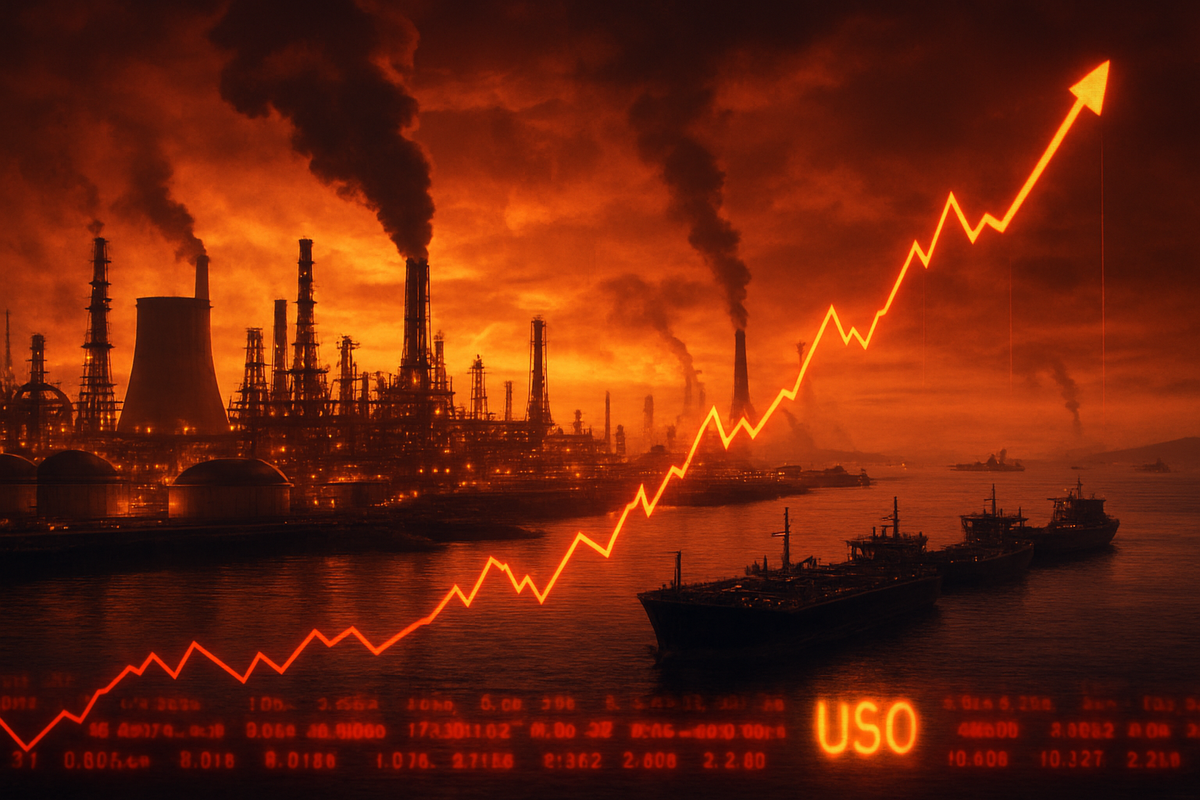
The global energy landscape has been thrust into a state of high-velocity volatility as of March 2026, marking what many analysts are calling the "Third Great Oil Shock." In a stunning reversal from the relative stability seen at the start of the year, oil prices have undergone a violent upward repricing following the outbreak of direct military hostilities between the United States, Israel, and Iran. The rally has sent shockwaves through financial markets, with the United States Oil Fund (NYSE Arca: USO) skyrocketing approximately 46% since late February, as traders scramble to price in a massive geopolitical risk premium that shows no signs of dissipating.
The immediate implications are being felt at every level of the global economy. Brent Crude (ICE: BZ=F) has vaulted past the critical $90 per barrel threshold, briefly touching $119 earlier this week before settling in the mid-$90s amid rumors of a coordinated strategic reserve release. As the Islamic Revolutionary Guard Corps (IRGC) issues increasingly bellicose threats to halt all maritime oil exports from the Persian Gulf, the world is facing the very real prospect of a prolonged energy deficit. For the average consumer, this spike translates to rapidly rising fuel costs, while for the market, it represents a fundamental shift in asset allocation toward energy-heavy portfolios.
Escalation in the Gulf: A Timeline of the Crisis
The current crisis traces its origin to February 28, 2026, when a combined US-Israeli military initiative, dubbed "Operation Epic Fury," was launched against Iranian nuclear and military infrastructure. The operation, which reportedly resulted in the death of Iran’s Supreme Leader, Ali Khamenei, fundamentally altered the security architecture of the Middle Middle East. In the immediate aftermath, his son, Mojtaba Khamenei, assumed leadership with the backing of the IRGC, quickly pivoting the nation to a "total war" economic posture and leveraging Iran’s primary weapon: its control over the world’s most vital oil chokepoint.
By March 2, the IRGC had effectively closed the Strait of Hormuz through a combination of naval mining and targeted drone strikes on commercial tankers. This chokepoint, which typically facilitates the transit of 20% of the world’s daily oil supply, has seen shipping traffic plummet by an estimated 95% in less than two weeks. The "One Liter" threat, issued by IRGC spokesmen on March 10, stated that Tehran would "not allow the export of even one liter of oil" from the Gulf to any nation aligned with the US or Israel, a move that has paralyzed regional exports from major producers like Saudi Arabia and the UAE.
The market reaction was instantaneous and parabolic. West Texas Intermediate (NYMEX: CL=F) jumped from $71.13 at the start of the month to nearly $96.50 this week. Institutional and retail investors have flooded into commodity-linked assets, with the United States Oil Fund (NYSE Arca: USO) serving as the primary lightning rod for this inflow. The fund’s 46% surge since the start of the conflict reflects not just current scarcity, but a collective bet that the physical damage to regional refineries and the persistence of the Hormuz blockade will keep supply constrained for months to come.
Winners and Losers: Portfolios in the Crosshairs
The energy sector has emerged as the lone oasis in a desert of market uncertainty. Major integrated oil companies like ExxonMobil (NYSE: XOM) and Chevron (NYSE: CVX) have seen their valuations swell as their upstream assets become significantly more lucrative. ConocoPhillips (NYSE: COP) has also seen a marked uptick in investor interest, as its heavy focus on domestic U.S. production makes it a perceived "safe haven" from Middle Eastern instability. Beyond individual stocks, specialized ETFs are being utilized for aggressive hedging; the Invesco DB Oil Fund (NYSE Arca: DBO) has recorded a 34% gain since the conflict began, benefiting from its "optimum yield" strategy which minimizes the cost of rolling futures contracts.
Conversely, the "losers" of this energy shock are concentrated in the transportation and consumer discretionary sectors. Airlines are facing a brutal squeeze as jet fuel costs—the industry's largest variable expense—surge toward historic highs. Delta Air Lines (NYSE: DAL) and United Airlines (NASDAQ: UAL) have both seen their stock prices under pressure as they contemplate fuel surcharges that could dampen travel demand just ahead of the spring season. Similarly, shipping and logistics firms are grappling with increased operational costs and the logistical nightmare of rerouting vessels away from the Persian Gulf.
Investors are increasingly turning to complex hedging instruments to navigate the turbulence. ProShares ETFs, particularly the ProShares Ultra Bloomberg Crude Oil (NYSE Arca: UCO), have seen record trading volumes as "pros" and retail speculators alike seek 2x leveraged exposure to the price spike. For those looking to protect against a potential "blow-off top" or a sudden de-escalation, the ProShares UltraShort Bloomberg Crude Oil (NYSE Arca: SCO) has become a popular tool to "fade" the rally during temporary pullbacks. These instruments have moved from the fringe of portfolio management to the center stage as volatility remains at multi-year highs.
A New Global Paradigm: The Significance of the Shock
This event is not merely a temporary price spike; it represents a systemic shift that fits into several broader industry trends. First, it underscores the continued, and perhaps underestimated, global dependence on fossil fuels despite a decade of "green" transition efforts. The sheer speed with which the US-Israel-Iran conflict disrupted global markets suggests that energy security remains the ultimate geopolitical lever. We are seeing a "re-carbonization" of security policy, where domestic production in the Permian Basin and elsewhere is being prioritized over long-term climate goals in the name of national stability.
Regulatory and policy implications are already emerging. The Biden administration, facing an election year and the prospect of $6-per-gallon gasoline, is reportedly weighing a massive release from the Strategic Petroleum Reserve (SPR) that could dwarf previous interventions. However, critics argue that such a move would be a "band-aid on a bullet wound" as long as the Strait of Hormuz remains contested. Comparisons to the 1973 OPEC embargo and the 1979 Iranian Revolution are becoming common among economists, who fear that a sustained period of $100+ oil could trigger a global recession and reignite the inflationary fires that central banks have spent years trying to extinguish.
The ripple effects are also being felt among U.S. trading partners. European nations, already sensitive to energy costs following the 2022-2023 gas crisis, are once again looking at emergency rationing measures. The crisis is forcing a strategic pivot toward even more rapid adoption of alternative energy, not for environmental reasons, but as a matter of urgent national defense. For competitors in the energy space, this environment presents both an opportunity to capture market share and a challenge to maintain operations in an increasingly hostile maritime environment.
The Road Ahead: Scenarios for the Rest of 2026
Looking forward, the market faces two distinct possibilities. In the short term, if the United States and its allies can successfully clear the mines in the Strait of Hormuz and degrade the IRGC's naval capabilities, we could see a "relief sell-off" that sends oil back toward the $80 range. However, strategic pivots will be required; even a swift military victory would leave behind a legacy of damaged infrastructure and a permanently higher risk premium for Middle Eastern crude. Markets would likely remain skittish, with investors maintaining elevated positions in ETFs like DBO to guard against a second wave of hostilities.
Long-term scenarios are more daunting. Should the blockade persist or if the conflict escalates into a wider regional war involving Saudi Arabia or Iraq, analysts at major investment banks have floated a "worst-case" price target of $150 to $200 per barrel. Such a scenario would necessitate a massive shift in the global economy, likely leading to a mandatory transition toward electric vehicles and renewable heating at a pace the grid is currently unprepared to handle. Market opportunities may emerge in "energy efficiency" tech and domestic energy infrastructure (NYSE: XLU), as the focus shifts from finding oil to using less of it.
Wrap-up: Navigating the 2026 Energy Crisis
As of mid-March 2026, the oil market remains the epicenter of global financial anxiety. The 46% rally in the United States Oil Fund (NYSE Arca: USO) and the leap of Brent crude through $90 are clear indicators that the "peace dividend" in the Middle East has effectively evaporated. The combination of military action, the death of a major world leader, and the subsequent threat to global supply lines has created a perfect storm of volatility that has caught many traditional portfolio managers off guard.
Moving forward, the assessment for the market is one of "cautious defensive positioning." The immediate takeaways are clear: energy is no longer just a sector play but a mandatory hedge against geopolitical instability. Investors should watch for several key triggers in the coming months: the success of US naval operations in the Gulf, the rhetoric from the new Iranian leadership, and the potential for a coordinated IEA reserve release. While the surge has provided a windfall for some, the lasting impact will likely be a more expensive, more volatile, and more fragmented global energy market.
This content is intended for informational purposes only and is not financial advice