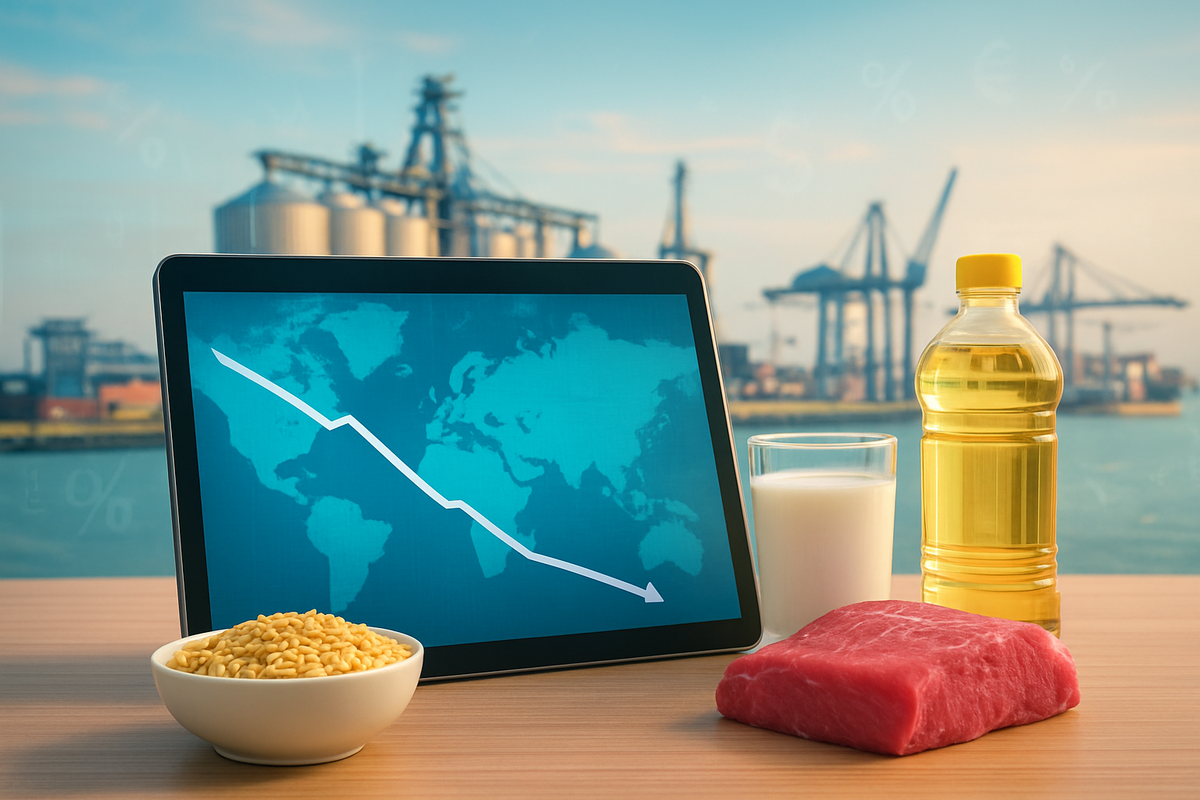
The global effort to curb food inflation received a significant boost as the year 2025 drew to a close. According to the latest report from the Food and Agriculture Organization (FAO) of the United Nations, the benchmark index for world food commodity prices fell for the fourth straight month in December. This downward trend offers a glimmer of hope for consumers and policymakers who have spent the last several years grappling with volatile grocery bills and supply chain instabilities.
The FAO Food Price Index (FFPI), which tracks the monthly changes in the international prices of a basket of commonly traded food commodities, averaged 124.3 points in December 2025. This represents a 0.6% decline from November and marks the lowest level for the index since the summer of 2024. While the monthly dip is modest, the cumulative effect of a four-month slide suggests that the "global glut" of staple crops is finally outweighing the geopolitical and climate-related pressures that dominated the earlier half of the decade.
Supply Surpluses and Seasonal Surges Drive Prices Down
The decline in December was primarily spearheaded by significant drops in the dairy and meat sectors, which offset continued strength in cereal and sugar prices. The Dairy Price Index led the retreat, falling 4.4% in a single month. This was the sixth consecutive monthly decline for the category, fueled by a surge in seasonal milk and cream production across Europe. With stocks accumulating rapidly in the Northern Hemisphere, international quotations for butter and cream plummeted, providing much-needed relief to the global food processing industry.
The Meat Price Index also contributed to the overall decline, easing by 1.3%. While poultry and bovine prices saw the most significant drops due to increased export availability from major producers, the global meat market remains a tale of two halves. In the United States, domestic cattle herds have hit their lowest levels since the 1950s, creating a sharp disconnect between falling international commodity prices and rising retail beef prices in North American supermarkets.
Conversely, the Cereal Price Index bucked the downward trend, rising 1.7% in December. This increase was driven by renewed anxieties regarding wheat export flows through the Black Sea and robust demand for maize from the ethanol sectors in both the United States and Brazil. Despite these localized spikes, the broader trend for 2025 remained one of stabilization compared to the extreme volatility seen in 2022 and 2023.
Agribusiness Giants Face Margin Compression Amid Price Slump
The transition from a high-price environment to a period of commodity abundance has created a challenging landscape for the world’s largest agricultural traders and processors. Archer-Daniels-Midland (NYSE: ADM) has been among the most visible casualties of this shift. As the global glut of corn and soybeans eroded processing margins, ADM reported its lowest profits in five years during 2025. In response to the tightening market, the company recently announced a major restructuring plan aimed at cutting up to 700 jobs and targeting nearly $750 million in cost savings to weather the downturn.
Similarly, Bunge Global SA (NYSE: BG) has felt the sting of falling oilseed prices. The company reported a nearly 50% year-on-year drop in net income in some segments, specifically citing weak processing margins in South America. However, Bunge’s strategic $34 billion merger with Viterra, completed in mid-2025, is now seen as a critical defensive move. Analysts suggest that the increased scale provided by the merger will allow Bunge to manage the current "balanced supply environment" more efficiently than its smaller competitors, even as margins remain razor-thin.
On the protein side, Tyson Foods (NYSE: TSN) presents a complex case of winners and losers within a single corporate umbrella. While the company’s beef segment is struggling with record-high cattle costs and has even announced the closure of its Lexington, Nebraska plant, its chicken segment has become a massive profit engine. Falling cereal prices have significantly lowered feed costs, allowing the chicken division to account for roughly 70% of Tyson's total profits in late 2025, effectively hedging against the losses in the beef sector.
A Precarious Balance: Inflation vs. Geopolitics
While the four-month decline in the FAO index is a positive signal for global food inflation, the broader picture remains complex. For the full year of 2025, the index averaged 127.2 points—roughly 4.3% higher than the 2024 average. This means that while prices are currently falling, they are doing so from a relatively high plateau, leaving many low-income, food-importing nations still vulnerable to high domestic inflation.
The current "deflationary note" is also highly susceptible to external shocks. FAO economists have warned that the progress made in late 2025 could be easily reversed by climate extremes. The transition between El Niño and La Niña cycles continues to threaten crop yields in key regions like Southeast Asia and South America. Furthermore, the "X-factors" of geopolitics—specifically tensions in the Middle East and the ongoing conflict in Eastern Europe—keep a permanent floor under wheat and energy prices, preventing a full return to pre-pandemic price levels.
Historically, periods of falling commodity prices have often been followed by shifts in trade policy. As major exporters like the U.S. and Russia deal with high inventories, there is an increasing risk of new tariffs or export restrictions aimed at protecting domestic farmers. These policy shifts could create localized price spikes even as the global index continues to trend downward.
Navigating the 2026 Outlook
Looking ahead to the first half of 2026, the market is expected to remain in a state of "cautious abundance." Short-term opportunities may emerge for food retailers and consumer packaged goods companies, such as Mondelez International (NASDAQ: MDLZ) and The Kraft Heinz Company (NASDAQ: KHC), who may see their input costs stabilize or decline, potentially allowing for margin expansion if they can maintain retail price points.
However, for the primary producers and traders, the "strategic pivot" of 2026 will be focused on efficiency and cost discipline. Investors should watch for further consolidation in the agricultural sector as smaller players struggle to survive in a low-margin environment. The ability of companies to adapt to shifting trade corridors and climate-resilient supply chains will be the primary differentiator between market leaders and laggards in the coming year.
The Road Ahead for Investors
The December FAO report confirms that the global food market has entered a new phase of the cycle. The era of scarcity-driven price spikes has, for now, given way to a period of supply-side recovery. The key takeaways for the market are clear: global food inflation is easing, but the underlying structural risks—climate, energy, and geopolitics—have not disappeared.
As we move into 2026, investors should keep a close eye on the "feed-to-protein" ratio, which is currently benefiting poultry and pork producers, and the ongoing margin compression in the grain processing sector. While the downward trend in the FAO Food Price Index is a welcome development for the global economy, the path to true price stability remains narrow and fraught with potential disruptions.
This content is intended for informational purposes only and is not financial advice.