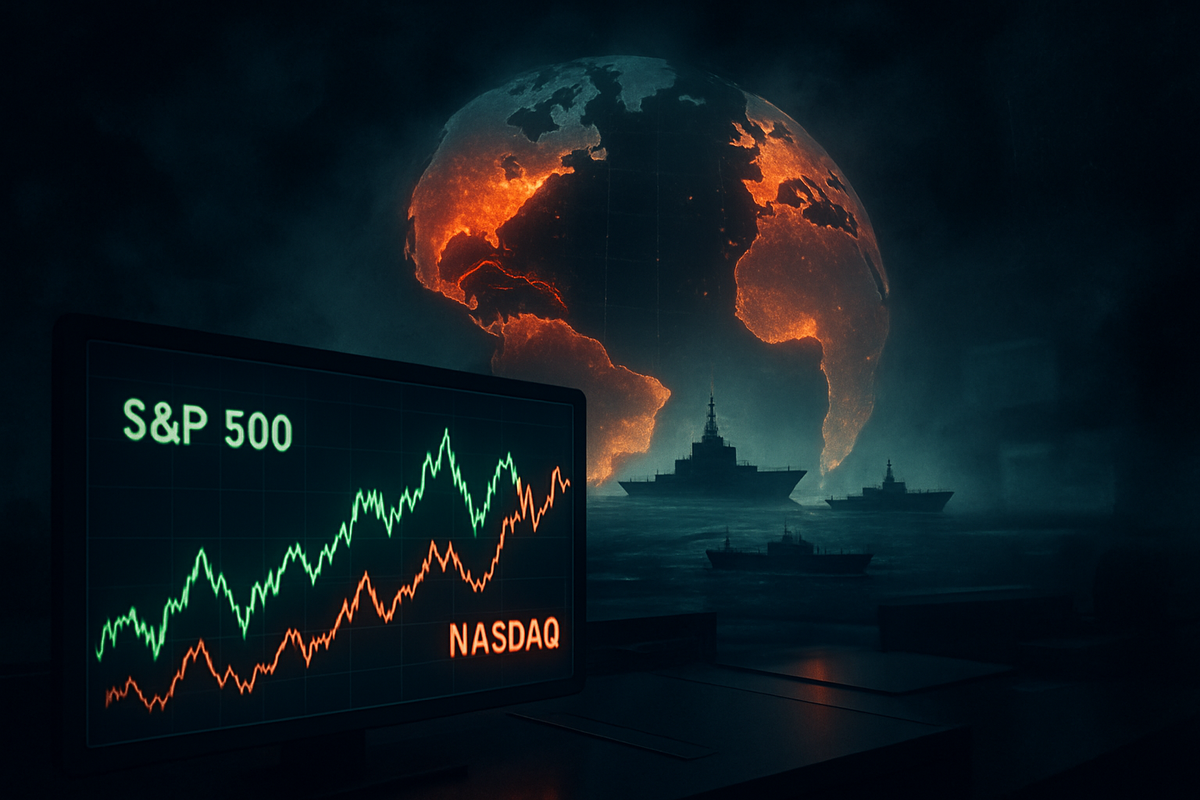
As of January 7, 2026, the global financial markets are grappling with a paradox of record-breaking valuations and intensifying geopolitical instability. While the S&P 500 and Nasdaq Composite began the year at historic highs, a series of rapid-fire international crises has introduced a "geopolitical risk premium" that is beginning to weigh heavily on investor sentiment. The optimism that fueled the 2025 rally—centered on the "Silicon Supercycle" and the monetization of Artificial Intelligence—is now being tested by a world that feels increasingly fragmented and volatile.
The immediate catalyst for the current market hesitation is a trifecta of regional shocks: a high-stakes military operation in South America, a "gray zone" naval blockade in the South China Sea, and a nuclear standoff in the Middle East. These events have collectively stalled the momentum of the S&P 500, which reached 6,944.82 earlier this week, and the Nasdaq, which stands at 23,547.17. While indices remain near their peaks, the narrowness of the market breadth and a record-low Equity Risk Premium (ERP) of just 0.02% suggest that Wall Street has left itself almost no margin for error as these global tensions escalate.
The 'Venezuela Shock' and the South China Sea Standoff
The most dramatic event of the new year occurred on January 3, 2026, when a U.S. military operation targeted the leadership of the Maduro administration in Venezuela. This "Black Swan" event sent shockwaves through the energy and commodity markets. Initially, the news triggered a "flight to safety," with gold prices surging over 2% and silver jumping 7% in a single session. While the operation was framed as a move to stabilize the region and eventually unlock the world’s largest proven oil reserves, the immediate uncertainty regarding supply disruptions and regional retaliation has kept the S&P 500 Energy sector in a state of extreme volatility.
Simultaneously, the "Justice Mission 2025" exercises by the Chinese military have transitioned into a semi-permanent encirclement of Taiwan. These "gray zone" tactics—short of open warfare but designed to disrupt maritime trade—have placed the global semiconductor supply chain under immense pressure. The Nasdaq, heavily weighted toward chip designers and manufacturers, has seen its early January gains erased as investors weigh the risk of a partial blockade on the Taiwan Strait. This comes just as the tech sector was celebrating the launch of next-generation AI architectures at CES 2026, creating a jarring disconnect between technological progress and physical security risks.
In the Middle East, the Iran-Israel nuclear standoff has reached a fever pitch following U.S. airstrikes on Iranian enrichment facilities. This has revived fears of a closure of the Strait of Hormuz, a move that would jeopardize nearly 20% of the world’s daily oil consumption. While a global oil surplus of approximately 3.8 million barrels per day has acted as a temporary buffer, the "energy risk premium" is back on the table, complicating the Federal Reserve’s efforts to maintain a stable inflationary environment as 2026 begins.
Corporate Winners and Losers in a Fragmented World
The shifting geopolitical landscape is creating a stark divide between companies positioned to benefit from "National Champion" economics and those vulnerable to supply chain disruptions. In the energy sector, U.S. majors like Chevron (NYSE: CVX) and ConocoPhillips (NYSE: COP) saw an initial surge following the Venezuela operation, as traders bet on these firms leading the eventual reconstruction of the Venezuelan oil industry. However, these gains have been tempered by broader market fears that a prolonged conflict could destabilize South American production in the short term.
The defense sector has emerged as a primary beneficiary of the rising global temperature. Lockheed Martin (NYSE: LMT) and Northrop Grumman (NYSE: NOC) have seen their stocks rally as U.S. defense outlays are projected to surpass the $1 trillion milestone for the first time in 2026. This surge is driven by a massive modernization cycle in missile defense and naval capabilities, as Western nations pivot toward a "Third Nuclear Era" posture. Conversely, the technology sector faces a more nuanced reality. While NVIDIA (NASDAQ: NVDA) continues to dominate the AI landscape with its new "Vera Rubin" architecture, its reliance on Taiwan Semiconductor Manufacturing Company (NYSE: TSM) makes it a focal point for geopolitical risk. Any tightening of the South China Sea blockade could lead to severe margin compression for hardware giants like Apple (NASDAQ: AAPL), which are already struggling with the inflationary costs of reshoring their manufacturing bases.
The industrial sector is seeing a "reshoring harvest," with companies like Caterpillar (NYSE: CAT) benefiting from the construction of domestic "smart factories." However, this transition is not without cost. Data suggests that 86% of manufacturers intend to pass on the higher costs of domestic production and tariffs to consumers in 2026. This "reshoring tax" threatens to squeeze the margins of retail-heavy firms and could potentially reignite inflationary pressures that the market had hoped were a thing of the past.
The Significance of the 'Security Premium' Era
The current market environment marks a definitive shift away from the globalization-first era of the early 2000s toward what analysts are calling the "Security Premium" era. Geopolitical stability is no longer an assumed baseline for financial models; it is now a volatile variable that must be hedged. This trend is reflected in the divergence between equity and commodity markets. While the S&P 500 has largely ignored geopolitical risks over the last year, gold is currently trading at an 11.5% premium above its fundamental value, signaling that sophisticated investors are preparing for a "systemic transformation."
This shift also has profound fiscal implications. The surge in defense spending, combined with the costs of industrial subsidies like the "One Big Beautiful Bill" (OBBBA), is expected to push the federal deficit higher by 0.9% of GDP in 2026 alone. With interest payments now the second-largest federal expense, the market is becoming increasingly sensitive to the "fiscal gap." There is a growing concern that the bond market could eventually "crowd out" private capital, forcing a hawkish turn from the Federal Reserve even if economic growth begins to cool under the weight of geopolitical tensions.
Historical precedents, such as the energy shocks of the 1970s or the post-2022 realignment following the invasion of Ukraine, suggest that markets can remain resilient for a time but eventually succumb to "geopolitical fatigue." The current valuation of the Nasdaq, trading at roughly 26 times earnings, leaves little room for the kind of supply chain "heart attacks" that a South China Sea blockade would represent.
The Path Forward: Earnings and Policy Pivots
In the short term, the Q4 2025 earnings season, set to begin later this month, will be the ultimate reality check for the 2026 rally. Investors will be looking for concrete "AI ROI" (Return on Investment) to justify the massive capital expenditures of the past two years. If tech giants cannot demonstrate that their AI platforms are providing a sufficient hedge against rising operational and geopolitical costs, the Nasdaq could face a significant correction.
Strategically, we are likely to see a "Great Rebalancing" in 2026. Many analysts expect a rotation out of the "Magnificent Seven" and into the Russell 2000 and value-oriented industrials. As the valuation gap between high-growth tech and small-cap value reaches historic extremes, the relative safety of domestic-focused, smaller companies may become increasingly attractive to those looking to avoid international crosswinds.
Potential scenarios for the remainder of the year range from a "Goldilocks" ceasefire in Eastern Europe—which would provide a massive relief rally—to a "Stagflationary Shock" if Middle Eastern tensions lead to a sustained closure of key shipping lanes. Investors should watch for any signs of a "bond vigilante" resurgence, where rising yields on the 10-year Treasury begin to act as a hard ceiling for equity valuations.
Summary and Investor Outlook
The first week of 2026 has served as a wake-up call for a market that had grown accustomed to perpetual growth. The "Venezuela Shock" and the ongoing maneuvers in the South China Sea have reminded Wall Street that the "Silicon Supercycle" does not exist in a vacuum. While the S&P 500 and Nasdaq remain near all-time highs, the underlying foundations are increasingly brittle, characterized by narrow risk premiums and a growing reliance on government-funded industrial policy.
Moving forward, the market will likely be defined by "geopolitical antifragility"—the ability of certain sectors, particularly defense and domestic industrials, to thrive in a world of chaos. However, for the broader indices to maintain their upward trajectory, a de-escalation in the South China Sea and a successful "soft landing" for the new U.S. energy initiatives in South America will be essential.
Investors should maintain a defensive posture in the coming months, keeping a close eye on the Equity Risk Premium and the resilience of the semiconductor supply chain. While the technological breakthroughs of 2026 are real, the "geopolitical tax" on those breakthroughs is rising. The "easy gains" of the post-pandemic era have officially given way to a more complex, high-stakes environment where security is the new currency of the realm.
This content is intended for informational purposes only and is not financial advice.