In a dramatic de-escalation of a week-long geopolitical standoff, President Donald Trump has officially withdrawn his threat to impose sweeping tariffs on eight key NATO allies over the disputed acquisition of Greenland. The sudden pivot, announced during the World Economic Forum in Davos, Switzerland, has sent a wave of optimism through global markets, effectively ending a period of intense volatility that had threatened to fracture the transatlantic alliance.
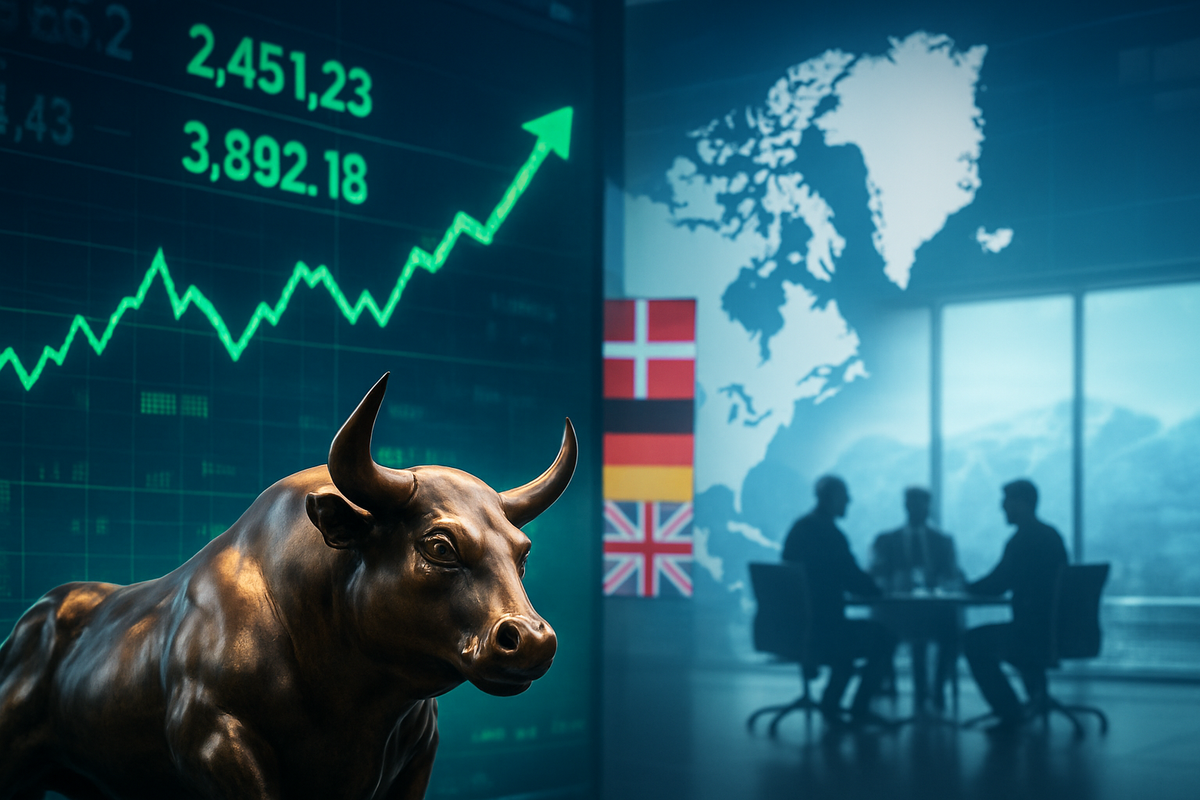
The news triggered an immediate surge in equities, with the Dow Jones Industrial Average (DJIA) gaining more than 400 points by the closing bell on January 22, 2026. This "relief rally" follows a tumultuous start to the week where markets suffered their worst losses in months. For investors and world leaders alike, the reversal signals a shift from a "trade-war-first" stance toward a more cooperative, albeit defense-heavy, strategy regarding Arctic security.
From Brinkmanship to Breakthrough: The 120-Hour Crisis
The crisis began in earnest on Saturday, January 17, 2026, when President Trump reignited his long-standing ambition for the United States to purchase Greenland from Denmark. The administration announced a plan to impose 10% tariffs—set to rise to 25% by June—on a group of eight NATO nations dubbed the "Target 8": Denmark, Germany, France, the United Kingdom, Sweden, the Netherlands, Norway, and Finland. The President argued that these nations were not contributing sufficiently to "hemispheric security" and that the acquisition of Greenland was a necessary "real estate deal" for 21st-century defense.
The initial reaction was a severe market shock. When U.S. markets opened following the Martin Luther King Jr. Day holiday on January 20, the Dow plummeted 877 points as investors braced for a multi-front trade war with Europe. However, the tide began to turn on January 21 at the Davos summit. After a private, high-stakes meeting with NATO Secretary-General Mark Rutte, President Trump signaled a change in tone via social media, ruling out military force and suggesting a "security-based framework" rather than an immediate change in sovereignty.
The formal cancellation of the February 1 tariff deadline on the afternoon of January 22 solidified the market's recovery. The Dow’s 400-point jump, combined with a late-session rally the day prior, has allowed the blue-chip index to recoup nearly all its "Greenland losses." Diplomatic sources suggest the breakthrough involved a compromise where the U.S. would gain expanded access to Arctic missile defense sites and radar installations in exchange for maintaining current trade status.
Winners and Losers: Corporate Tickers in the Crosshairs
The "Greenland Pivot" has created distinct tiers of winners in the equity markets, most notably among defense contractors and European manufacturers who were previously staring down the barrel of a trade war.
Lockheed Martin (NYSE: LMT) and Northrop Grumman (NYSE: NOC) emerged as primary beneficiaries. While defense stocks were initially viewed as safe havens during the escalation, they gained further ground on news of the "Arctic Security Framework." Analysts at Truist Securities noted that the focus on missile defense and Arctic surveillance directly benefits Lockheed's F-35 program and its advanced radar divisions. RTX Corporation (NYSE: RTX), formerly Raytheon, also saw its shares climb as the new framework is expected to accelerate the deployment of the "Golden Dome" missile defense system across northern Europe.
In Europe, the relief was palpable for the automotive sector. Volkswagen (OTC:VWAGY) and BMW (OTC:BMWYY) had seen their shares battered early in the week on fears that German autos would be the first target of retaliatory measures. Following the de-escalation, Volkswagen shares jumped 5.6%, as the threat of a $1.1 billion earnings hit from U.S. tariffs vanished overnight. Similarly, Mercedes-Benz Group AG (OTC:MBGYY) saw a sharp reversal in its downward trend, gaining 2.6% as trade tensions with Washington eased.
However, the outlook remained mixed for the energy and shipping sectors. A.P. Møller - Mærsk A/S (CPH:MAERSK-B), the Danish shipping giant, faced significant "sovereignty risk" during the peak of the tension. While the share price stabilized after the tariff withdrawal, the company remains under pressure from broader global trade volatility. Meanwhile, Equinor (NYSE: EQNR), the Norwegian energy titan, failed to join the relief rally, closing down 4.07% on January 22 due to concurrent delays in its major Bay du Nord project and lingering concerns over the "geopolitical complexity" of future Arctic drilling operations.
A New Precedent for Transatlantic Trade Policy
This week’s events fit into a broader trend that market participants have dubbed the "TACO" trade—an acronym for "Trump Always Chickens Out"—whereby the President utilizes extreme tariff threats as a high-pressure negotiating tactic, only to settle for a more moderate "framework" once financial markets begin to buckle. This cycle of volatility has become a hallmark of the 2025-2026 administration, forcing traders to build "volatility premiums" into international trade-linked stocks.
The wider significance of this event lies in the restructuring of NATO’s priorities. By trading the threat of tariffs for increased defense commitments in the Arctic, the Trump administration has effectively turned a trade dispute into a strategic military expansion. This sets a precedent where economic leverage is used directly to reshape military alliances, a move that may have long-term ripple effects on how other NATO members, such as France and Germany, negotiate their own defense spending.
Furthermore, the involvement of Mark Rutte as a mediator suggests that the institutional framework of NATO still holds significant weight, even under an "America First" executive. The resolution of the crisis without a formal trade war prevents a catastrophic decoupling of the U.S. and EU economies, which many analysts feared would lead to a global recession by the second half of 2026.
The Road Ahead: Monitoring the "Arctic Framework"
In the short term, markets are likely to remain buoyant as the immediate threat of a trade war has been neutralized. However, strategic pivots will be required for companies operating in the Arctic circle. Investors should look for a surge in government contracts related to "hardened" infrastructure and northern surveillance. The "Arctic Security Framework" is expected to be formalized in the coming months, likely during a follow-up summit in Copenhagen or Reykjavik.
The long-term challenge will be the implementation of these defense promises. If the "Target 8" nations do not follow through with the agreed-upon infrastructure for U.S. missile defense, the threat of tariffs could return just as quickly as it left. Strategic adaptations will be necessary for European exporters, who may continue to diversify their supply chains away from a heavy reliance on the U.S. market to avoid being used as pawns in future "real estate" negotiations.
Market Outlook and Final Takeaways
The "Greenland Crisis" of January 2026 serves as a potent reminder of how quickly geopolitical headlines can move billions in market capitalization. The key takeaway for investors is that while the rhetoric of the Trump administration remains aggressive, the threshold for actual economic disruption remains high, particularly when it threatens the stability of the U.S. domestic stock market.
Moving forward, the market will likely be characterized by a "wait-and-see" approach toward the Arctic. The relief rally provides a temporary cushion, but the underlying tensions regarding NATO spending and territorial sovereignty remain unresolved. Investors should closely watch for any signs of friction during the formal drafting of the "Arctic Security Framework," as well as the quarterly earnings reports of major defense and industrial firms to see how much of this geopolitical risk has been permanently priced in.
Ultimately, while the 400-point Dow rally is a welcome sign for bulls, the "Greenland episode" has added a new layer of complexity to the global trade landscape that will likely dominate market discourse for the remainder of the year.
This content is intended for informational purposes only and is not financial advice.