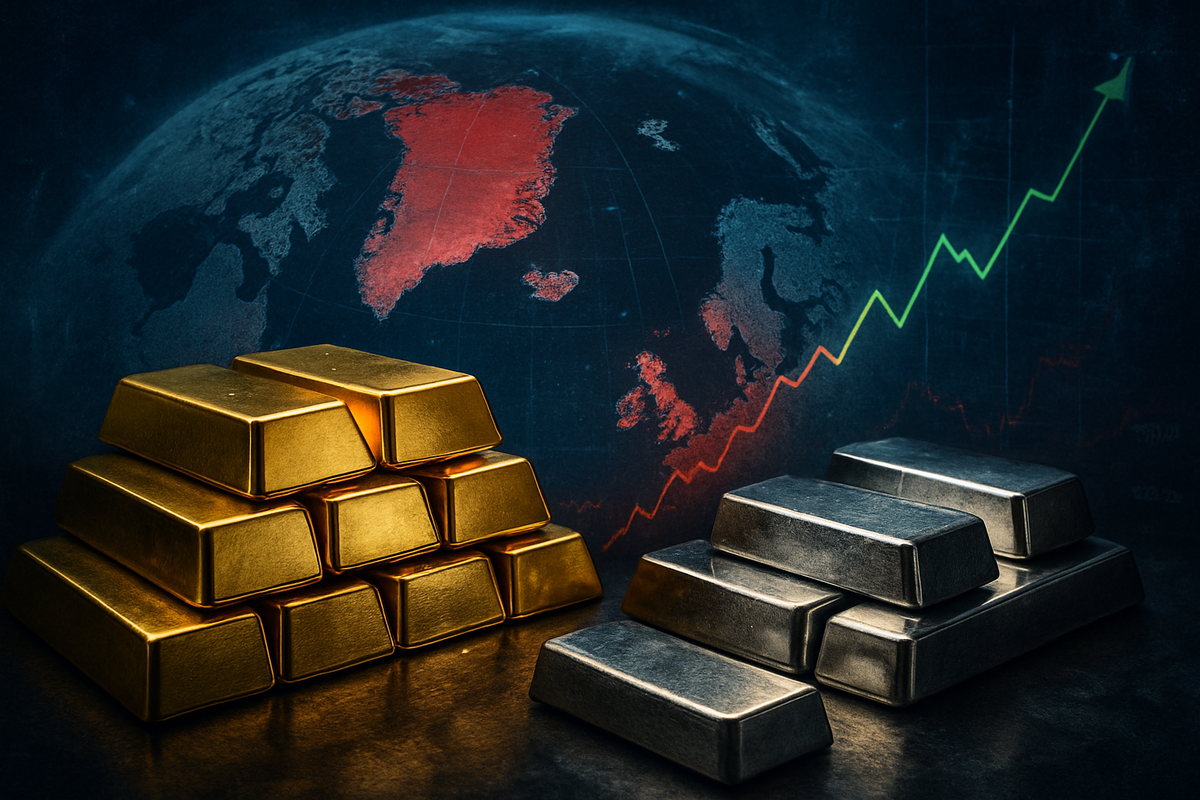
The global financial landscape reached a fever pitch this Monday, January 19, 2026, as precious metals shattered all previous records. Gold surged to a staggering $4,700 per ounce, while Silver broke past the $93 mark, fueled by a perfect storm of aggressive U.S. foreign policy and a weakening greenback. Investors are fleeing traditional equities in a frantic rush for safe-haven assets as the world prepares for a potential transatlantic trade war.
The primary catalyst for this historic rally is a dramatic escalation in rhetoric from the White House. President Donald Trump has intensified his push for the United States to acquire Greenland, framing the move as a "national security necessity" to counter Russian and Chinese influence in the Arctic. To force the hand of the Danish government and its European allies, the administration has announced a sweeping tariff regime targeting major European economies, sending shockwaves through global markets and destabilizing the currency exchange.
A Timeline of Geopolitical Brinkmanship
The road to $4,700 gold began in early January 2026, when President Trump revived his 2019 proposal to purchase Greenland, this time with a far more aggressive posture. By January 10, the Danish government, supported by a coalition including the United Kingdom, France, and Germany, formally rejected the U.S. overture, citing national sovereignty. In response, on January 17, the White House announced a two-phase tariff plan: a 10% levy on all goods from a "Northern European Coalition" effective February 1, 2026, scheduled to automatically increase to 25% by June 1 if a deal for Greenland is not reached.
The immediate reaction from the European Union—a threat to activate its "anti-coercion instrument"—has left markets fearing a total breakdown in Western trade relations. This uncertainty has been further compounded by the unexpected behavior of the Bloomberg Dollar Spot Index. Typically, a strong dollar accompanies geopolitical strife, but the index has recently dipped to 1,210.55. Investors are increasingly wary that Trump’s isolationist trade policies will inflict long-term damage on the domestic economy, leading to a "sell America" trade that is directing capital away from the dollar and into the hard certainty of gold and silver.
Winners and Losers in the Commodities Super-Cycle
The primary beneficiaries of this price explosion are the major mining entities and precious metal streamers. Agnico Eagle Mines (NYSE: AEM) and AngloGold Ashanti (NYSE: AU) have seen their valuations soar as they capitalize on the highest margins in the history of the industry. U.S. Gold Corp (NASDAQ: USAU) has emerged as a particularly high-interest play for domestic investors, given its strategic Wyoming-based projects that align with the current administration's "America First" resource mandate.
In the silver sector, the impact is even more pronounced due to an ongoing industrial supply deficit. First Majestic Silver (NYSE: AG) and Hecla Mining (NYSE: HL) have seen triple-digit percentage gains over the last quarter as silver’s dual role as an industrial metal and a monetary hedge becomes more critical. Streaming giants like Wheaton Precious Metals (NYSE: WPM) and Franco-Nevada (NYSE: FNV) are also reaping massive rewards, as their royalty-based models provide them with pure exposure to the price upside without the direct burden of rising operational costs.
Conversely, the losers are becoming clear. European exporters, particularly German automakers and French luxury conglomerates, are bracing for a catastrophic blow to their margins. Furthermore, U.S. manufacturers that rely on high-tech European components are seeing their input costs rise even before the tariffs take effect, as the weakening dollar makes imports more expensive.
The Broader Significance: A New Era of Isolationism
This event marks a significant departure from the post-Cold War era of global cooperation. The weaponization of trade tariffs to achieve territorial acquisition is a tactic that many analysts compare to the "gunboat diplomacy" of the 19th century, rather than the digital-age diplomacy of the 21st. The push for Greenland is no longer seen as a whimsical real estate ambition, but as a strategic chess move to control Arctic shipping lanes and mineral deposits that are becoming accessible due to thinning ice.
The current market behavior mirrors the "stagflation" fears of the 1970s, but with a modern twist. The rush into silver is particularly telling; it indicates that the market is not just afraid of war, but of a systemic shortage of the materials needed for the green energy transition. As the U.S. alienates its traditional partners, the global reserve status of the dollar is being questioned more openly than at any point in the last eighty years, providing a structural tailwind for gold that could last for a decade.
The Path Forward: Deadlines and Retaliation
The short-term focus for investors will be the February 1 deadline. If the first round of 10% tariffs is implemented without a diplomatic breakthrough, analysts at Citigroup suggest gold could easily clear the $5,000 threshold by early spring. The ultimate "wildcard" remains the Danish response; should Denmark seek closer military ties with other global powers to protect its territory, the geopolitical risk premium on precious metals would likely skyrocket further.
Strategic pivots are already underway. Multi-national corporations are scrambling to reroute supply chains away from the transatlantic corridor, though such transitions take years, not weeks. In the meantime, the market should prepare for continued volatility. We are entering a period where "geopolitical alpha"—the ability to trade based on political shifts—will be the most valuable asset in a fund manager's toolkit.
Market Outlook and Final Thoughts
The record-breaking ascent of gold and silver is a loud signal from the markets that the era of predictable global trade is over. The combination of territorial ambition and aggressive protectionism from the White House has created a "fear trade" of unprecedented proportions. While the Bloomberg Dollar Spot Index's decline suggests a lack of confidence in the current U.S. trajectory, it has simultaneously acted as the accelerant for the precious metals fire.
Moving forward, investors should keep a close eye on the June 1 tariff escalation date and any moves by the European Central Bank to support its own members. The "Greenland Gambit" has permanently altered the risk profile of the Western world. For the foreseeable future, gold and silver are not just commodities; they are the only perceived insurance policy in a world where the old alliances are rapidly dissolving.
This content is intended for informational purposes only and is not financial advice.