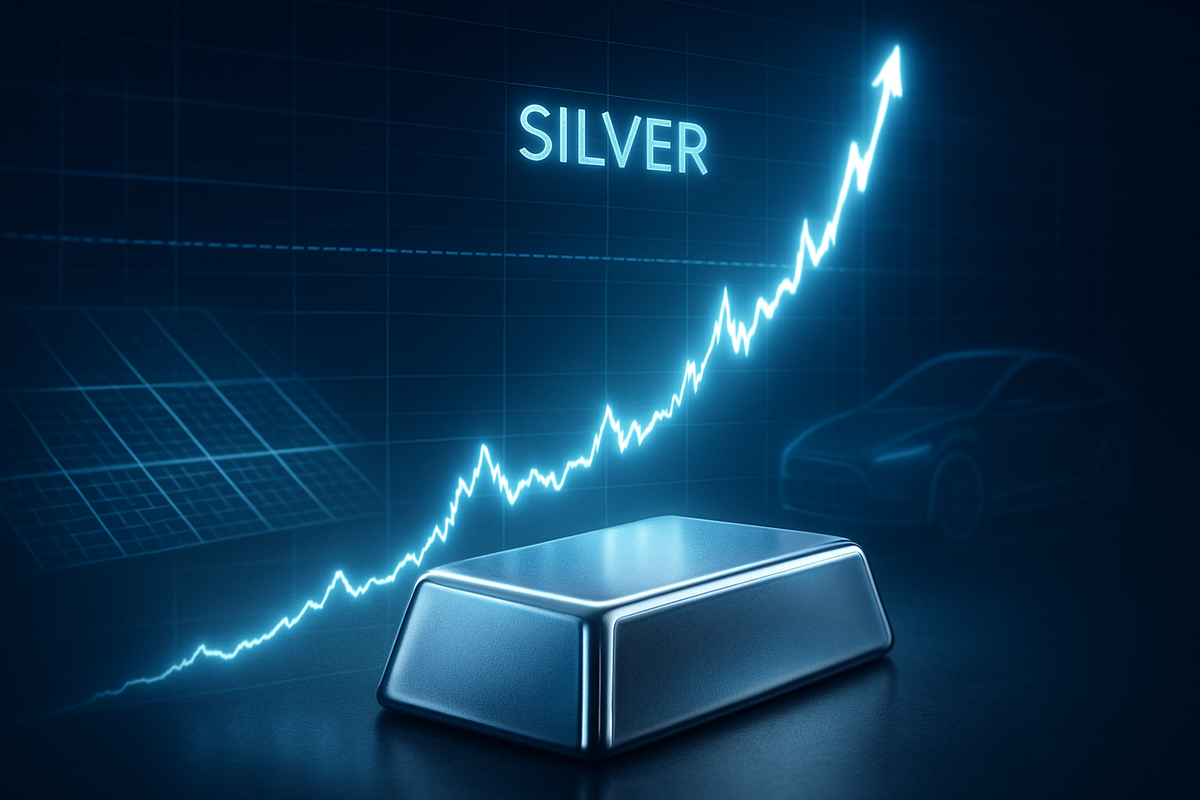
The silver market witnessed a seismic shift on January 16, 2026, as the "devil's metal" finally cast off decades of price stagnation, surging 7.5% in a single trading session to breach the $93-an-ounce mark. This historic rally marks the first time in history that silver has crossed the $90 threshold, effectively doubling its value in less than eighteen months and signaling a fundamental realignment of the global precious metals complex.
The immediate implications of this move are being felt across the globe, from the trading floors of Chicago and London to the manufacturing hubs of Shenzhen. For investors, the breach of $90 represents the culmination of a multi-year supply-demand imbalance that many analysts believe has permanently altered the silver-to-gold ratio. For the broader market, the surge acts as a stark warning: the green energy transition and the artificial intelligence boom are consuming critical materials at a rate that current mining infrastructure simply cannot sustain.
The Perfect Storm: A Timeline of the $93 Breakthrough
The road to $93 began in earnest during the final quarter of 2025, when a series of structural deficits began to collide with geopolitical maneuvering. While silver has long been a favorite of retail "squeeze" enthusiasts, the current rally is driven by cold, hard industrial necessity. Throughout 2025, global silver inventories at the COMEX and the London Bullion Market Association (LBMA) plummeted to decade lows, as solar panel manufacturers and electric vehicle (EV) titans began securing private, long-term supply contracts, bypassing the public exchanges entirely.
The breaking point arrived this week following a two-pronged catalyst. First, the Chinese Ministry of Commerce announced new "strategic export license" requirements for refined silver, citing the need to protect domestic high-tech manufacturing. As the world’s leading refiner and consumer of the metal, this move effectively throttled the global "free float." Simultaneously, a weaker-than-expected inflation print in the U.S. led the Federal Reserve to signal further interest rate cuts, causing the U.S. Dollar to soften and traditional safe-haven buying to accelerate.
The trading session on January 16 saw silver open at $86.50 before a massive wave of institutional buying—largely suspected to be short-covering by bullion banks—pushed the price through the psychological $90 barrier. Within three hours of the New York open, the metal touched a session high of $93.42. Unlike the short-lived spikes of 1980 or 2011, which were driven by speculative corners or temporary crises, this move appears backed by an "inelastic" industrial floor that has left market bears with nowhere to hide.
Mining Titans and Tech Giants: The Winners and Losers
The primary beneficiaries of the $90+ silver era are the pure-play silver miners and streaming companies. Hecla Mining (NYSE: HL) and Pan American Silver (NASDAQ: PAAS) have seen their market capitalizations balloon as their unhedged production profiles offer direct exposure to these record prices. Streaming giant Wheaton Precious Metals (NYSE: WPM) has emerged as perhaps the biggest winner, as its fixed-cost contracts allow it to acquire silver at a fraction of the current spot price, generating record-breaking free cash flow margins that were once unthinkable in the mining sector.
Conversely, the industrial sector is reeling from what some are calling a "metallization crisis." For solar energy leaders like JinkoSolar (NYSE: JKS) and First Solar (NASDAQ: FSLR), the surge represents a massive spike in input costs. Modern N-type solar cells, which have become the industry standard, require significantly more silver than previous generations. With silver now trading above $90, the cost of silver paste alone can account for nearly 30% of a panel’s total manufacturing cost, threatening to slow the pace of global decarbonization efforts unless "thrifting" technologies can be accelerated.
High-tech manufacturers and automotive leaders like Tesla (NASDAQ: TSLA) and Apple (NASDAQ: AAPL) are also facing margin compression. An average electric vehicle contains roughly 25 to 50 grams of silver used in everything from battery management systems to autonomous driving sensors. At $93 an ounce, the silver component of a vehicle now represents a meaningful line item in the bill of materials. While these companies have deep pockets, the cumulative effect across millions of units and devices—including the silver-heavy infrastructure required by NVIDIA (NASDAQ: NVDA) for AI data centers—is forcing a re-evaluation of product pricing and supply chain resilience.
A Historic Shift in the Precious Metals Landscape
To understand the magnitude of today’s event, one must look back at the historical precedents of 1980 and 2011, when silver briefly touched the $50 mark. In those instances, the price was driven by the Hunt Brothers' attempt to corner the market and a post-financial crisis flight to safety, respectively. Both rallies were followed by spectacular collapses. However, the 2026 rally is fundamentally different; it is the result of a structural deficit that has persisted for five consecutive years. Silver is no longer just "poor man’s gold"—it is the indispensable "green metal."
This event also signals a potential "great compression" of the gold-to-silver ratio. For much of the last decade, the ratio hovered above 80:1. With silver at $93 and gold trading near $5,000, the ratio has tightened toward 54:1, nearing its historical 20th-century average. This shift suggests that silver is finally being priced as a strategic industrial asset rather than a mere monetary substitute. The ripple effects are also being felt in the copper and zinc markets, as 70% of silver is produced as a byproduct of base metal mining, leading to increased volatility across the entire commodities spectrum.
What Lies Ahead: The Road to $100 and Beyond
In the short term, market analysts expect a period of extreme volatility as the market "digests" the $90 breach. There is a high probability of technical pullbacks as traders take profits, but the structural shortage remains unresolved. We may see a strategic pivot from industrial users who will likely accelerate research into silver alternatives, such as copper-plated solar cells. However, these technologies are years away from the scale needed to displace silver’s unique conductivity and reliability.
Long-term, the focus will shift to "demand destruction" versus "supply response." At $93 an ounce, previously uneconomic silver deposits become viable, potentially triggering a new wave of exploration and mine restarts. However, because most silver is a byproduct of other metals, increasing silver supply isn't as simple as digging more holes; it requires an increase in global demand for lead, zinc, and copper as well. Investors should watch for announcements regarding government stockpiling, especially as nations begin to view silver as a matter of national energy security.
Closing Thoughts: A New Era for Commodities
The ascent of silver to $93 an ounce is more than just a headline-grabbing price move; it is a validation of the "commodity supercycle" that has been brewing for years. The transition to a digital and green economy has a physical cost, and that cost is now being reflected in the price of the world's most conductive metal. The era of cheap, abundant silver is over, replaced by a competitive landscape where securing physical supply is as important as the price itself.
Moving forward, the $90 level will likely serve as a new support floor rather than a ceiling. Investors should maintain a close eye on inventory levels at the major exchanges and watch for any signs of China further tightening its grip on exports. As we enter the second half of the decade, the "silver squeeze" has evolved from a retail meme into a global industrial reality, with lasting implications for the future of energy and technology.
This content is intended for informational purposes only and is not financial advice