As the final trading days of 2025 unfold, the financial markets are witnessing a familiar spectacle: the resilience of NVIDIA (NASDAQ: NVDA). On Tuesday, December 30, 2025, the semiconductor giant staged a remarkable intraday turnaround, rebounding from early session lows to lead a broader rally across the technology sector. The recovery underscores a persistent reality that has defined the last three years of trading—global appetite for artificial intelligence infrastructure remains the primary engine of the modern bull market.
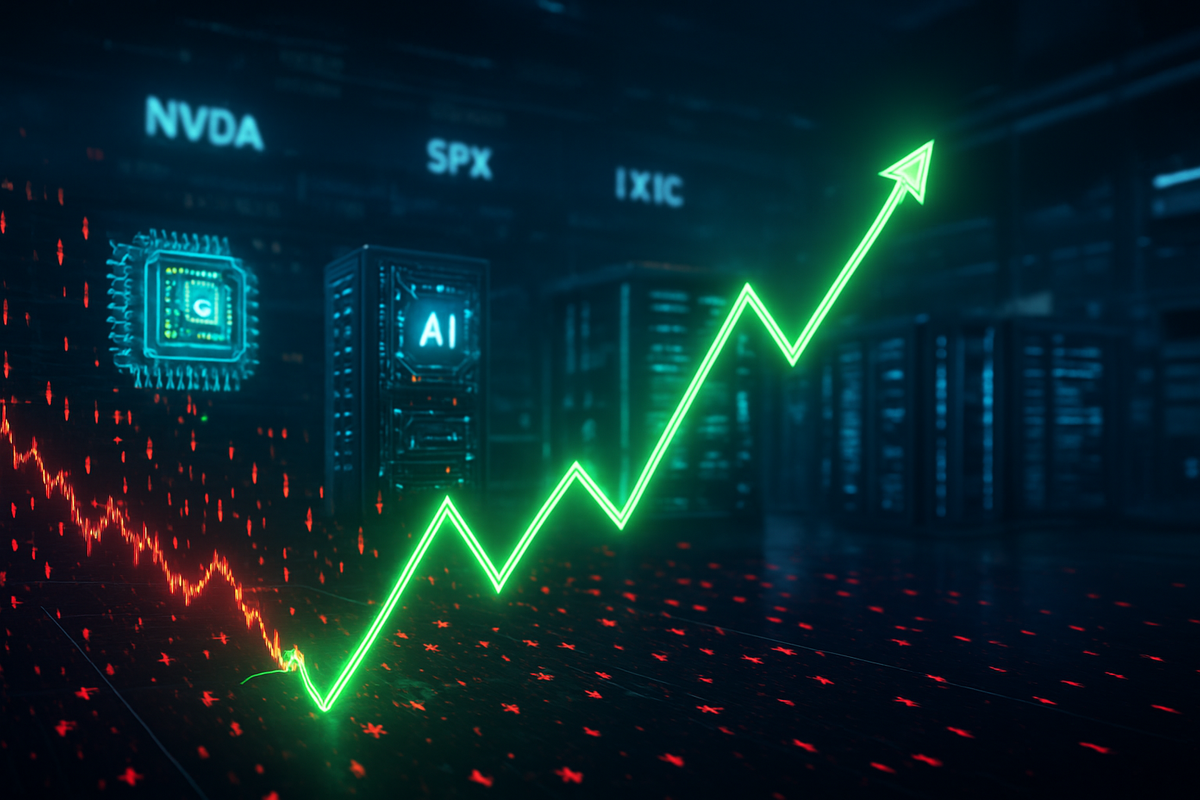
The morning session began with a wave of profit-taking and tax-loss harvesting, pushing Nvidia shares down nearly 3.2% within the first hour of trading. However, by mid-afternoon, the stock had erased those losses, trading up 1.8% as institutional buyers stepped in to capitalize on the dip. This intraday swing not only stabilized Nvidia but acted as a "magnetic north" for the S&P 500 (INDEXSP: .INX) and the Nasdaq Composite (INDEXNASDAQ: .IXIC), both of which followed the chipmaker’s trajectory back into positive territory.
Inside the Rebound: Blackwell Ultra and the Sovereign AI Surge
The catalyst for Tuesday’s reversal appears to be a dual-pronged realization among investors regarding Nvidia’s supply chain and its expanding customer base. Early in the session, rumors of a minor logistics bottleneck in the delivery of the new Blackwell Ultra (B300) chips caused a momentary flutter of concern. However, those fears were quickly quelled by reports from supply chain analysts at TSMC (NYSE: TSM) and SK Hynix, confirming that Blackwell production is not only on track but remains "sold out through mid-2026."
This timeline of events follows a blockbuster year for Nvidia, which saw its market capitalization hover between $4.2 trillion and $4.5 trillion throughout the fourth quarter of 2025. The immediate market reaction to the intraday dip was a testament to the "buy-the-dip" mentality that has become institutionalized among Nvidia shareholders. As the stock hit its session low of $138.40 (adjusted for 2024 splits), a surge in high-frequency trading volume signaled that the floor was firm.
Key stakeholders, including major hyperscalers like Microsoft (NASDAQ: MSFT) and Meta (NASDAQ: META), continue to signal that their capital expenditure (CapEx) for 2026 will exceed previous records. Meta, in particular, has been a vocal proponent of Nvidia’s Blackwell architecture, utilizing the chips to power its increasingly sophisticated "Agentic AI" models. The intraday recovery was further bolstered by news of a fresh $2 billion "Sovereign AI" contract from a consortium of Northern European nations, looking to build independent, domestic AI factories using Nvidia’s NeoCloud architecture.
The Competitive Landscape: Winners, Losers, and the Second-Source Struggle
While Nvidia continues to dominate, the ripple effects of its intraday volatility are felt across the entire semiconductor ecosystem. Advanced Micro Devices (NASDAQ: AMD) saw its shares mirror Nvidia’s recovery, though to a lesser extent. AMD has successfully established itself as the "second source" of choice for many hyperscalers with its Instinct MI350X series. However, despite AMD’s gains in inference performance, Nvidia’s deeply entrenched CUDA software ecosystem remains a formidable moat that competitors are finding difficult to breach.
On the losing side of this architectural divide is Intel (NASDAQ: INTC). As 2025 draws to a close, Intel has struggled to maintain the momentum of its Gaudi line, recently pivoting its strategy toward the "Jaguar Shores" platform slated for 2026. While Intel’s foundry business has seen some wins, its inability to capture a significant share of the high-end AI training market has left it trailing in the current super-cycle.
Meanwhile, the "silent winners" of Nvidia’s continued dominance are the specialized memory and equipment providers. Micron Technology (NASDAQ: MU) and SK Hynix have seen their valuations soar alongside Nvidia, as the transition to High-Bandwidth Memory (HBM4) becomes the new battleground for AI performance. Any recovery in Nvidia is viewed by the market as a proxy for the health of these critical suppliers, who are currently operating at maximum capacity to meet the demands of the Blackwell Ultra ramp-up.
A Concentration Crisis? Nvidia’s Role as the Market’s Central Nervous System
The significance of Nvidia’s intraday recovery extends far beyond a single ticker symbol. As of late 2025, Nvidia’s weighting in the S&P 500 has reached a historic 8%, a level of concentration rarely seen in market history. This has created what some analysts call a "concentration crisis," where the health of the entire U.S. retirement system is increasingly tethered to the production yields of a single company’s GPUs.
This event fits into a broader industry trend where AI has moved from a speculative venture into a national security priority. The rise of "Sovereign AI" initiatives—now a $20 billion business for Nvidia—represents a shift in the global order. Nations are no longer content to lease AI power from Silicon Valley; they want to own the silicon themselves. This geopolitical demand provides a "floor" for Nvidia’s valuation that did not exist during previous tech cycles, such as the dot-com era or the mobile revolution.
Historically, such high levels of market concentration have preceded periods of heightened volatility. However, unlike the Cisco or Intel peaks of 2000, Nvidia’s growth is backed by massive, realized cash flows and a forward P/E ratio that, while high at 48x, is supported by triple-digit earnings growth. The regulatory environment remains a wildcard, as U.S. export restrictions to China continue to evolve, but for now, the market seems content to follow Nvidia’s lead.
The Road to 2026: From Blackwell to Vera Rubin
Looking ahead, the short-term focus for investors will be the transition from the Blackwell architecture to the highly anticipated "Vera Rubin" platform, expected to sample in late 2026. The strategic pivot for Nvidia in the coming months will involve moving deeper into the "AI Factory" model, selling not just chips, but entire data center racks (like the GB300) that integrate networking, cooling, and compute into a single, high-margin product.
Market opportunities are emerging in the "Agentic AI" space, where software agents perform complex tasks autonomously. This requires a shift from training-heavy workloads to inference-heavy workloads, a transition that Nvidia is navigating by increasing the high-bandwidth memory on its Blackwell Ultra chips. The challenge will be managing the sheer scale of the energy requirements for these next-gen data centers, which has already led to Nvidia forming strategic partnerships with nuclear and renewable energy providers.
Potential scenarios for 2026 include a "digestion phase" where hyperscalers slow their buying to integrate existing hardware, or a "second wave" of demand driven by the commercialization of humanoid robotics and autonomous vehicles. Investors should be prepared for continued high beta; while the recovery on December 30 was swift, it highlights the sensitivity of the indices to even minor shifts in the AI narrative.
Conclusion: A Market Defined by Silicon
The events of December 30, 2025, serve as a microcosm of the current financial era. Nvidia’s ability to shrug off a 3% morning decline and finish in the green is a powerful signal of the underlying strength of the AI super-cycle. The key takeaway for investors is that despite concerns over market concentration and record-high valuations, the fundamental demand for AI compute shows no signs of abating as we enter the new year.
As we move into 2026, the market will be watching for two critical factors: the sustainability of hyperscaler CapEx and the successful integration of HBM4 memory into the next generation of chips. While the "concentration crisis" remains a systemic risk, the sheer utility of Nvidia’s hardware in the global economy has made it a "must-own" asset for institutional and retail investors alike.
For now, Nvidia remains the undisputed king of the Nasdaq and the S&P 500. Its intraday recovery today wasn't just a win for the company; it was a sigh of relief for the entire market, proving once again that in the world of 2025, as Nvidia goes, so goes the world.
This content is intended for informational purposes only and is not financial advice