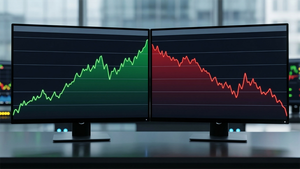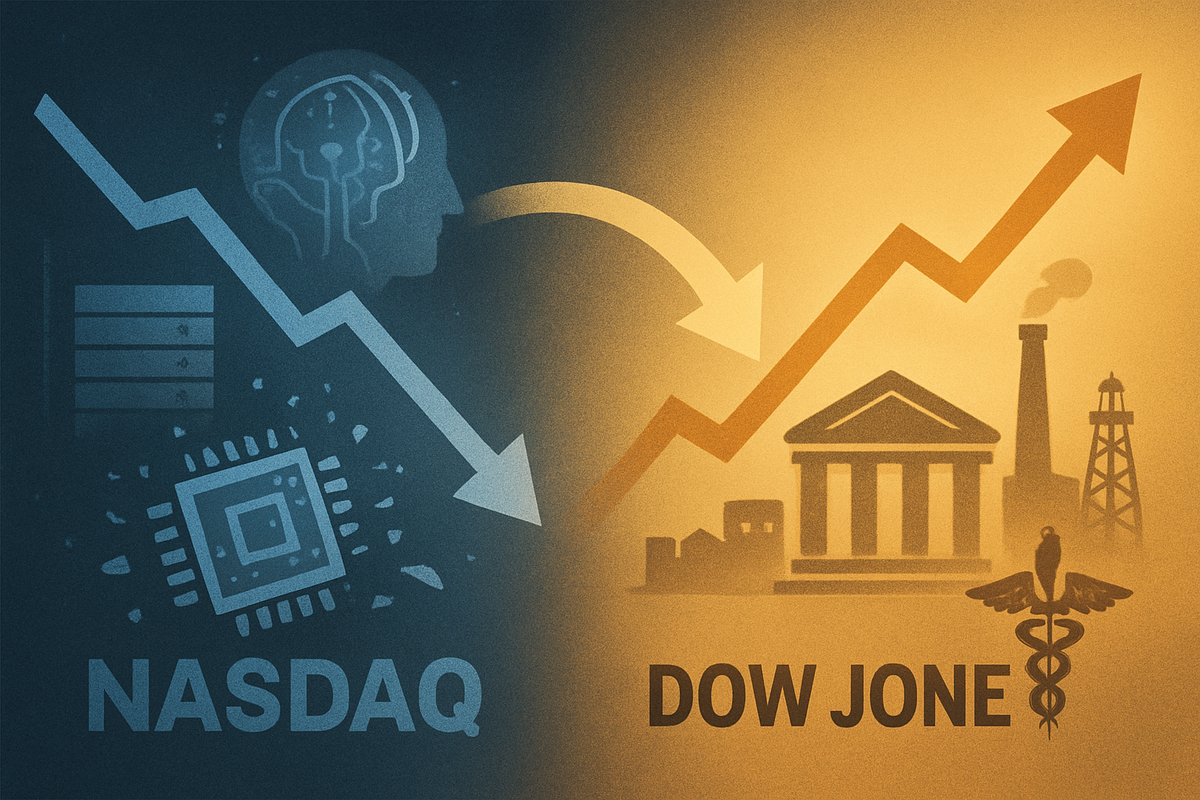
As of December 12, 2025, the financial markets are witnessing a significant "Great Rotation," a pronounced shift of capital from high-growth technology and Artificial Intelligence (AI) stocks to more traditional value sectors and defensive equities. This ongoing recalibration reflects evolving macroeconomic conditions, a reassessment of risk appetite, and a growing demand for tangible profitability over speculative growth. The immediate implication is a striking divergence in the performance of major market indices: the Dow Jones Industrial Average (DJIA) is surging to record highs, while the tech-heavy Nasdaq Composite (NASDAQ) is grappling with a significant slump and increased volatility. This pivot signals a potential end to the narrow, tech-led rallies that have characterized recent years, ushering in an era of broader market participation and a renewed focus on fundamental value.
The Shifting Sands of Market Leadership
This "Great Rotation" has been a developing theme throughout 2025, becoming particularly acute in recent months. A primary catalyst has been the Federal Reserve's cautious interest rate cuts in 2025, which, despite aiming for accommodation, have encouraged a broader reallocation of assets as investors grow increasingly concerned about elevated valuations in the tech and AI sectors. This has pushed capital towards companies with strong fundamentals, stable earnings, and more reasonable valuations.
Specific incidents have underscored this shift. On December 11, 2025, tech stocks, including the Nasdaq 100, experienced a notable downturn. Oracle's (NYSE: ORCL) disappointing earnings report, which missed cloud revenue targets and announced a substantial increase in data center spending, severely impacted the tech sector. Its shares plunged over 15%, dragging down other major AI-linked tech stocks such as Nvidia (NASDAQ: NVDA) and Broadcom (NASDAQ: AVGO). While the Nasdaq had a strong year overall, with a year-to-date return of 22.5% as of December 10, 2025, the recent pullback indicates heightened scrutiny of tech sector valuations. Venture capital still flows robustly into AI, but public markets are becoming more discerning, prioritizing proven profitability and sustainable growth over speculative future prospects. This marks a pivotal moment, signaling a fundamental recalibration after years of concentrated tech dominance and a move away from the "Magnificent Seven" mega-cap tech stocks that largely propelled previous market gains.
Winners and Losers in the Capital Reallocation
The "Great Rotation" is creating clear winners and losers across the market spectrum, as investors re-evaluate companies based on current profitability and sustainable growth rather than solely on future potential.
Companies characterized by high price-to-earnings (P/E) ratios and strong future growth expectations are most vulnerable. High-growth tech and AI pure-plays, whose valuations soared on future promise, are experiencing capital rotation away from them. Nvidia (NASDAQ: NVDA), despite reaching a market value exceeding $5 trillion in October 2025, has seen volatility amid overvaluation concerns. Palantir Technologies (NYSE: PLTR), trading at an exceptionally high 160 times sales, is considered the "most expensive stock in the S&P 500" with projected downside. Intel (NASDAQ: INTC) faces market share loss and is seen as historically expensive. Oracle (NYSE: ORCL) and Broadcom (NASDAQ: AVGO) have both experienced share price drops following disappointing results or margin pressure related to AI investments. Consumer Discretionary segments, particularly auto sales, and Real Estate Investment Trusts (REITs) are also losing ground due to sensitivity to higher interest rates and reduced consumer spending.
Conversely, mature businesses with stable earnings, lower P/E ratios, and often consistent dividends are attracting significant capital. The Financials sector, including Berkshire Hathaway (NYSE: BRK.A, BRK.B), is benefiting from anticipated declines in interest rates and improved lending environments. The Energy sector is gaining from firmer commodity prices and surging demand from massive AI data centers. Industrials, such as Eaton Corp (NYSE: ETN) and Trane Technologies (NYSE: TT), are poised to win from infrastructure investments related to AI. Healthcare, with companies like Zimmer Biomet (NYSE: ZBH), Bristol-Myers Squibb (NYSE: BMY), Merck (NYSE: MRK), Danaher (NYSE: DHR), GSK (NYSE: GSK), and Pfizer (NYSE: PFE), offers resilience and continuous innovation. Consumer Staples like Campbell's (NYSE: CPB), Constellation Brands (NYSE: STZ), Clorox (NYSE: CLX), and Mondelez International (NASDAQ: MDLZ), along with Utilities such as American Water Works Company Inc. (NYSE: AWK) and Consolidated Edison Inc. (NYSE: ED), are attracting investors seeking stability. Materials, International Equities, and Small-Cap stocks are also showing renewed vigor, benefiting from broader market diversification and attractive valuations.
Wider Significance and Historical Context
The "Great Rotation" in late 2025 is more than a fleeting market trend; it signifies a profound recalibration driven by a complex interplay of macroeconomic shifts, evolving investor sentiment, and intensifying regulatory pressures. This reallocation of capital is reshaping industry leadership and forcing a re-evaluation of how value is created and sustained in the modern economy.
This event fits into broader industry trends marked by persistent inflation, with rates sticky around 3% even as the Federal Reserve cautiously eases monetary policy. Fiscal policy, characterized by growing sovereign debt and increasing budget deficits, is also taking center stage, influencing bond markets and investment trends. Investor exuberance for AI and tech stocks, at one point seen by a Bank of America survey as an "over-inflated by hype" bubble, has given way to a more cautious assessment of valuations. The market is now demanding tangible AI-driven value creation and measurable customer outcomes, shifting focus from rapid infrastructure "buildout" to effective utilization of AI. Ripple effects are evident in the underperformance of tech stocks, while value sectors like financials, energy, industrials, and healthcare are benefiting. Regulatory scrutiny is also intensifying, with antitrust investigations targeting tech giants like Google (NASDAQ: GOOGL) and Meta Platforms (NASDAQ: META), and a patchwork of AI regulations emerging globally. Historically, the performance of growth and value stocks has been cyclical, with value often outperforming over the long run after periods of growth dominance, much like the post-dot-com bubble era. While direct comparisons are nuanced, current fears of an AI "bubble" echo sentiments from past market frenzies, though the macroeconomic backdrop of sticky inflation and influential fiscal policies presents a unique dynamic.
What Comes Next: Navigating the Evolving Landscape
The "Great Rotation" is expected to continue shaping financial markets through 2026 and beyond, ushering in an era of broadened market leadership and a more discerning investment environment.
In the short term (next 6-12 months), expect continued sector divergence. Tech and AI stocks will face ongoing scrutiny regarding profitability, with investors demanding tangible returns over speculative growth, especially for the "Magnificent Seven." Value stocks, particularly in financials and healthcare, are poised for continued outperformance, bolstered by strong earnings and improving economic fundamentals. The Federal Reserve's cautious monetary policy, with only one anticipated rate cut in 2026 after three in 2025, will continue to exert gravitational pressure on high-growth valuations, making value more attractive. This environment will also bring heightened volatility, underscoring the need for diversification. Long term (1-5+ years), the market is likely to see a more mature and selective investment environment, rewarding fundamental strength and adaptability. AI's influence will expand beyond pure tech, integrating into core businesses across various industries. However, tempered expectations for long-term U.S. stock returns, as suggested by Vanguard, and concerns about the capital intensity of AI infrastructure, remain pertinent. Strategic pivots for investors include rebalancing portfolios towards undervalued, resilient industries, focusing on fundamentals and high-quality dividend stocks, and embracing active management. Companies must adapt by demonstrating clear pathways to profitability from AI investments. Opportunities abound in undervalued traditional sectors, AI infrastructure providers ("picks and shovels" plays), emerging markets, and small/mid-cap value stocks. Challenges include persistent AI "bubble" concerns, valuation pressures on high-growth tech, the complexities of AI monetization and regulation, and ongoing economic instability. Potential scenarios range from a continued gradual rotation and a soft landing for tech to a broad-based AI productivity boost or persistent "vibepression" and volatility.
Comprehensive Wrap-Up: A New Market Paradigm
The "Great Rotation" from high-flying tech and AI to value stocks marks a fundamental recalibration of market expectations and a maturing economic cycle. After years of concentrated market performance in a handful of mega-cap technology and AI companies, investors are now seeking stability, tangible profitability, and diversification.
Key takeaways include the cooling valuations for tech/AI, the resurgence of value stocks across industrials, energy, healthcare, and financials, and a renewed emphasis on diversification and fundamental value. Moving forward, the market will be shaped by the Federal Reserve's rate policy, which, despite a recent cut, is nearing the end of its easing cycle amidst sticky inflation. Economic growth remains resilient but uneven, fostering a "K-shaped" environment with sustained churn and rotation. The lasting impact of this rotation is expected to be a more robust and resilient market ecosystem, reducing systemic risks associated with over-reliance on a single industry and reinforcing the cyclical nature of markets. It will push for tangible returns from AI ventures, shaping future innovation towards proven profitability.
Investors should closely watch central bank policies, particularly future interest rate adjustments, and monitor sector divergence, expecting traditional sectors to gain momentum while tech-heavy indices face ongoing pressure. Scrutiny of AI profitability and widespread adoption will be crucial, along with macroeconomic indicators such as inflation, labor market conditions, and GDP growth. Geopolitical developments and continuous portfolio rebalancing across sectors, investment styles, and geographic regions will be essential for managing risk and capitalizing on emerging opportunities in the months ahead.
This content is intended for informational purposes only and is not financial advice