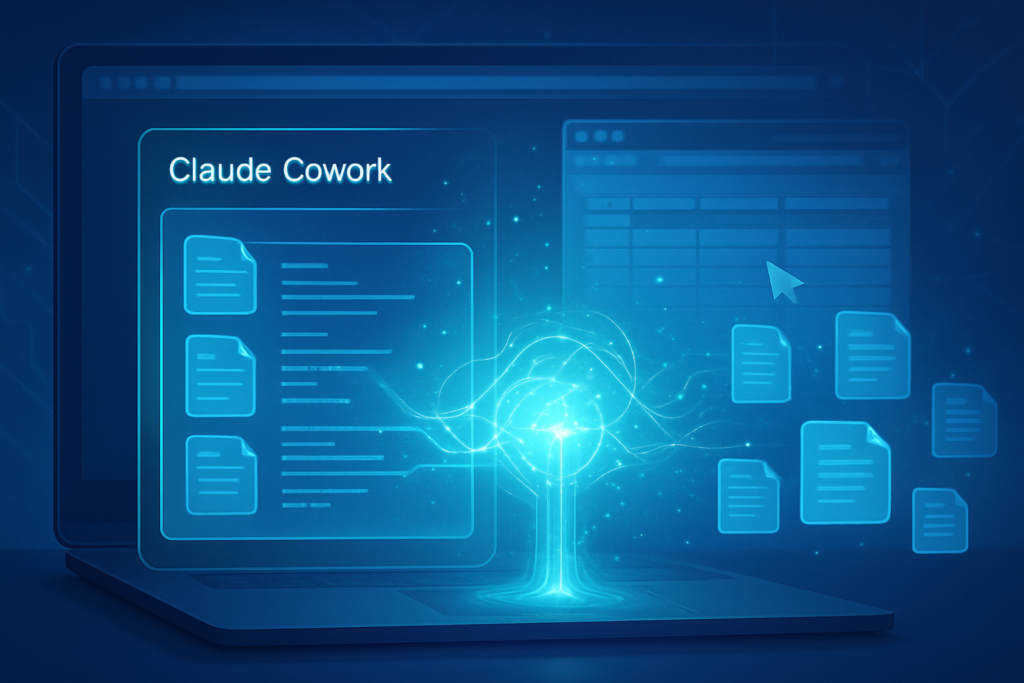
On January 12, 2026, Anthropic signaled a paradigm shift in the artificial intelligence landscape with the launch of Claude Cowork. This research preview represents a decisive step beyond the traditional chat window, transforming Claude from a conversational assistant into an autonomous digital agent. By granting the AI direct access to a user’s local file system and web browser, Anthropic is pivoting toward a future where "doing" is as essential as "thinking."
The launch, initially reserved for Claude Max subscribers before expanding to Claude Pro and enterprise tiers, arrives at a critical juncture for the industry. While previous iterations of AI required users to manually upload files or copy-paste text, Claude Cowork operates as a persistent, agentic entity capable of navigating the operating system to perform high-level tasks like organizing directories, reconciling expenses, and generating multi-source reports without constant human hand-holding.
Technical Foundations: From Chat to Agency
Claude Cowork's most significant technical advancement is its ability to bridge the "interaction gap" between AI and the local machine. Unlike the standard web-based Claude, Cowork is delivered via the Claude Desktop application for macOS, utilizing Apple Inc. (NASDAQ: AAPL) and its native Virtualization Framework. This allows the agent to run within a secure, sandboxed environment where it can interact with a user-designated "folder-permission model." Within these boundaries, Claude can autonomously read, create, and modify files. This capability is powered by a new modular instruction set dubbed "Agent Skills," which provides the model with specialized logic for handling complex office formats such as .xlsx, .pptx, and .docx.
Beyond the local file system, Cowork integrates seamlessly with the "Claude in Chrome" extension. This enables cross-surface workflows that were previously impossible; for example, a user can instruct the agent to "research the top five competitors in the renewable energy sector, download their latest quarterly earnings, and summarize the data into a spreadsheet in my Research folder." To accomplish this, Claude uses a vision-based reasoning engine, capturing and processing screenshots of the browser to identify buttons, forms, and navigation paths.
Initial reactions from the AI research community have been largely positive, though experts have noted the "heavy" nature of these operations. Early testers have nicknamed the high consumption of subscription limits the "Wood Chipper" effect, as the agent’s autonomous loops—planning, executing, and self-verifying—can consume tokens at a rate significantly higher than standard text generation. However, the introduction of a "Sub-Agent Coordination" architecture allows Cowork to spawn independent threads for parallel tasks, a breakthrough that prevents the main context window from becoming cluttered during large-scale data processing.
The Battle for the Desktop: Competitive Implications
The release of Claude Cowork has effectively accelerated the "Agent Wars" of 2026. Anthropic’s move is a direct challenge to the "Operator" system from OpenAI, which is backed by Microsoft Corporation (NASDAQ: MSFT). While OpenAI’s Operator has focused on high-reasoning browser automation and personal "digital intern" tasks, Anthropic is positioning Cowork as a more grounded, work-focused tool for the professional environment. By focusing on local file integration and enterprise-grade safety protocols, Anthropic is leveraging its reputation for "Constitutional AI" to appeal to corporate users who are wary of letting an AI roam freely across their entire digital footprint.
Meanwhile, Alphabet Inc. (NASDAQ: GOOGL) has responded by deepening the integration of its "Jarvis" agent directly into the Chrome browser and the ChromeOS ecosystem. Google’s advantage lies in its massive context windows, which allow its agents to maintain state across hundreds of open tabs. However, Anthropic’s commitment to the Model Context Protocol (MCP)—an industry standard for agent communication—has gained significant traction among developers. This strategic choice suggests that Anthropic is betting on an open ecosystem where Claude can interact with a variety of third-party tools, rather than a "walled garden" approach.
Wider Significance: The "Crossover Year" for Agentic AI
Industry analysts are calling 2026 the "crossover year" for AI, where the primary interface for technology shifts from the search bar to the command line of an autonomous agent. Claude Cowork fits into a broader trend of "Computer-Using Agents" (CUAs) that are redefining the relationship between humans and software. This shift is not without its concerns; the ability for an AI to modify files and navigate the web autonomously raises significant security and privacy questions. Anthropic has addressed this by implementing "Deletion Protection," which requires explicit user approval before any file is permanently removed, but the potential for "hallucinations in action" remains a persistent challenge for the entire sector.
Furthermore, the economic implications are profound. We are seeing a transition from Software-as-a-Service (SaaS) to what some are calling "Service-as-Software." In this new model, value is derived not from the tools themselves, but from the finished outcomes—the organized folders, the completed reports, the booked travel—that agents like Claude Cowork can deliver. This has led to a surge in interest from companies like Amazon.com, Inc. (NASDAQ: AMZN), an Anthropic investor, which sees agentic AI as the future of both cloud computing and consumer logistics.
The Horizon: Multi-Agent Systems and Local Intelligence
Looking ahead, the next phase of Claude Cowork’s evolution is expected to focus on "On-Device Intelligence" and "Multi-Agent Systems" (MAS). To combat the high latency and token costs associated with cloud-based agents, research is already shifting toward running smaller, highly efficient models locally on specialized hardware. This trend is supported by advancements from companies like Qualcomm Incorporated (NASDAQ: QCOM), whose latest Neural Processing Units (NPUs) are designed to handle agentic workloads without a constant internet connection.
Experts predict that by the end of 2026, we will see the rise of "Agent Orchestration" platforms. Instead of a single AI performing all tasks, users will manage a fleet of specialized agents—one for research, one for data entry, and one for creative drafting—all coordinated through a central hub like Claude Cowork. The ultimate challenge will be achieving "human-level reliability," which currently sits well below the threshold required for high-stakes financial or legal automation.
Final Assessment: A Milestone in Digital Collaboration
The launch of Claude Cowork is more than just a new feature; it is a fundamental redesign of the user experience. By breaking out of the chat box and into the file system, Anthropic is providing a glimpse of a world where AI is a true collaborator rather than just a reference tool. The significance of this development in AI history cannot be overstated, as it marks the moment when "AI assistance" evolved into "AI autonomy."
In the coming weeks, the industry will be watching closely to see how Anthropic scales this research preview and whether it can overcome the "Wood Chipper" token costs that currently limit intensive use. For now, Claude Cowork stands as a bold statement of intent: the age of the autonomous digital employee has arrived, and the desktop will never be the same.
This content is intended for informational purposes only and represents analysis of current AI developments.
TokenRing AI delivers enterprise-grade solutions for multi-agent AI workflow orchestration, AI-powered development tools, and seamless remote collaboration platforms.
For more information, visit https://www.tokenring.ai/.