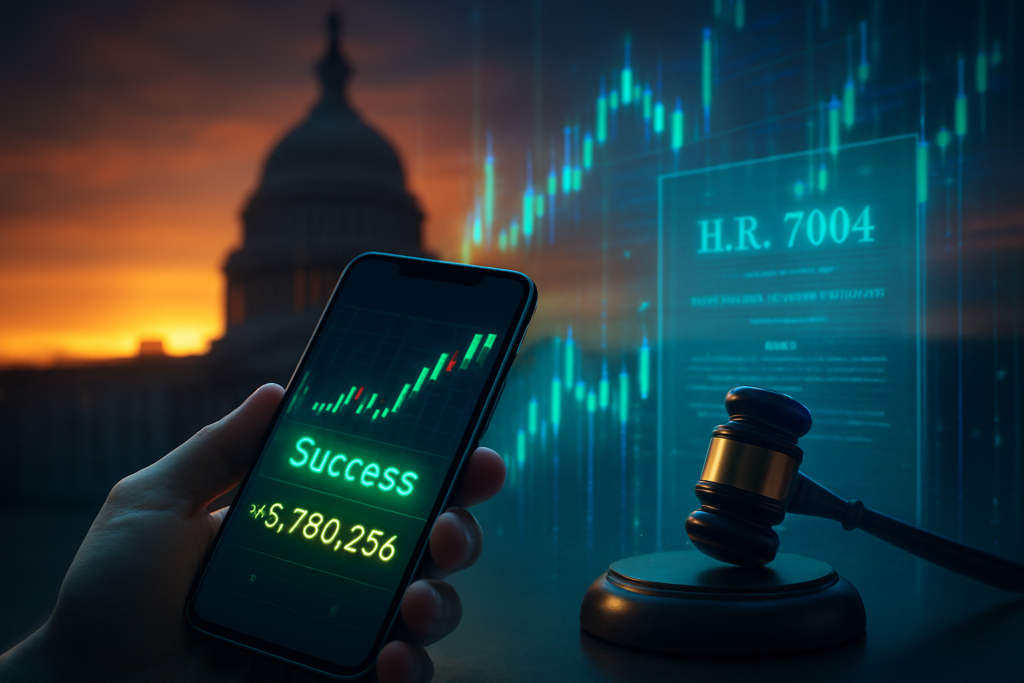
The sudden $400,000 profit on a Venezuelan regime-change contract has done more than just mint a new crypto-millionaire; it has ignited a firestorm on Capitol Hill. As of January 23, 2026, the prediction market industry is facing its most significant regulatory reckoning to date with the introduction of the "Public Integrity in Financial Prediction Markets Act of 2026" (H.R. 7004).
Introduced by Congressman Ritchie Torres (D-NY), the bill seeks to effectively outlaw "insider trading" in the world of event contracts. The push follows a suspicious trade on Polymarket that perfectly anticipated the U.S. special forces' capture of Nicolás Maduro, turning a modest $32,000 position into nearly half a million dollars in less than 24 hours. While the trade has been hailed by some as a triumph of "Information Finance," it has provided lawmakers with the "smoking gun" needed to argue that government staffers are treating classified intelligence like a personal brokerage account.
The Market: What's Being Predicted
The primary market under the microscope isn't just the fate of foreign dictators, but the survival of the prediction market industry itself. On PredictIt, a popular platform for political wagering, the contract "Will H.R. 7004 pass in 2026?" is currently trading at 12 cents, suggesting a meager 12% probability that the bill will become law this year.
Despite the low odds of the full act passing a divided Congress, related "proxy" markets show a much higher expectation for regulatory intervention. On Kalshi, a platform regulated by the Commodity Futures Trading Commission (CFTC), a market tracking whether the CFTC will adopt new insider trading rules by year-end is trading at 20%.
Trading volume has reached feverish heights. In January 2026 alone, Polymarket has seen over $6 billion in total volume, a 40% month-over-month increase. Much of this liquidity is concentrated in geopolitical and regulatory "risk" contracts, as institutional traders and retail bettors alike scramble to hedge against the potential for a federal crackdown.
Why Traders Are Betting
The catalyst for H.R. 7004 was an account pseudonymously known as "Burdensome-Mix." On January 3, 2026, just hours before "Operation Absolute Resolve"—the mission that led to the capture of Nicolás Maduro—was declassified, this trader placed $32,000 on "Yes" shares for Maduro’s exit. At the time, the market was trading at less than 8 cents. When the news broke, the shares hit $1.00, resulting in a $404,000 windfall.
Suspicion immediately fell on government insiders. The account was funded via Coinbase Global, Inc. (NASDAQ: COIN) without the use of privacy mixers, allowing investigators to trace the funds back to a U.S.-based exchange. This "pitch-perfect" timing has led Congressman Torres to argue that the current legal framework is insufficient to prevent staffers with access to briefing materials from front-running the public.
"We cannot have a system where a junior staffer at the Pentagon can pay off their student loans by betting on the very missions our brave service members are executing," Torres said during a press briefing last week.
Broader Context and Implications
The introduction of H.R. 7004 represents the "maturation" of the prediction market sector, often called InfoFi. For years, these markets operated in a legal gray area, but the massive scale of the 2024 and 2025 election cycles proved they are here to stay. Major brokerage firms like Robinhood Markets, Inc. (NASDAQ: HOOD) and Interactive Brokers Group, Inc. (NASDAQ: IBKR) have already integrated event contracts into their platforms, further blurring the lines between gambling and traditional finance.
The bill's provisions are modeled after the 2012 STOCK Act, which aimed to prevent members of Congress from using non-public information to trade stocks. H.R. 7004 would extend these prohibitions to "event contracts" tied to government policy, military actions, and political outcomes.
However, the industry is split on the implications. While Kalshi CEO Tarek Mansour has voiced support for the bill—viewing federal "rules of the road" as a prerequisite for institutional trust—decentralized advocates on Polymarket argue that the "insider information" actually makes the markets more accurate. They contend that the $400,000 Maduro trade provided a valuable signal to the world that something major was about to happen, effectively serving as an early warning system.
What to Watch Next
The most immediate milestone for the bill is a House Committee hearing scheduled for late February 2026. Traders will be watching for any signs of Republican support; currently, the bill has 30 Democratic co-sponsors, including former Speaker Nancy Pelosi, but lacks a GOP lead. If a prominent Republican joins the effort, the odds of passage on PredictIt could easily double overnight.
Simultaneously, the CFTC has opened a formal investigation into the "Burdensome-Mix" account. If the commission manages to unmask the trader and prove they are a government employee, the resulting scandal could provide the political momentum needed to bypass congressional gridlock.
Finally, keep an eye on the Supreme Court. Several legal challenges regarding the CFTC’s authority to regulate "public interest" markets are currently making their way through the appellate courts. A ruling that limits the CFTC’s power would make H.R. 7004 even more critical for those seeking to rein in the markets.
Bottom Line
The "Public Integrity in Financial Prediction Markets Act" is a classic example of "regulation by scandal." The $400,000 Maduro windfall provided a clear narrative of abuse that has forced the hand of regulators and lawmakers. While the markets currently give the bill a low 12% chance of passing in its current form, the era of the "unregulated wild west" for political betting is clearly drawing to a close.
Whether through H.R. 7004 or administrative action by the CFTC, the integration of prediction markets into the broader financial system—represented by the likes of Robinhood (NASDAQ: HOOD)—means that "insider trading" rules are no longer an if, but a when. For now, the "Burdensome-Mix" trade stands as a testament to the power of prediction markets to surface hidden information—and the political firestorms that follow when they do.
This article is for informational purposes only and does not constitute financial or betting advice. Prediction market participation may be subject to legal restrictions in your jurisdiction.
PredictStreet focuses on covering the latest developments in prediction markets. Visit the PredictStreet website at https://www.predictstreet.ai/.