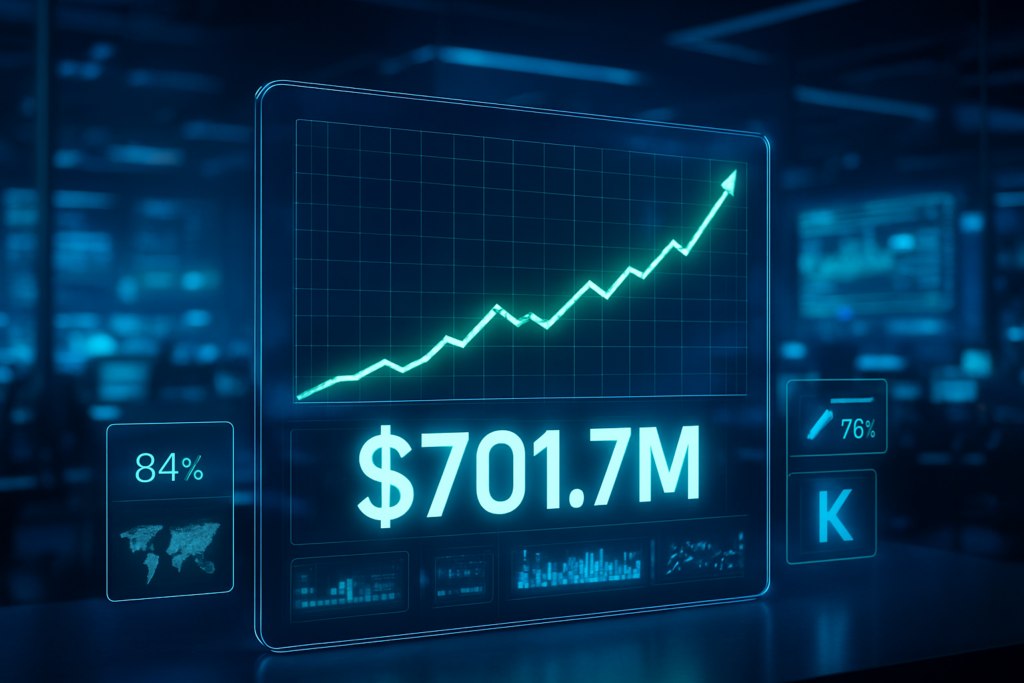
On January 12, 2026, the global financial landscape reached a watershed moment that many analysts are calling the "death of the pundit and the birth of the market." Total daily trading volume across prediction platforms skyrocketed to a record-breaking $701.7 million, shattering the previous day's record and signaling a fundamental shift in how the world processes breaking news. As traditional news cycles struggled to keep pace with a rapidly unfolding geopolitical crisis and a domestic constitutional standoff, traders turned to event-based contracts to find the "price of truth."
The surge was led by Kalshi, the U.S.-regulated powerhouse, which commanded a staggering 66.4% of the market share, processing over $465 million in trades within a single 24-hour window. This explosion in volume isn't just a flash in the pan; it represents the culmination of a year-long growth trajectory that began in 2025. With probabilities now shifting in real-time on everything from Federal Reserve policy to international conflicts, prediction markets have officially transitioned from niche speculative hobbies to the primary "truth engines" for the modern global economy.
The Market: What’s Being Predicted
The record-shattering volume on January 12 was primarily driven by a "perfect storm" of high-stakes contracts. At the center of the frenzy was the "March Fed Rate Cut" market. Following a series of contradictory economic signals, including a December jobs report that showed a mere 50,000 positions added, the market for a 25-basis-point cut in March saw massive inflows. Liquidity on Kalshi and the decentralized platform Polymarket reached levels comparable to mid-cap equity markets, with the probability of a cut swinging wildly between 60% and 74% as traders parsed live data.
Beyond macroeconomics, the market proved its mettle in the face of geopolitical chaos. The sudden reported capture of Venezuelan President Nicolás Maduro by U.S. forces sent "flash markets" into overdrive. While mainstream news outlets were still waiting for official government confirmation, prediction markets were already repricing global energy costs and regional stability. Within minutes, over $120 million was wagered on the outcome of the incident and its immediate aftermath, providing a real-time sentiment gauge that preceded traditional reporting by nearly an hour.
The infrastructure facilitating these bets has matured significantly. Robinhood (NASDAQ: HOOD) played a pivotal role as the primary retail gateway, utilizing Kalshi’s back-end to allow millions of users to trade event contracts directly alongside their stock portfolios. Meanwhile, Interactive Brokers (NASDAQ: IBKR), through its ForecastEx affiliate, catered to institutional hedgers who used these markets to offset risks associated with the burgeoning "Fed Independence" constitutional crisis. This combination of retail accessibility and institutional depth has created a liquidity flywheel that was unthinkable just two years ago.
Why Traders Are Betting
The primary driver of the current betting frenzy is the unprecedented level of regulatory and institutional clarity. In 2025, a landmark legal victory for Kalshi in the Ninth Circuit Court of Appeals paved the way for the permanent legalization of election and event betting in the United States. This "regulatory green light" encouraged major Wall Street players to enter the fray. Intercontinental Exchange (NYSE: ICE) signaled the industry's total acceptance with a landmark $2 billion investment into Polymarket, treating event-based contracts as a legitimate and essential asset class.
Traders are also being drawn by the sheer speed of information discovery. In a world of deepfakes and fragmented media, the "skin in the game" requirement of prediction markets acts as a powerful filter for noise. On January 12, as rumors of a standoff between the U.S. Department of Justice and Federal Reserve Chair Jerome Powell circulated, the markets provided a clear-eyed assessment of the situation’s gravity. While social media was rife with speculation, the "Fed Chair Ouster" contract on Kalshi remained remarkably stable, correctly signaling to traders that the crisis, while serious, was unlikely to lead to an immediate resignation.
This shift has also been bolstered by the emergence of "Superforecasters" and professional arbitrageurs. Firms like Goldman Sachs (NASDAQ: GS) have reportedly begun exploring the integration of prediction market data into their broader derivative and risk-management desks. By treating these markets as a superior alternative to traditional polling or expert intuition, traders are finding that they can hedge against "black swan" events with much higher precision than was previously possible.
Broader Context and Implications
The record-breaking volume on January 12 marks the official arrival of "Information Finance," or InfoFi—a concept popularized by Ethereum co-founder Vitalik Buterin. InfoFi posits that market mechanisms are the most efficient way to distill human judgment and aggregate unbiased information. We are no longer just betting on outcomes; we are participating in a decentralized system that assigns a financial value to the accuracy of information. This has profound implications for how public sentiment is measured and how policy is made.
Historically, prediction markets have demonstrated a remarkable ability to outperform traditional polling, particularly during the 2024 and 2025 election cycles. This accuracy has turned them into a vital tool for corporate planning. When a company can see a 70% market-priced probability of a specific regulatory change, they can adjust their strategy months in advance. The fact that major news tickers like CNBC and CNN now display live prediction market probabilities alongside the S&P 500 is a testament to this newfound cultural and financial authority.
However, the rise of InfoFi also brings new challenges. Regulatory scrutiny remains intense, especially regarding the potential for "manipulation via information"—where a trader might attempt to influence a real-world event to profit from a contract. Platforms like Kalshi have invested heavily in surveillance technology to combat this, but as volumes hit the billion-dollar-a-day mark, the stakes for maintaining market integrity have never been higher.
What to Watch Next
As we look toward the remainder of 2026, the focus will shift to the upcoming midterm elections and the resolution of the "Fed Independence" debate. These events are expected to provide the next major liquidity tests for the industry. If daily volumes continue their current trajectory, $1 billion days could become the standard by the end of the year. Investors should keep a close eye on the integration of prediction markets into broader fintech apps, as further partnerships between platforms like Robinhood and event exchanges could bring tens of millions of new participants into the ecosystem.
Another key milestone will be the potential launch of "Corporate Intelligence" markets, where companies might offer internal prediction markets to employees to forecast project deadlines or sales targets. This internal use of InfoFi could provide a secondary growth engine for the industry. Additionally, the role of Dr. Philip Tetlock, recently appointed to the board of Interactive Brokers' ForecastEx, will be crucial in bridging the gap between academic "superforecasting" and high-frequency event trading.
Bottom Line
The $701.7 million day on January 12 was not just a record; it was a proof of concept. It proved that prediction markets can handle massive volume, provide high-velocity information in times of crisis, and attract a diverse range of participants from retail traders to institutional hedgers. Kalshi’s 66.4% market share demonstrates the power of a regulated, user-friendly interface in a maturing market, while the broader InfoFi movement suggests that our relationship with information is changing forever.
Prediction markets are no longer the "fringe" of finance; they are the new tape. They provide a transparent, objective, and financially-backed look at the future, offering a clarity that traditional media often lacks. As we move deeper into 2026, the question is no longer whether prediction markets are accurate, but how quickly the rest of the financial world will adapt to the reality they present.
This article is for informational purposes only and does not constitute financial or betting advice. Prediction market participation may be subject to legal restrictions in your jurisdiction.
PredictStreet focuses on covering the latest developments in prediction markets.
Visit the PredictStreet website at https://www.predictstreet.ai/.