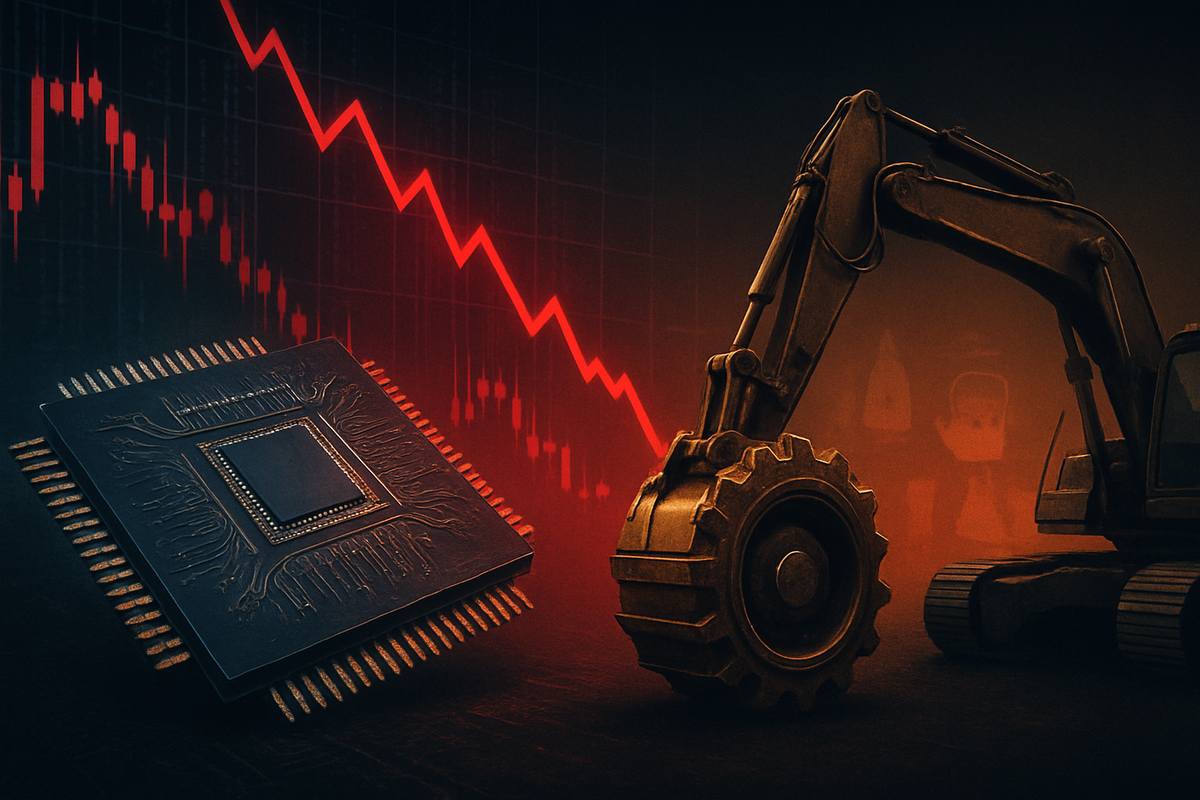
The opening bell on Monday, March 9, 2026, brought little relief to investors as two of the market’s most significant heavyweights, Intel Corporation (NASDAQ: INTC) and Caterpillar Inc. (NYSE: CAT), continued a punishing downward slide. Both stocks saw intraday plunges of 4.5% to 5.2%, punctuating a volatile week that has erased billions in market capitalization. This retreat comes as a shock to many retail investors, given both companies’ roles as cornerstones of the U.S. industrial and technological landscape and their generally high market rankings leading into the new year.
The immediate implications are clear: the “Goldilocks” environment that sustained high valuations throughout 2025 is fracturing. As capital rotates out of former tech darlings and high-multiple cyclicals, the broader market is grappling with a fundamental question of whether the artificial intelligence boom has hit a hardware ceiling and if the "real economy" can withstand rising capital costs. For Intel and Caterpillar, once seen as safe-haven bets for growth and infrastructure, the sell-off represents a bruising re-evaluation of their 2026 prospects.
The Perfect Storm: Manufacturing Snubs and Macro Pressure
The collapse in share prices did not happen in a vacuum. For Intel (NASDAQ: INTC), the catalyst was a devastating series of setbacks regarding its foundry ambitions. In early March, reports began circulating that Nvidia (NASDAQ: NVDA) had officially paused testing of Intel’s 18A manufacturing process, a node that CEO Pat Gelsinger had previously touted as the company's "comeback" ticket. This news, combined with the February launch of the DeepSeek V4 AI model—which demonstrated that high-level AI performance could be achieved with far less hardware than previously thought—triggered a "valuation crisis." Investors, fearing a burst in the semiconductor CapEx bubble, fled the stock, driving it down over 5% this morning.
Caterpillar (NYSE: CAT) faced its own set of unique pressures. The industrial giant was rocked by the disclosure that CEO Joseph Creed had sold roughly $2.3 million in stock just days prior to the March 9th slide. While such sales are often scheduled, the timing couldn't have been worse, coming alongside a fresh analyst report projecting a $2.6 billion surge in tariff-related costs for 2026. With Treasury yields touching 4.11%, the cost of financing for Caterpillar’s heavy-machinery customers has spiked, leading to a sudden cooling in the North American construction equipment market.
The timeline of this sell-off suggests a coordinated retreat. While February saw a gradual cooling, the first full week of March transformed into what traders are calling the "Great Rebalancing." The sell-off was exacerbated by a "risk-off" mood triggered by geopolitical tensions in the Middle East, which pushed crude oil prices above $85 per barrel. For companies like Caterpillar, which are highly sensitive to fuel costs and global trade stability, the rising geopolitical heat was the final straw.
From Growth to Safety: Winners and Losers of the Pivot
In the wake of this volatility, the market’s winners and losers are being clearly delineated. On the losing side, the semiconductor equipment and heavy industrial sectors are bearing the brunt. Intel’s struggles have dragged down secondary suppliers and equipment makers who were betting on a massive U.S. manufacturing expansion. Caterpillar’s dip has similarly pulled down peers in the machinery space, as investors fear a broader peak in the global infrastructure cycle.
Conversely, the "Consumer Staples" sector has emerged as the unexpected champion of early 2026. As the Nasdaq Composite fell nearly 7% over the last month, defensive stocks like Walmart (NYSE: WMT) have surged to all-time highs above $120. Investors are treating these companies as the "new offense," prioritizing steady earnings and dividend reliability over the high-beta promises of AI and global expansion.
Other notable winners include PepsiCo (NASDAQ: PEP) and Hershey (NYSE: HSY), which have seen inflows as the Consumer Staples Select Sector (XLP) outperformed the broader S&P 500 by over 13 percentage points year-to-date. This flight to quality highlights a massive shift from "bits to atoms"—but specifically, to the atoms people consume daily, rather than the ones used to build bridges or data centers.
A Dot-Com Echo? Analyzing the Structural Shift
The current market behavior is drawing uncomfortable comparisons to the 2000 dot-com crash. Historical precedents show that when large-cap staples rally while technology leaders plummet by over 1% on consecutive days, it often signals a fundamental re-rating of the market’s valuation structure. The "DeepSeek Shock" of early 2026 has forced a realization that software efficiency might outpace hardware demand, threatening the high-growth narrative that propelled Intel and its peers for years.
Furthermore, the broader industry trend is shifting toward "resilience over growth." The supply chain anxieties of the early 2020s have been replaced by margin anxieties. With projected tariff costs rising and energy prices fluctuating due to strikes on Iranian military facilities, the "just-in-time" industrial model that Caterpillar championed is under scrutiny. Regulatory eyes are also turning toward the AI sector, where the efficiency of new models like DeepSeek may lead to decreased subsidies for domestic chip manufacturing if the hardware "arms race" begins to decelerate.
The ripple effects are extending to global partners. European industrial firms and Asian component manufacturers are closely watching the U.S. rotation. If the American consumer shifts focus exclusively toward staples and away from tech-heavy investments, the global manufacturing index could face a significant contraction by the second half of 2026.
The Road Ahead: Strategic Pivots and Market Watch
Looking forward, Intel (NASDAQ: INTC) faces a critical juncture. The company must prove that the 18A node pause is a temporary hurdle rather than a systemic failure. Short-term, the company is likely to engage in aggressive cost-cutting and a potential restructuring of its foundry business to regain investor trust. However, if they cannot secure a major partner like Nvidia or Apple (NASDAQ: AAPL) for their advanced nodes by Q3, the stock may find a new, much lower floor.
For Caterpillar (NYSE: CAT), the path forward depends on the resilience of the U.S. housing and infrastructure market. A strategic pivot toward mining and energy-transition equipment—sectors less sensitive to residential interest rates—may be required to offset the cooling construction market. Investors will be watching the next round of manufacturing data and the Federal Reserve’s commentary on Treasury yields; any sign of a rate pause could provide the relief needed for CAT to stabilize.
Market participants should prepare for a period of heightened "sector churn." The opportunity now lies in identifying which companies can maintain margins in a 4%+ yield environment. While the sell-off in large-cap staples like Intel and Caterpillar is painful, it may create a more balanced market long-term, moving away from the AI-concentrated frenzy of the past three years.
Closing Thoughts for the 2026 Investor
The events of early March 2026 serve as a stark reminder that even the most "solid" market rankings cannot protect a company from a fundamental shift in investor sentiment. The 4-5% plunge in Intel and Caterpillar is more than just a bad day of trading; it is a signal that the market is re-evaluating the value of industrial growth and the true longevity of the AI investment cycle.
Moving forward, the focus will remain on "tangible moats." Investors should watch for the Q2 earnings season to see if Intel can clear its inventory buffers and if Caterpillar’s management can provide a more reassuring outlook on tariff impacts. The market is moving toward a defensive posture, and for now, the "safe" bet of 2025 has become the "risk" of 2026. Staying vigilant regarding interest rate fluctuations and global trade policy will be essential for those looking to navigate this transition.
This content is intended for informational purposes only and is not financial advice.