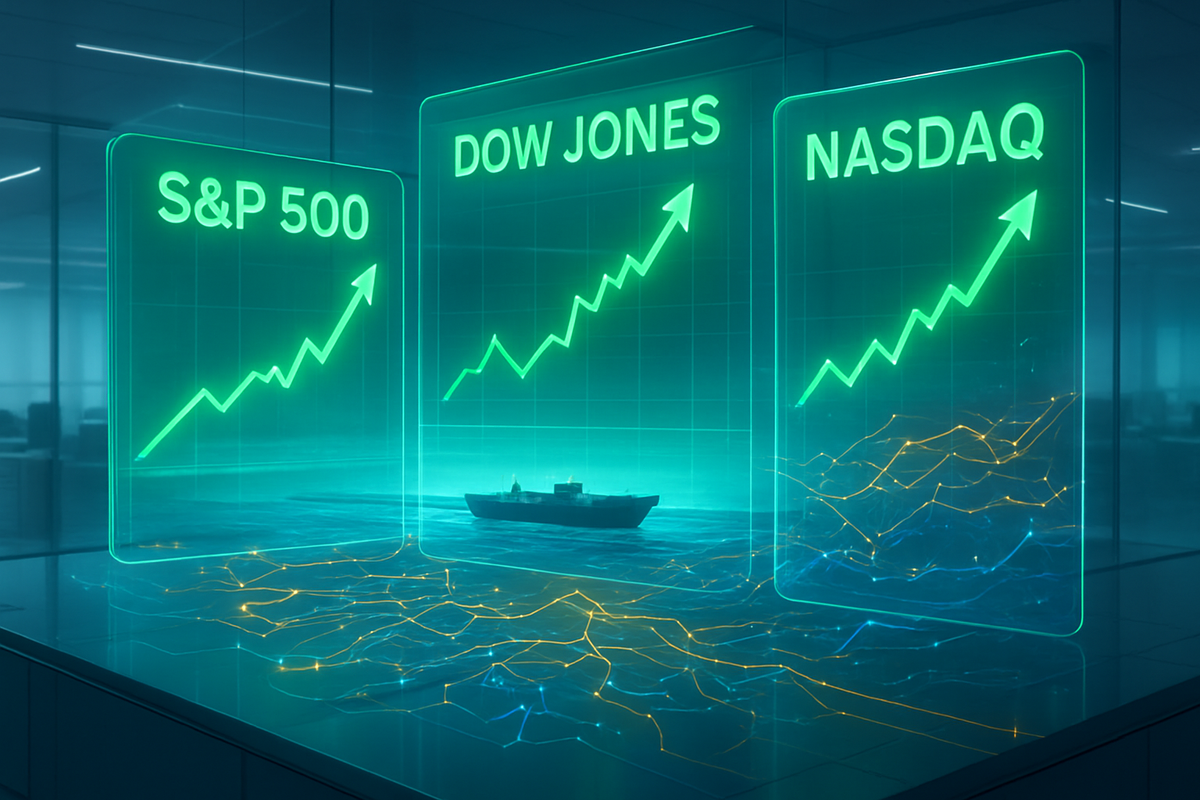
The U.S. stock market experienced a powerful broad-based rebound on Monday, March 16, 2026, as investors seized on signs of cooling geopolitical friction and a significant retreat in global energy prices. The S&P 500 surged by 1.2%, marking its strongest single-session performance in over a month, while the Dow Jones Industrial Average (INDEXDJX: .DJI) climbed more than 480 points to reclaim territory above the 47,000 level. The tech-heavy Nasdaq Composite (INDEXNASDAQ: .IXIC) led the major indices with a 1.4% gain, driven by renewed optimism in the artificial intelligence sector and a collective sigh of relief across trading floors.
This "relief rally" comes after three weeks of persistent volatility, during which markets were rattled by supply chain fears and a spike in crude oil. The sudden shift in sentiment on Monday suggests that the market’s underlying appetite for risk remains robust, provided that the inflationary pressures from the energy sector stay contained. As the Federal Reserve prepares for its mid-March policy meeting later this week, the day's price action indicates that investors are increasingly confident in a "soft landing" scenario for the U.S. economy in 2026.
Cooling Tensions and Falling Crude Trigger Market Reversal
The primary catalyst for Monday's surge was a decisive pullback in energy markets. Just a week prior, West Texas Intermediate (WTI) crude had spiked above $100 per barrel following an Iranian blockade of the Strait of Hormuz. However, news broke early Monday that a U.S.-led maritime coalition would begin escorting tankers through the vital waterway, significantly reducing the "fear premium" embedded in energy prices. WTI crude fell nearly 4% to approximately $94.75, while Brent crude retreated toward $101. These developments were bolstered by a statement from U.S. Energy Secretary Chris Wright, who expressed optimism that the current Middle Eastern conflict could reach a resolution within the coming weeks.
Further supporting the rally was a highly influential research note from Goldman Sachs (NYSE: GS). The firm’s analysts argued that the recent energy supply shock appeared to be "narrowly contained," suggesting it was unlikely to trigger the kind of broad-based, runaway inflation that would force the Federal Reserve to abandon its current path. This assessment was timely, coming just 48 hours before the Fed’s March 18 interest rate decision. Current market pricing suggests a near-certainty that the central bank will hold rates steady between 3.5% and 3.75%, preserving the hope for rate cuts later this summer.
The timeline leading up to this moment has been defined by a "wait-and-see" approach from institutional players. Following the February Consumer Price Index (CPI) report, which showed year-over-year inflation at a manageable 2.4%, the market had been searching for a reason to move higher. The combination of de-escalating military tensions and the International Energy Agency’s (IEA) coordinated release of 400 million barrels of strategic reserves provided exactly the spark that bulls needed to retake control of the narrative.
AI Giants and Chipmakers Lead the Charge While Defensives Lag
Technology and semiconductor stocks were the day’s undisputed winners, with investors rotating aggressively back into growth-oriented names. Nvidia (NASDAQ: NVDA) saw its shares climb 2.6% as the company kicked off its highly anticipated GTC 2026 developer conference in San Jose. Sentiment was further bolstered by the U.S. Commerce Department’s decision to withdraw a planned restriction on AI chip exports, removing a major regulatory cloud that had been hovering over the sector. Similarly, Micron Technology (NASDAQ: MU) surged 5.7% after announcing plans for a second massive manufacturing facility in Taiwan, signaling that the global demand for AI-adjacent hardware shows no signs of flagging.
Meta Platforms (NASDAQ: META) was another standout, rising 3% following reports of a radical internal restructuring aimed at diverting $27 billion toward a new AI infrastructure partnership with Nebius. Even Tesla (NASDAQ: TSLA) managed a 1% gain after CEO Elon Musk teased the "Terafab" project, a specialized AI chip facility designed to accelerate autonomous driving capabilities. In the digital asset space, the return of risk appetite sent Bitcoin back above $73,000, lifting shares of MicroStrategy (NASDAQ: MSTR) and Coinbase (NASDAQ: COIN) by 4.2% and 3.3%, respectively.
Conversely, the day was less kind to defensive sectors and energy-heavy firms. As oil prices plummeted, Occidental Petroleum (NYSE: OXY) and ConocoPhillips (NYSE: COP) saw their early-year momentum stall, finishing the day as relative laggards. The Materials sector also faced headwinds; Newmont (NYSE: NEM) fell 1.2% as gold prices retreated in favor of higher-yielding risk assets. The most dramatic individual loss came from the retail sector, where Ulta Beauty (NASDAQ: ULTA) plummeted 14.2% after a significant earnings miss and a downgrade in its 2026 fiscal guidance, highlighting that consumer discretionary spending remains sensitive to the broader economic climate.
The 2026 Economic Landscape: AI Maturity and Inflation Stability
The significance of this rally extends beyond a single day’s gains; it reflects the maturing "AI Economy" of 2026. Unlike the speculative fever of 2023 and 2024, the current market strength is increasingly driven by tangible infrastructure builds and verified corporate restructuring. The fact that the market could absorb a major geopolitical shock in the Middle East and rebound within weeks suggests a level of institutional resilience that was absent in previous cycles.
This event also highlights a shifting relationship between energy prices and the Federal Reserve. Historically, a spike toward $100 oil would have sent markets into a tailspin on fears of a 1970s-style stagflation. However, the 2026 economy is significantly more energy-efficient, and the rapid expansion of domestic renewable and nuclear projects has provided a buffer. The Goldman Sachs (NYSE: GS) report confirming that the "inflationary spillover" was limited is a testament to how much the U.S. economic engine has evolved over the last three years.
Furthermore, this rally fits into the broader trend of "sector rotation" that has defined the early half of 2026. Investors are no longer buying the entire market indiscriminately; instead, they are penalizing companies like Adobe (NASDAQ: ADBE), which fell 7.5% today amid succession concerns, while rewarding those with clear AI execution paths. This discernment indicates a "stock-picker's market" where fundamental performance is beginning to outweigh macro-driven hysteria.
What to Watch: The Fed, Energy Volatility, and Earnings Season
Looking ahead, the immediate focus remains on the Federal Reserve’s announcement on Wednesday, March 18. While a "hold" is widely expected, the "dot plot" and Chair Jerome Powell’s commentary will be scrutinized for any hawkish shifts in response to the recent energy volatility. If the Fed acknowledges the stabilizing inflation data, the current rally could find the legs to push the S&P 500 toward new all-time highs by early April.
Strategically, companies in the S&P 500 may need to pivot their messaging toward cost-efficiency and AI integration to maintain investor favor. The massive "SaaS-pocalypse" that hit companies like Workday (NASDAQ: WDAY) earlier this year serves as a cautionary tale: growth at any cost is no longer the standard. Investors are now demanding high-beta growth paired with sustainable margins. Short-term challenges could emerge if the maritime coalition in the Middle East faces setbacks, as any return to $105+ oil would likely scuttle the current recovery.
In the long term, the "Terafab" and Taiwan expansion projects announced by Tesla (NASDAQ: TSLA) and Micron Technology (NASDAQ: MU) suggest that the capital expenditure cycle for the next generation of computing is only just beginning. Market participants should watch for potential supply chain bottlenecks in these massive construction projects, as they could serve as the next major "pinch point" for the global economy.
Market Outlook: A Fragile but Formidable Recovery
Monday’s performance offers a compelling snapshot of a market that is learning to navigate a complex, multipolar world. The 1.2% gain in the S&P 500 and the 480-point rise in the Dow are clear signals that the "relief" felt by investors is genuine, predicated on the idea that the worst of the 2026 energy shock may be behind us. The decoupling of the tech sector from broader macro fears on the back of the GTC 2026 conference highlights the enduring power of the technological revolution to drive equity values.
Moving forward, the market remains in a "fragile but formidable" state. While the bulls are currently in the driver's seat, the dependency on a stable geopolitical environment and a cooperative Federal Reserve cannot be overstated. Investors should maintain a balanced posture, keeping a close eye on the 10-year Treasury yield and the weekly inventory reports for crude oil, which will likely dictate the market's direction through the end of the quarter.
The key takeaway for the coming months is that the "soft landing" remains the base case, but it is a landing that requires constant navigation. As AI matures from a buzzword into a structural component of the S&P 500's earnings power, the companies that can successfully bridge the gap between high-tech innovation and disciplined fiscal management will continue to lead the way in this new economic era.
This content is intended for informational purposes only and is not financial advice.