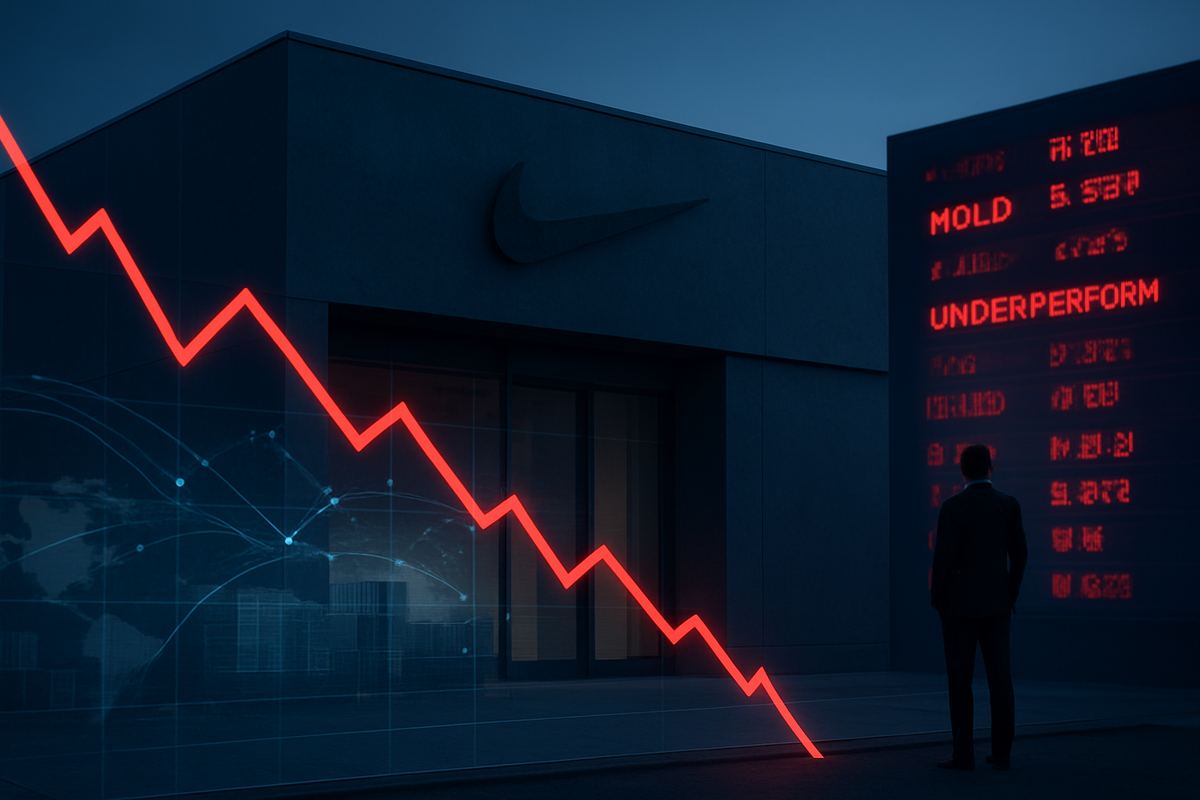
The athletic apparel giant Nike (NYSE: NKE) is finding itself in an unfamiliar position as 2026 begins: defensive. After a year of underperforming the broader market, a fresh wave of analyst downgrades in February 2026 has sent the stock reeling into the mid-$60 range. The downgrades, led by major financial institutions, reflect a growing consensus that the "Swoosh" is struggling to navigate a perfect storm of geopolitical trade headwinds, a fundamental shift in how consumers spend their discretionary income, and a strategic pivot that has yet to yield the promised "win."
The immediate implications for the market are stark. Nike’s struggle is being viewed as a bellwether for the entire global retail sector. As of February 27, 2026, the company’s inability to maintain its premium margins while facing double-digit revenue declines in key growth markets like China has raised alarms. Investors are no longer giving the brand the benefit of the doubt, instead demanding proof that its new "Win Now" strategy can actually restore profitability in an era defined by high tariffs and fragmented consumer loyalty.
The Margin Squeeze: A Timeline of Disappointment
The current wave of pessimism reached a fever pitch following Nike’s Q2 Fiscal 2026 earnings report in late December 2025. While the company technically beat lowered earnings-per-share estimates, the "quality" of those earnings was deeply concerning. Net income plummeted by 32% year-over-year, dropping to $792 million, as gross margins were eroded by a massive 300-basis-point contraction. This decline was driven by the necessity of heavy discounting to clear excess inventory and the sudden imposition of new 15% global import tariffs, which analysts estimate added a staggering $1.5 billion in annualized costs to Nike’s supply chain.
In the weeks leading up to today, February 27, 2026, the analyst community has moved from cautious to bearish. Needham & Company (NASDAQ: NDAQ) kicked off the trend in early January by downgrading the stock to "Hold," citing a "muddled" turnaround and sluggish sell-through in North American wholesale channels. This was followed by a more aggressive "Underperform" rating from BNP Paribas (OTC:BNPQY), which highlighted a profit warning from major Chinese retail partner Pou Sheng as a sign that Nike’s regional troubles were systemic rather than seasonal. By late February, the sentiment was clear: Nike’s historical dominance is being tested by forces largely outside its control.
The key players in this drama include CEO Elliott Hill, who took the helm with the promise of returning Nike to its wholesale roots and revitalizing product innovation. However, the transition back to wholesale partnerships after years of focusing on Direct-to-Consumer (DTC) has proven more expensive and operationally complex than anticipated. Market reactions have been swift; Nike shares have lost significant ground against the S&P 500 over the last twelve months, leaving institutional investors questioning whether the brand's premium valuation is still justified in a low-growth environment.
Winners and Losers in the Global Retail Realignment
As Nike retreats to stabilize its core business, a new set of winners is emerging. In the domestic market, wholesale partners like Foot Locker (NYSE: FL) and Dick’s Sporting Goods (NYSE: DKS) stand to benefit from Nike’s strategic "u-turn." After years of being starved of top-tier inventory during Nike’s DTC-first era, these retailers are seeing a 8% uptick in wholesale allocations. If Hill’s strategy succeeds in driving traffic back to these multi-brand stores, Foot Locker and Dick's could see a significant revitalization of their footwear segments.
Conversely, the clear "losers" in this shift are Nike’s digital and owned-store divisions. Nike Direct revenue fell 14% in the most recent quarter, a sign that the company’s digital-first dream has hit a ceiling as consumers pull back on premium app-based spending. Internationally, the narrative is even more lopsided. In the Greater China region, Nike saw a 17% revenue collapse. The primary beneficiaries have been domestic Chinese giants like Anta Sports (HKG:2020) and Li-Ning (HKG:2331), which have capitalized on rising nationalistic sentiment and a faster, more localized supply chain to snatch market share away from the Western incumbent.
The broader supply chain ecosystem is also feeling the heat. Logistics providers and manufacturers who relied on Nike's high-volume, China-centric production model are scrambling to adapt as Nike aggressively diversifies its manufacturing base to avoid the 15% tariff wall. This "de-risking" comes at a high price; the shift to alternative manufacturing hubs in Southeast Asia and South America has led to increased "landed costs" and temporary execution gaps, making Nike a short-term loser in operational efficiency even as it seeks long-term geopolitical stability.
A Wider Significance: Trade Wars and the Death of DTC Hegemony
Nike’s current predicament serves as a case study for two of the most significant trends in the mid-2020s: the end of "unfettered" globalism and the re-balancing of the retail model. The 15% global import tariff is not just a Nike problem; it is a structural shift that is forcing every multinational corporation to rethink its dependence on low-cost Chinese manufacturing. Nike's struggle to absorb $1.5 billion in new costs without passing them on to an already stretched consumer highlights the "inflationary floor" that now exists in the global apparel market.
Furthermore, Nike’s retreat from its DTC-heavy strategy signals the end of the "Direct-to-Consumer at all costs" era. For years, the market rewarded companies for cutting out the middleman, but the high cost of digital customer acquisition and the logistical burden of individual shipping have proven unsustainable for a brand of Nike’s scale. The industry is watching Nike’s "Win Now" pivot toward wholesale as a blueprint for other legacy brands—such as Adidas (OTC:ADDYY) and Under Armour (NYSE: UA)—who are also trying to find the right balance between brand control and mass-market reach.
Historically, Nike has been able to innovate its way out of slumps. However, the current environment mirrors the late 1990s, when the brand faced similar criticisms regarding product staleness and a changing global trade landscape. The difference today is the speed of the competition and the fragmented nature of consumer attention. The "ripple effect" of Nike’s downgrade is already being felt in the valuations of other luxury and premium discretionary brands, as analysts recalibrate expectations for a "higher-for-longer" cost environment and a more cautious consumer base.
The Road Ahead: Can the Swoosh Rebound?
The short-term outlook for Nike remains cloudy. Management has already guided for a low-single-digit revenue decline in the upcoming Q3 FY2026 results, with gross margins expected to remain under pressure near the 39.5% mark. For the remainder of 2026, the company’s primary mission will be "inventory hygiene"—clearing out the last of its "Classics" footwear lines through heavy promotions to make room for a new wave of innovation promised for the 2026 holiday season.
In the long term, Nike’s survival as a market leader depends on two strategic pivots. First, it must successfully "de-China" its supply chain without permanently elevating its cost structure. Second, it must re-establish its "cool factor" with younger consumers who have increasingly turned to niche brands like Hoka or On Holding (NYSE: ONON) for performance and Anta for lifestyle. The "Win Now" strategy is a defensive play to stabilize the balance sheet, but a true recovery will require an offensive play in the form of a "must-have" product that transcends current trade and economic headwinds.
Market opportunities may emerge if Nike can leverage its massive data troves to make its wholesale partnerships more efficient than they were in the past. By providing partners like Dick's Sporting Goods with hyper-localized inventory insights, Nike could potentially create a "hybrid" model that combines the scale of wholesale with the precision of DTC. However, until the "landed costs" of its new global manufacturing footprint are stabilized, the stock is likely to remain a "show-me" story for the foreseeable future.
Conclusion: Watching the Finish Line
The downgrading of Nike in February 2026 marks a pivotal moment for the world’s largest sportswear brand. The core takeaways are clear: the combination of geopolitical trade barriers (specifically the 15% tariff) and a localized collapse in the Chinese market has broken the old Nike growth algorithm. While North American sales remain a relative bright spot, they are not enough to offset the margin compression and international headwinds currently battering the company’s bottom line.
Moving forward, the market will be looking for stability over growth. Investors should watch for three key indicators over the coming months: the stabilization of gross margins above 40%, any signs of a turnaround in Greater China footwear demand, and the successful launch of new performance silhouettes that can command full-price sales. If Nike can navigate these challenges, the current mid-$60 price point may eventually look like a generational buying opportunity; if not, the "Swoosh" may be facing a long, slow walk toward brand dilution.
For now, the consensus remains one of caution. Nike is a titan in transition, and as any marathoner knows, the middle miles are often the most grueling. The company has the resources and the brand equity to cross the finish line, but the path to 2027 looks uphill and fraught with obstacles.
This content is intended for informational purposes only and is not financial advice.