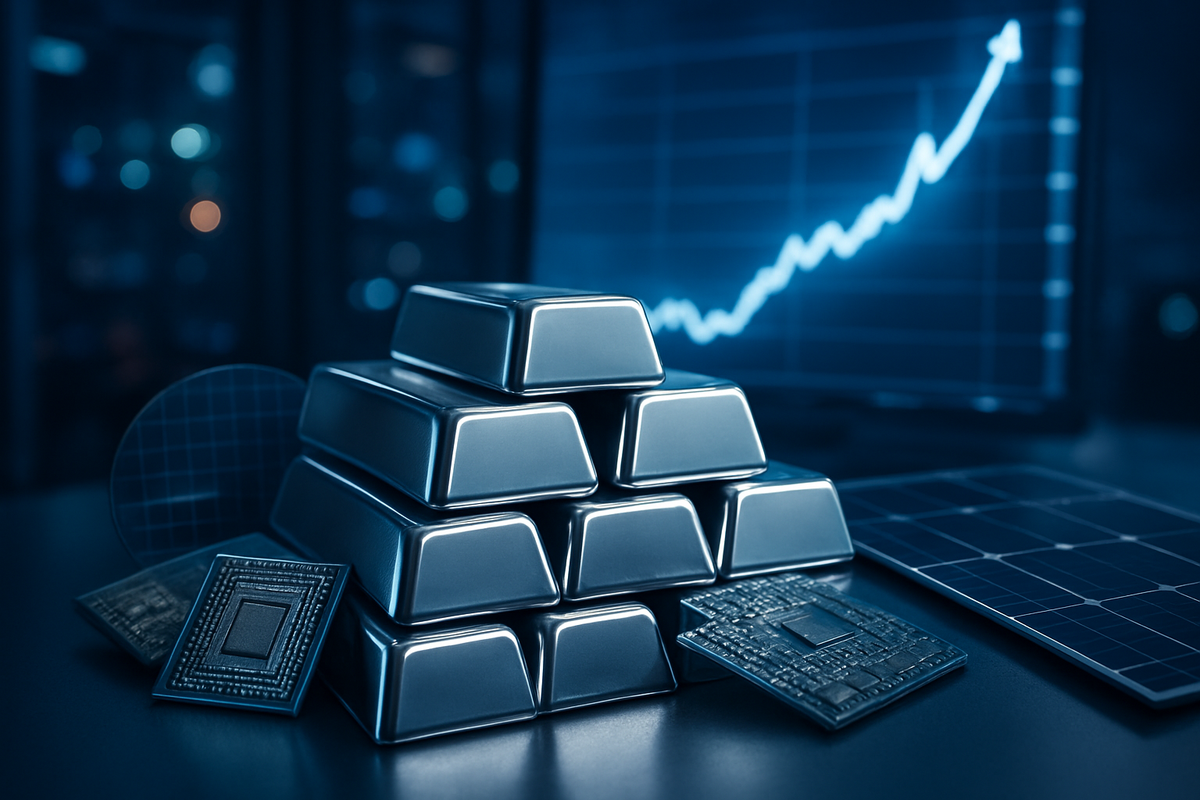
The global financial landscape reached a fever pitch this week as silver prices surged past the historic $95 per ounce threshold, eventually breaching $105 in a parabolic move that has left even the most bullish analysts stunned. Driven by a perfect storm of chronic supply deficits, aggressive industrial demand from the green energy sector, and a sudden restriction on global exports, the "white metal" has officially transitioned from a perennial underperformer into the world’s most sought-after industrial commodity. This rally has effectively doubled silver’s value in less than a year, sparking a speculative frenzy that has drawn comparisons to the most legendary bull runs in market history.
The immediate implications are profound, affecting everything from the cost of high-efficiency solar panels to the manufacturing margins of the world’s largest technology firms. With silver now trading at levels once deemed impossible, the market is grappling with a severe physical liquidity crisis. Institutional investors are flooding into the iShares Silver Trust (NYSE Arca: SLV) at a record pace, while industrial end-users are reportedly bypassed traditional exchanges to secure physical bullion directly from miners, fearing that the available supply may simply vanish.
The Perfect Storm: Five Years of Deficits and a 95 Million Ounce Gap
The current price explosion is the culmination of a structural imbalance that has been building since 2021. For the fifth consecutive year, the global silver market has operated in a deep deficit, with 2025 concluding with a staggering 95 million ounce supply-demand gap. This cumulative shortfall, which has now exceeded 820 million ounces over the last half-decade, has systematically drained the vaults of the London Bullion Market Association (LBMA) and the COMEX. The timeline of this crisis accelerated sharply on January 1, 2026, when China—the world’s second-largest producer and a dominant refining hub—implemented strict new export licensing requirements for silver, citing "national strategic necessity" for its burgeoning semiconductor and green energy industries.
This policy shift acted as the catalyst for the current "speculative frenzy." Market strategists note that unlike the Hunt Brothers' attempt to corner the market in 1980, the current rally is driven by inelastic industrial demand. The transition to TOPCon (Tunnel Oxide Passivated Contact) solar cells, which require significantly higher silver loads than previous technologies, has pushed solar demand toward 300 million ounces annually. When combined with the rapid adoption of Silver Solid-State Batteries in high-end electric vehicles and the massive silver requirements for AI data center infrastructure, the physical market simply reached a breaking point.
Winners and Losers in the New Silver Era
The primary beneficiaries of this rally are the primary silver miners and diversified precious metals producers. Companies like Pan American Silver Corp. (NYSE: PAAS) and First Majestic Silver Corp. (NYSE: AG) have seen their market capitalizations triple as the soaring spot price translates directly to massive free cash flow. Furthermore, the iShares Silver Trust (NYSE Arca: SLV) has become a primary beneficiary of "safe-haven" flows, as investors treat the metal not just as an industrial necessity but as a hedge against the currency volatility and geopolitical tensions that have marked the early weeks of 2026.
Conversely, the "losers" in this scenario include major industrial players who have failed to secure long-term supply contracts. Large-scale solar manufacturers and automotive giants are facing a margin squeeze of unprecedented proportions. While tech titans like Nvidia Corporation (NASDAQ: NVDA) have the capital to absorb higher costs, the sheer volume of silver required for AI-ready data centers is beginning to impact bottom-line projections. Strategists are closely watching whether these companies will be forced to pass these costs onto consumers or search for inferior substitutes, which could delay the rollout of next-generation infrastructure.
A Fundamental Shift: From Monetary Hedge to Tech Powerhouse
The wider significance of silver's $95+ price point lies in its total decoupling from traditional gold-ratio correlations. Silver is no longer merely "gold’s restless cousin"; it has been repriced as a scarce infrastructure asset. This shift mirrors the trajectory of high-growth tech stocks. In 2025, while Nvidia (NASDAQ: NVDA) delivered impressive gains, silver outperformed the AI giant by nearly fourfold, reaching a total market capitalization that briefly rivaled the world’s largest technology firms. This "Nvidia-fication" of silver suggests that the market now views the metal as an essential component of the global digital and green transition.
Historically, such parabolic moves in commodities often lead to government intervention or "demand destruction," where the high price forces users to stop using the material. However, in the 2026 landscape, the lack of viable substitutes for silver in high-efficiency electronics and solar cells makes demand destruction unlikely in the short term. This has created a "supply-side trap" that mirrors the copper shortages of previous decades but with the added volatility of silver’s dual identity as a financial asset.
The Road to $150 or a Sharp Correction?
Looking ahead, the market faces two distinct paths. In the short term, the speculative frenzy could push prices toward $150/oz as short-sellers are liquidated and sovereign wealth funds continue to build strategic stockpiles. Strategic pivots are already underway, with major electronics manufacturers reportedly funding "urban mining" initiatives to recover silver from discarded e-waste more efficiently. If China maintains its export restrictions throughout 2026, the global "scarcity premium" will likely remain elevated, forcing a permanent shift in how industrial companies manage their raw material inventories.
However, a long-term risk remains in the form of technological adaptation. At $100/oz, the incentive for labs to develop silver-free solar cells or conductive pastes is at an all-time high. While such innovations typically take years to reach commercial scale, the current price environment will undoubtedly accelerate these research and development timelines. Investors should prepare for extreme volatility; while the fundamentals remain historically tight, the parabolic nature of the recent move suggests that any cooling of geopolitical tensions or a surprise increase in recycling scrap could lead to sharp, temporary pullbacks.
Navigating the Silver Supercycle
In summary, the rally to $95/oz and beyond is not merely a "meme-driven" event but the logical conclusion of a multi-year structural deficit meeting an unprecedented industrial revolution. The key takeaways for the market are the exhaustion of global vault stocks and the emergence of "resource nationalism" as a primary driver of commodity pricing. Moving forward, the silver market will likely be characterized by higher baseline volatility and a closer correlation with tech-sector capital expenditures than with traditional inflation metrics.
For investors and industry watchers, the coming months will be defined by two critical factors: the persistence of China's export licenses and the quarterly earnings reports of major tech and green energy firms. If these companies can maintain margins despite $100 silver, the rally may have much further to run. However, any sign of a slowdown in solar deployments or AI infrastructure buildouts could signal the peak of this historic cycle. For now, silver remains the undisputed king of the 2026 market, proving that in a high-tech world, the most valuable assets are often the ones found in the earth.
This content is intended for informational purposes only and is not financial advice