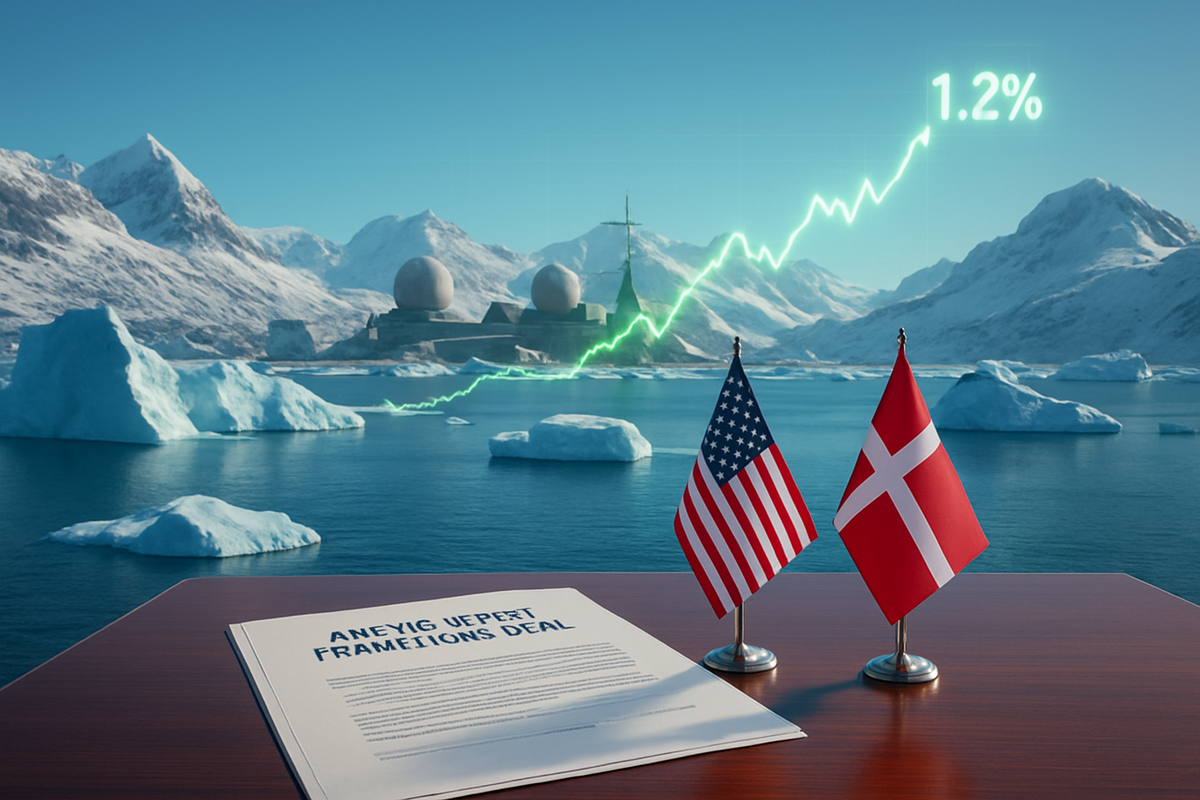
Major U.S. equity markets surged on Wednesday after President Donald Trump announced a pivotal shift in his administration's Arctic strategy, backing away from a proposed "Greenland Tax" that had threatened to ignite a trade war with European allies. The Dow Jones Industrial Average, S&P 500, and Nasdaq Composite all closed higher by approximately 1.2%, recovering from a sharp sell-off earlier in the week. The rally followed an announcement from the World Economic Forum in Davos, where the President unveiled a "Framework Deal" that replaces immediate tariff threats with a long-term strategic partnership focused on mineral access and missile defense.
The breakthrough comes as a massive relief to global trade sentiment, which had been reeling since the President’s January 17th ultimatum: a 10% blanket tariff on key European nations—including Denmark, Germany, and the UK—unless a deal for the "transfer of sovereignty" of Greenland was reached. While the framework stops short of a territorial sale, it secures what the White House calls "total strategic access" to the Arctic's vast resources and a critical expansion of the U.S. missile defense shield.
From Ultimatums to Davos: The "Arctic Sentry" Breakthrough
The market’s volatility over the past 72 hours reflects the high-stakes nature of what many analysts are calling the "Greenland Gambit." On January 17, 2026, the administration shocked global markets by announcing a tiered tariff structure, starting at 10% in February and escalating to 25% by June, specifically targeting the trade partners of the Kingdom of Denmark. The goal was ostensibly to force a sale of the resource-rich island, citing national security and the need to counter Russian and Chinese influence in the Arctic Circle.
However, the narrative shifted dramatically during a high-profile meeting between President Trump and NATO Secretary-General Mark Rutte in Davos. Following the sit-down, the President announced he would "indefinitely pause" the tariffs in exchange for the "Framework of a Future Deal." This agreement, titled the "Arctic Sentry" pact, involves a significant update to the 1951 bilateral defense treaty. Key components include the installation of elements of the $175 billion "Golden Dome" missile defense system on Greenlandic soil and the establishment of a new NATO-led security corridor to monitor undersea infrastructure.
The immediate market reaction was a "relief rally" of significant proportions. The Dow jumped 589 points, erasing nearly all of the losses incurred when the tariff threat was first issued. Initial market reactions suggest that investors are betting on the stability of this compromise, viewing the pivot from territorial acquisition to resource partnership as a more sustainable path for American interests without the collateral damage of a transatlantic trade war.
Resource Giants and Defense Contractors Lead the Gains
The framework deal has created a clear set of winners in the equity markets, particularly among companies poised to benefit from Arctic infrastructure and mineral extraction. Critical Metals Corp (Nasdaq:CRML), which owns the Tanbreez rare earth project in South Greenland, saw its shares spike as the framework guarantees "preferential access" for U.S.-aligned firms to the island's massive deposits of critical minerals. Similarly, MP Materials Corp. (NYSE: MP) benefited from the administration's renewed focus on bypassing Chinese dominance in the rare earth supply chain.
In the defense sector, Lockheed Martin (NYSE: LMT) and RTX Corporation (NYSE: RTX) are being viewed as primary beneficiaries of the "Golden Dome" expansion. The framework calls for an unprecedented level of military construction in the Arctic, ranging from advanced radar installations to deep-water port facilities. Investors are also keeping a close eye on major mining outfits like Agnico Eagle Mines (NYSE: AEM) and Barrick Gold Corporation (NYSE: GOLD), as the deal reportedly includes provisions for "shared prosperity zones" that could lower the regulatory hurdles for large-scale mining operations in the Greenlandic interior.
On the losing side, companies heavily reliant on the "safe-haven" trade—such as gold miners—saw some of their recent gains pruned as the immediate threat of a trade war receded. However, the broader mining sector remains buoyed by the prospect of long-term access to the Arctic’s untapped wealth. Retailers and manufacturers who were bracing for a 10% hike in European import costs also saw a significant bounce, as the immediate inflationary pressure of the "Greenland Tax" was removed from their 2026 outlooks.
The Broader Significance: A New Era of "Resource Geopolitics"
The pivot on Greenland represents a significant evolution in 21st-century trade policy. By leveraging tariffs not just for domestic protectionism but as a tool for securing strategic geographic assets and mineral rights, the administration has introduced a new brand of "resource geopolitics." This event fits into a broader trend of "friend-shoring" and "de-risking" from adversarial supply chains, particularly regarding the rare earth elements essential for high-tech defense and green energy sectors.
The "Arctic Sentry" framework also signals a fragile but necessary recalibration of the U.S.-EU relationship. While European leaders like French President Emmanuel Macron had initially threatened to activate the EU’s "Anti-Coercion Instrument," the Davos compromise suggests a path toward cooperation. Historically, this event draws comparisons to the 1940s-era "Destroyers for Bases" deal, where the U.S. provided military aid in exchange for land rights—a precedent the administration appears to be modernizing for the age of critical mineral scarcity.
However, the ripple effects are likely to be felt in the Arctic Council, where Russia and China have long sought to expand their footprint. By formalizing a U.S.-NATO "mineral and defense corridor" through Greenland, the framework essentially creates a Western bulkhead in the north. The policy implication is clear: the Arctic is no longer a peripheral environmental concern but a primary theater of economic and military competition.
What Comes Next: Implementation and Environmental Hurdles
In the short term, the market will look for a formal signing ceremony to solidify the framework into a binding treaty. Investors should anticipate some volatility as the Danish and Greenlandic parliaments review the details of the "preferential access" clauses. While the threat of immediate tariffs has been lifted, the administration has made it clear that the "Golden Dome" and mineral concessions are non-negotiable requirements for keeping the tariffs at bay permanently.
A significant strategic pivot will be required from the companies looking to enter the Greenlandic market. The environmental challenges of mining in the Arctic are immense, and the "Arctic Sentry" pact will likely face fierce opposition from global environmental groups. Companies like Freeport-McMoRan (NYSE: FCX) or other diversified miners may need to invest heavily in "green mining" technologies to satisfy local Greenlandic governance, even if the U.S. framework eases federal-level restrictions.
Looking further ahead, the successful implementation of this deal could serve as a blueprint for future U.S. trade negotiations. If the "tariffs-for-access" model works in Greenland, it could potentially be applied to other resource-rich regions, fundamentally changing how global trade agreements are structured. The long-term challenge will be maintaining the delicate balance between security interests and the sovereignty of allied nations.
Market Outlook: Investors Watch for Ratification
The Greenland pivot has successfully navigated the U.S. markets away from a looming trade disaster, at least for the time being. The 1.2% rally signals a market that is hungry for stability and willing to embrace "unconventional" diplomatic successes if they lead to tangible economic opportunities. For the moving market, the focus now shifts from the "threat of tax" to the "promise of growth" in the defense and critical mineral sectors.
As we move through the first quarter of 2026, investors should watch for the specific language of the renegotiated 1951 defense pact. Any friction in the ratification process by the Danish government could re-introduce the tariff threat, potentially triggering a reversal of today’s gains. Furthermore, the pace of infrastructure spending related to the "Golden Dome" will be a key metric for evaluating the performance of major defense contractors.
In summary, the Arctic Framework Deal is more than just a trade compromise; it is a signal that the administration is willing to use every tool in the economic shed to secure America’s technological and military future. While the "Greenland Tax" may have been a bluff, the resulting access to the "Mineral Frontier" appears very real. For now, Wall Street is happy to take the win, but the lasting impact will depend on whether this "concept of a deal" can be transformed into a permanent pillar of Western security.
This content is intended for informational purposes only and is not financial advice.