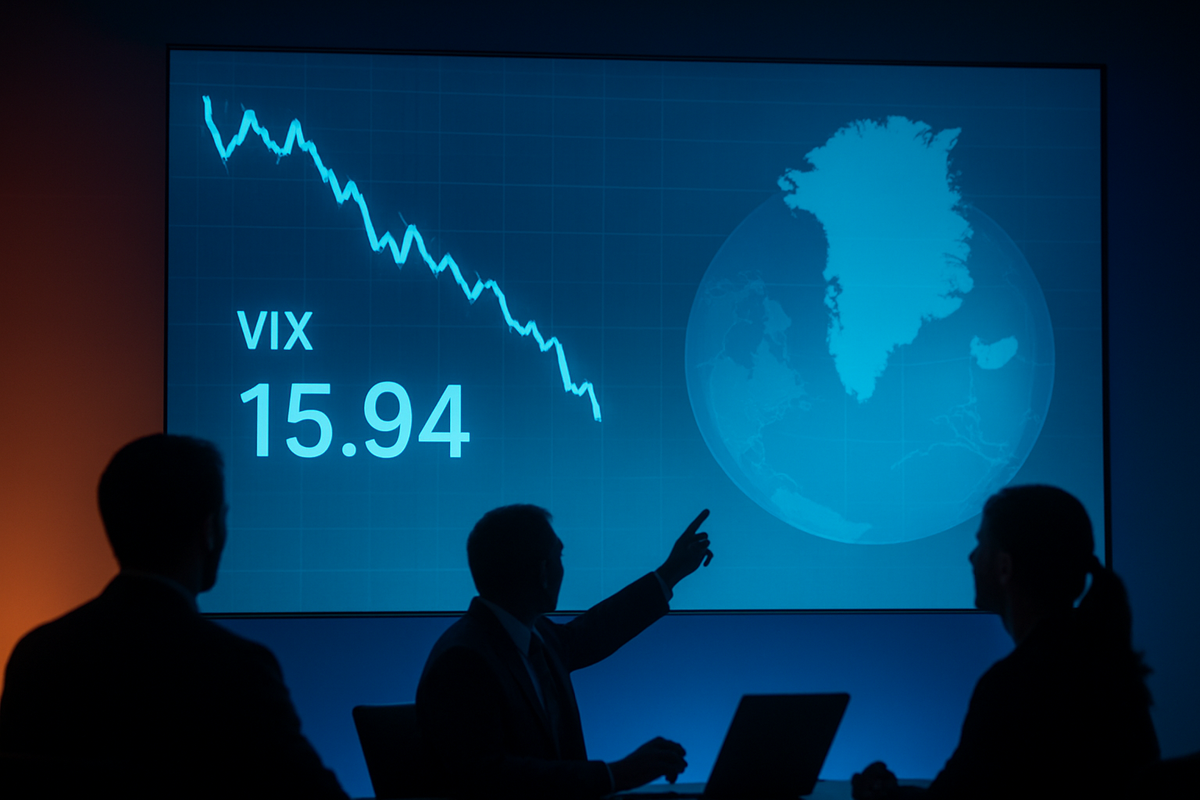
Wall Street witnessed a surge in risk-on sentiment today as the Cboe Volatility Index (VIX) fell by over 5%, closing at 15.94. The decline marks a sharp reversal from the "Greenland Chill" that gripped markets earlier this week, providing a clear signal that investors are betting on a stabilization of transatlantic trade relations. The retreat in the market’s "fear gauge" follows an announcement from the White House that it would indefinitely suspend proposed tariffs against Denmark and several other European allies.
The sudden pivot by President Trump has restored confidence in global equity markets, which had been reeling from the prospect of a new trade war. By rowing back on the 10% tariff threat—previously linked to the administration's renewed interest in acquiring Greenland—the U.S. government has effectively neutralized a major source of geopolitical uncertainty. This move has allowed the S&P 500 and the Nasdaq to regain significant ground, as traders pivot back to growth-oriented sectors and move away from safe-haven assets like gold and Treasury bonds.
The Arctic De-Escalation: A Timeline of the 'Greenland Chill'
The volatility spike began in earnest on Saturday, January 17, 2026, when President Trump reignited a dormant diplomatic firestorm by demanding that Denmark facilitate the U.S. purchase of Greenland. The administration framed the acquisition as a critical national security measure to counter Russian and Chinese expansion in the Arctic. When the Danish government and Greenlandic authorities reaffirmed that the territory was "not for sale," the White House responded with a sweeping threat: a 10% tariff on all goods from eight European nations, including Germany, France, and the United Kingdom, scheduled to take effect on February 1.
The market reaction on Tuesday, January 20—the first full trading day of the week—was one of widespread panic. The VIX surged past the 20 level for the first time in months, while major indices suffered their worst single-day losses since late 2025. However, the tension broke during the World Economic Forum in Davos, Switzerland. Following a high-stakes meeting with NATO Secretary General Mark Rutte, the President announced via social media that the tariffs were "on hold" in exchange for a "new framework" regarding Arctic security and mineral rights.
This de-escalation led to what veteran traders call the "TACO" trade (Trump Always Chickens Out), where the market rallies on the expectation that aggressive trade rhetoric will eventually be softened to avoid economic self-sabotage. By Thursday, January 22, the VIX had descended to its current level of 15.94, confirming that the immediate threat of a transatlantic trade war has been priced out of the market.
Winners and Losers: From Auto Giants to Shipping Titans
The rollback of tariff threats has created a distinct set of winners, particularly among European exporters and global logistics firms. German automakers, which were in the crosshairs of the proposed 10% duty, saw a significant relief rally. Shares of BMW (OTC: BMWYY) and Volkswagen (OTC: VWAGY) rose sharply as the threat to their U.S. profit margins evaporated. Similarly, Mercedes-Benz Group (OTC: MBGYY) benefited from the restored certainty in the luxury automotive market, where a 10% price hike could have severely dampened demand.
Danish pharmaceutical giant Novo Nordisk (NYSE: NVO) also emerged as a winner, as investors had feared that a trade spat could lead to regulatory hurdles or retaliatory measures affecting the healthcare sector. In the shipping industry, A.P. Møller - Mærsk A/S (OTC: AMKBY) saw its stock stabilize after several days of heavy selling. As one of the world's largest container shipping companies, Maersk is highly sensitive to shifts in global trade policy, and the removal of the Greenland-related tariffs protects critical trade routes between Europe and North America.
On the losing side, "fear-index" speculators and long-volatility fund managers saw their positions eroded by the 5% drop in the VIX. Defense contractors like Lockheed Martin (NYSE: LMT) and Boeing (NYSE: BA), which might have benefited from increased Arctic defense spending under a Greenland purchase scenario, saw more muted gains compared to the broader market. Additionally, rare earth mining companies like MP Materials (NYSE: MP), which had seen speculative buying on the hope that the U.S. would gain direct control of Greenland’s massive mineral deposits, saw some of those gains pared back as a full acquisition now seems unlikely.
The Significance: Trade Signaling and Arctic Ambitions
This episode fits into a broader trend of "geopolitical signaling" that has defined the second Trump administration. Analysts argue that the Greenland tariff threat was never intended to be a permanent trade policy, but rather a high-stakes negotiating tactic to force European allies into contributing more to Arctic defense and granting the U.S. preferential access to critical minerals. The VIX's rapid descent suggests that the market has become accustomed to this "fire and fury" approach, learning to discount the initial shock in favor of the eventual compromise.
The wider ripple effects of this event are significant for NATO relations. While the immediate economic threat is gone, the diplomatic friction caused by the Greenland demand may linger, potentially affecting future cooperation on energy policy and technology regulation. For competitors like China and Russia, the brief rift between the U.S. and its European allies provided a glimpse into the potential for Western fragmentation, though the quick resolution has largely closed that window for now.
Historically, this event draws parallels to the 2019 "Greenland incident" and the various tariff threats against Mexico and Canada during the first Trump term. In each case, the VIX acted as a barometer for executive unpredictability. The current stabilization at 15.94 indicates that, while the "Trump Premium" remains a factor in market pricing, the threshold for a sustained volatility spike has moved higher as investors become more cynical regarding the longevity of trade threats.
Looking Ahead: The Future of the Arctic Frontier
In the short term, markets will likely remain in a "risk-on" mode as the February 1st tariff deadline has been removed. However, the "framework" for Arctic security mentioned by the President remains vague. Investors should look for strategic pivots from companies involved in the "Greenland economy." We may see increased joint ventures between U.S. firms and the Danish government to develop the island's infrastructure and mining sectors, satisfying the administration's desire for mineral security without the need for a formal purchase or trade war.
A potential challenge that may emerge is the legislative response from the U.S. Congress. If the administration attempts to redirect funds toward Arctic defense without clear budgetary approval, it could trigger a domestic political standoff, potentially bringing volatility back into the markets by mid-year. Traders should also monitor the June 1st date, which was the original "second phase" of the proposed tariffs, to ensure the administration does not revive the threat if progress on the "mineral framework" stalls.
Summary and Investor Outlook
The decline of the VIX to 15.94 represents a triumph of market pragmatism over political theater. The core takeaways for investors are that the transatlantic trade relationship, while stressed, remains intact, and the "Arctic play" has shifted from a territorial acquisition strategy to one of economic and security cooperation. The immediate relief in the automotive and shipping sectors highlights the continued sensitivity of global supply chains to executive-level trade decisions.
Moving forward, the market is expected to remain resilient as long as the "TACO" trade holds true. However, investors should watch for any signs of renewed tension in the Arctic or shifts in the administration's mineral policy. The lasting impact of this event will likely be a more vigilant approach to "headline risk," where traders must balance the aggressive rhetoric of the White House against the underlying economic realities of global trade. For the coming months, the VIX will be the most critical indicator to watch as the administration continues to navigate its complex relationship with the European Union.
This content is intended for informational purposes only and is not financial advice