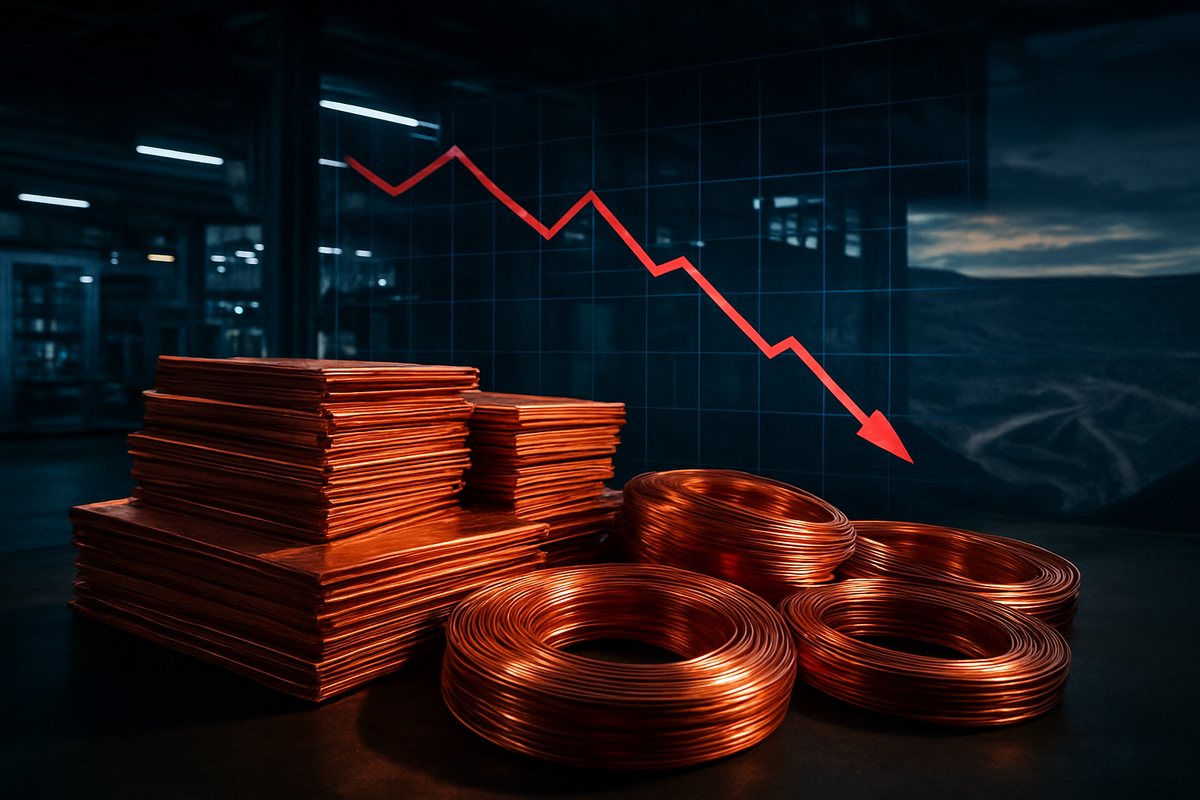
On January 22, 2026, Freeport-McMoRan (NYSE: FCX) reported fourth-quarter 2025 financial results that topped Wall Street estimates on both the top and bottom lines. Despite delivering a significant earnings beat fueled by record-high metal prices, shares of the Phoenix-based mining giant tumbled in early trading, eventually closing down nearly 2% at $60.58. The market's reaction underscored a classic "sell the news" event, as investors moved to lock in profits following a blistering three-month rally that saw the stock gain 46% heading into the release.
The paradox of falling share prices in the face of strong performance highlights a growing tension in the commodities market. While the "copper squeeze" remains the dominant narrative for 2026, concerns over rising operational costs in Indonesia and a conservative production outlook for the coming year have prompted a tactical retreat by institutional investors who had priced in a flawless execution.
The Quarter of High Prices and Operational Hurdles
Freeport-McMoRan reported adjusted earnings per share (EPS) of $0.47, comfortably ahead of the $0.32 consensus estimate. Total revenue for the quarter reached $5.63 billion, surpassing expectations of $5.28 billion. These results were primarily driven by a 28% year-over-year increase in average realized copper prices, which hit $5.33 per pound in the final months of 2025. Gold prices also provided a substantial tailwind, padding the company's margins despite significant production headwinds.
The operational backdrop, however, was far from smooth. The company is still grappling with the aftermath of a "mud-rush" incident at its flagship Grasberg mine in Indonesia, which occurred in late 2025. This geological disruption led to a 39% decline in copper production and an 85% plunge in gold output for the quarter. While higher prices offset the volume loss, the incident forced unit net cash costs up by 34% to $2.22 per pound. Management’s 2026 sales outlook of 3.4 billion pounds of copper was viewed by some analysts as overly cautious, reflecting the slow phased restart of the Grasberg Block Cave mine, which isn't expected to reach full capacity until the second quarter of 2026.
Sorting Winners and Losers in the Global Supply Crunch
As Freeport-McMoRan navigates its Indonesian challenges, the broader copper sector is seeing a divergence in performance. Southern Copper Corporation (NYSE: SCCO) has emerged as a primary beneficiary of the current price environment. Unlike Freeport, Southern Copper maintains the world’s largest reserves with significantly lower cash costs, positioning it as a "pure-play" winner. With a $15 billion capital investment plan focused largely on stable jurisdictions in Peru and Mexico, SCCO is projected to see earnings growth of nearly 18% in 2026, attracting investors looking for exposure without the specific regional risks currently dogging FCX.
Meanwhile, diversified giants like BHP Group Limited (NYSE: BHP) and Rio Tinto Group (NYSE: RIO) are aggressively pivoting to fill the supply gap. BHP recently formed a 50-50 joint venture to develop the massive Filo del Sol deposits in South America, while Rio Tinto is ramping up its Oyu Tolgoi underground mine in Mongolia. On the other side of the ledger, companies heavily reliant on third-party smelting, such as Antofagasta plc (LSE: ANTO), are facing a different set of pressures. Antofagasta recently negotiated historic-low treatment and refining charges (TC/RCs) with Chinese smelters—a signal of extreme concentrate scarcity that benefits miners but threatens the profitability of the global smelting industry.
The Strategic Shift: AI, Electrification, and "Downstreaming"
The market's lukewarm reaction to Freeport's beat also reflects a broader recalibration of the "Copper Fever" that has gripped markets since mid-2025. We are entering 2026 with a projected structural deficit of up to 330,000 metric tons. The primary catalyst is no longer just the traditional construction cycle, but the exponential growth of AI data centers. These facilities require roughly 27 to 33 tonnes of copper per megawatt—double the intensity of standard data centers. J.P. Morgan estimates that AI-related infrastructure alone will consume 475,000 metric tons of copper this year, an increase that supply-constrained miners are struggling to meet.
Furthermore, policy shifts in Indonesia are reshaping the industry's cost structure. The Indonesian government has moved forward with a mineral "downstreaming" policy, essentially banning the export of unprocessed copper concentrates to force domestic smelting. While Freeport has been granted temporary export quotas through April 2026 to mitigate revenue loss, the transition has introduced new taxes and operational complexities. This regulatory environment, combined with global grid modernization and the steady demand for electric vehicle infrastructure, has created a high-price floor that makes any operational misstep by a major player like Freeport particularly visible to shareholders.
The Road Ahead: Volatility Amidst a Growing Deficit
Looking forward, the immediate challenge for Freeport-McMoRan will be the successful ramp-up of its Manyar smelter in Gresik, Indonesia. Reaching full capacity is essential for the company to exit its current "force majeure" state and fully capitalize on the $12,000-per-tonne copper prices forecasted by some major banks for the second quarter of 2026. In the short term, the stock may face continued volatility as technical indicators suggest it remains overbought despite the post-earnings dip.
Longer-term, the industry is bracing for an era of consolidation. With new "greenfield" mines taking up to 15 years to develop, established companies with existing "brownfield" expansion opportunities are becoming prime acquisition targets. Investors should watch for potential M&A activity involving mid-tier producers as the "Big Four" look to secure their supply chains against a deficit that is expected to widen toward 2030.
Market Wrap-Up and Final Thoughts
The decline in Freeport-McMoRan’s stock following a double-beat earnings report is a stark reminder that in a high-expectation environment, "good" results are sometimes not enough. The 46% rally leading into January 2026 had already priced in the high metal prices; what investors were looking for was an operational "all-clear" signal from Indonesia that did not materialize.
For the market moving forward, the focus will remain on two fronts: the ability of producers to control escalating cash costs and the pace of demand from the technology sector. While profit-taking has cooled FCX’s momentum for now, the underlying fundamentals of the copper market—characterized by a looming structural deficit and unprecedented demand from AI and green energy—suggest that the broader bull case for copper remains intact. Investors should keep a close eye on copper inventory levels at the London Metal Exchange (LME) and production updates from the Grasberg mine in the coming months to gauge when the next leg of the rally might begin.
This content is intended for informational purposes only and is not financial advice.