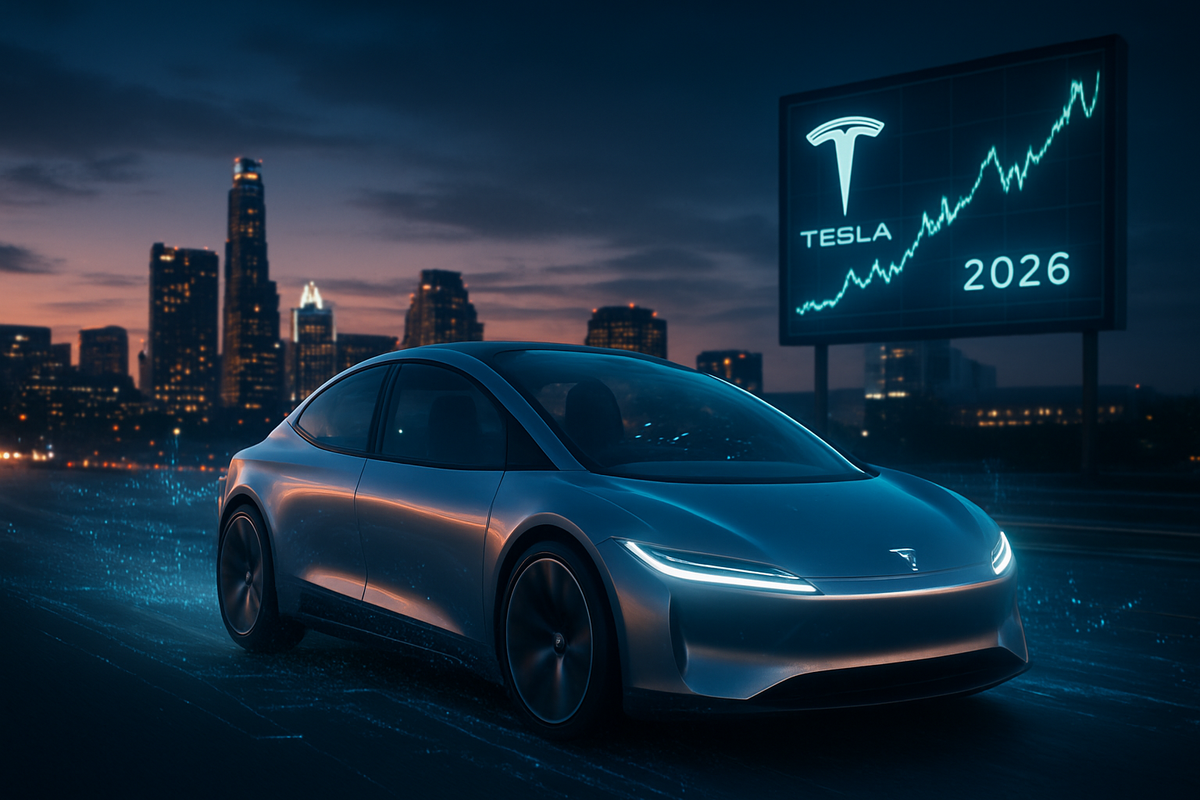
As the calendar turns to mid-January 2026, the global financial community has its eyes fixed on Austin, Texas. For Tesla (NASDAQ: TSLA), the next few weeks represent more than just another earnings cycle; they are the start of a definitive year that will likely determine whether the company’s pivot from a mass-market automaker to an artificial intelligence and robotics powerhouse is a visionary masterstroke or a costly overreach. With a critical earnings report scheduled for January 28 and the clock ticking toward a promised April production start for its "Cybercab," Tesla is facing a "moment of truth" that has left investors and analysts sharply divided.
The immediate implications are stark. Following a year where vehicle deliveries contracted for the second consecutive time—falling to 1.64 million units in 2025—the company’s valuation is increasingly untethered from its automotive sales and almost entirely dependent on its autonomous driving progress. As of January 12, 2026, the stock is trading on the promise of "unsupervised" Full Self-Driving (FSD) and the successful launch of a dedicated robotaxi fleet, making the upcoming Q4 2025 financial results a high-stakes referendum on CEO Elon Musk’s long-term roadmap.
The Push for Autonomy: Cybercab and FSD v14
The primary catalyst for Tesla’s current market narrative is the Cybercab, the sleek, steering-wheel-less two-seater unveiled in late 2024. Musk has recently doubled down on a mass production start date of April 2026 at Giga Texas, utilizing a revolutionary "Unboxed" manufacturing process designed to slash costs and accelerate output. Throughout early January, sightings of Cybercab prototypes at Tesla’s Fremont test track and crash-safety facilities have intensified, signaling that the company is in the final stages of hardware validation.
Underpinning this hardware is FSD v14, which began rolling out to the fleet in late 2025. This latest iteration of Tesla’s software has moved away from legacy code entirely, relying on an end-to-end neural network that Musk claims possesses "reasoning" capabilities for complex urban environments. While the software has reached what some experts call a "quasi-Level 4" threshold, the company still lacks the regulatory green light for unsupervised commercial use on public roads in the United States. To bridge this gap, Tesla has logged over 7 billion cumulative FSD miles as of December 2025, aiming for a 10-billion-mile safety benchmark by mid-2026.
The timeline leading to this moment has been fraught with challenges. After the "delivery plateau" of 2024, Tesla spent much of 2025 restructuring its operations to prioritize AI compute and humanoid robotics. Key stakeholders, including major institutional investors and retail "bulls," have largely accepted the decline in traditional car margins in exchange for the high-margin potential of a software-driven robotaxi network. However, the pressure is mounting as the April 2026 production deadline approaches, with little room for the delays that have historically plagued Tesla’s new product launches.
Winners and Losers in the Autonomous Race
Tesla’s aggressive push into the robotaxi market creates a complex web of potential winners and losers. Tesla (NASDAQ: TSLA) itself stands as the primary beneficiary if it can successfully launch a low-cost, high-margin autonomous network. However, the company is no longer alone in the space. Alphabet Inc. (NASDAQ: GOOGL), through its subsidiary Waymo, has already established a dominant lead in commercial autonomous miles, operating in several major U.S. cities with a proven safety record. If Tesla fails to secure regulatory approval or faces hardware bottlenecks with its AI5 chip, Waymo could solidify its position as the de facto standard for autonomous ride-hailing.
The ride-sharing giants Uber Technologies (NYSE: UBER) and Lyft (NASDAQ: LYFT) face an existential threat or a massive opportunity. While a successful Tesla robotaxi network could theoretically undercut their pricing, many analysts believe Tesla will ultimately need to partner with existing platforms to manage fleet logistics and customer acquisition. Conversely, if Tesla’s "unsupervised" FSD remains elusive, Uber and Lyft may benefit from a slower transition to autonomy, allowing them to integrate various third-party autonomous technologies at their own pace.
Meanwhile, Nvidia (NASDAQ: NVDA) continues to be a critical player, providing the massive compute power required for Tesla’s training clusters, even as Tesla ramps up its own Dojo supercomputer and AI5 chip production. On the losing side, traditional legacy automakers like Ford (NYSE: F) and General Motors (NYSE: GM) continue to struggle with the dual burden of transitioning to EVs while lagging significantly behind in the software and AI capabilities necessary to compete in a world where "driving" is no longer a human requirement.
A Global Shift in Mobility and Regulation
The significance of Tesla’s 2026 deadlines extends far beyond its stock price; it marks a shift in the global industrial landscape. The transition to autonomy is increasingly viewed as the "Space Race" of the 2020s, with significant geopolitical implications. While U.S. federal regulators have been slow to create a unified framework for autonomous vehicles, states like Texas and Nevada have become testing grounds for the future. Tesla is currently focusing its lobbying efforts on these "permissive" jurisdictions to launch its first commercial routes.
Internationally, the landscape is shifting even faster. Tesla is slated to launch FSD in the United Arab Emirates this month, with European approval—starting in the Netherlands—expected by March 2026. This global fragmented regulatory environment creates a "patchwork" challenge for Tesla, but also offers multiple pathways to success if domestic U.S. hurdles prove too high. Historically, this mirrors the early days of the automobile, where local ordinances eventually gave way to national standards as the technology’s utility became undeniable.
Furthermore, the "Unboxed" manufacturing method Tesla is debuting with the Cybercab could disrupt the entire manufacturing sector. By moving away from the traditional assembly line, Tesla aims to reduce factory footprints by 40% and capital expenditures by 50%. If successful, this could force a total rethink of industrial engineering across sectors, from consumer electronics to aerospace, marking a third industrial revolution in manufacturing efficiency.
What Lies Ahead: The 2026 Roadmap
In the short term, all eyes are on the January 28 earnings call. Analysts are bracing for a difficult report, with consensus EPS estimates at $0.34—down nearly 50% from the previous year. Revenue is also expected to be slightly lower at $24.81 billion. The "wild card" remains Tesla Energy, which saw record deployments of 14.2 GWh in the final quarter of 2025. If the energy business can continue to scale at 50% year-over-year, it may provide the financial cushion Tesla needs to fund its AI ambitions without further diluting shareholders.
Looking toward the mid-to-long term, the successful ramp of the Cybercab in April will be the ultimate test. If Tesla can prove it can build these vehicles at scale and operate them safely without a human driver, the company’s valuation could skyrocket toward the multi-trillion-dollar figures Musk has projected. However, a failure to meet the April deadline or a significant safety incident involving FSD v14 could lead to a severe re-rating of the stock, as investors lose patience with the "AI-first" narrative.
Final Assessment: A High-Wire Act for Investors
As Tesla enters the 2026 fiscal year, it is a company in the midst of a radical metamorphosis. The old metrics of vehicle deliveries and automotive gross margins are being replaced by AI training capacity, FSD take rates, and regulatory milestones. For investors, the takeaway is clear: Tesla is no longer a car company, but a high-risk, high-reward bet on the future of autonomous mobility.
The coming months will provide the answers the market has been seeking. Watch closely for the January 28 earnings guidance, specifically any updates on the "Model 2" (the rumored $25,000 car) and the specific progress of FSD trials in Texas and Nevada. While the risks are substantial, the potential for Tesla to redefine the global transportation and energy markets remains its most compelling—and controversial—attribute.
This content is intended for informational purposes only and is not financial advice.