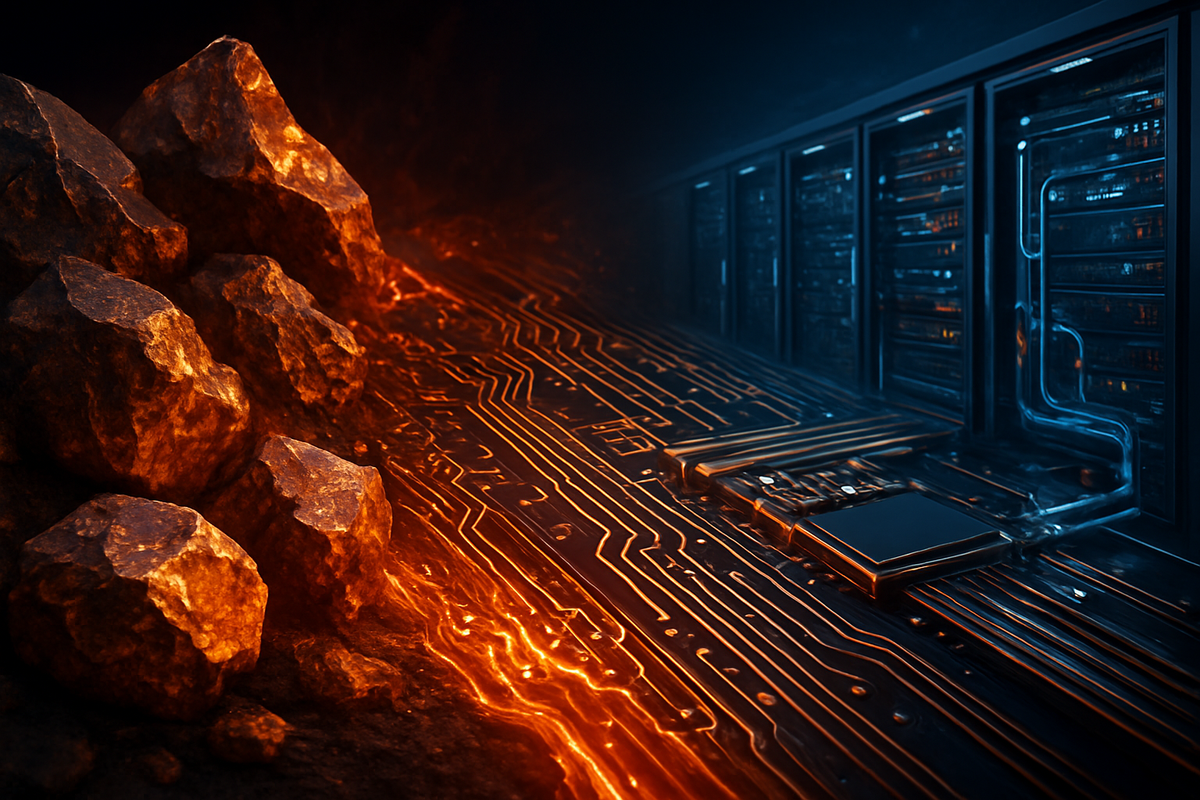
As the final bells ring on the 2025 trading year, one commodity stands as the undisputed king of the markets: copper. In a year defined by technological upheaval and a strained global supply chain, the "red metal" has undergone a historic "super-rally," with prices on the London Metal Exchange (LME) surging by more than 40% since January. Closing the year at a record high of $12,960 per metric ton, copper has effectively decoupled from the broader industrial slowdown, driven instead by the insatiable physical requirements of the artificial intelligence (AI) revolution and a global energy transition that has reached its critical "build-out" phase.
The implications of this price explosion are reverberating across the global economy. For mining giants, 2025 has been a year of windfall profits and operational challenges, while downstream consumers—from electric vehicle manufacturers to data center developers—are grappling with a "copper crunch" that threatens to inflate the costs of the digital and green transitions. As we look back on 2025, it is clear that copper is no longer just an industrial metal; it has become a strategic asset as essential to the 21st century as oil was to the 20th.
The Perfect Storm: A Timeline of the 2025 Surge
The 2025 rally did not happen in a vacuum but was the result of a "perfect storm" of demand shocks and supply-side disasters. The year began with copper trading at a relatively stable $8,500 per ton, but the narrative shifted rapidly in the second quarter. By April, institutional investors began pouring into copper "long" positions as the true scale of generative AI hardware requirements became public. It was revealed that modern hyperscale AI data centers require between 27 and 33 tonnes of copper per megawatt—nearly ten times the intensity of traditional facilities—to support advanced liquid cooling systems and high-density power distribution.
The situation turned from a rally to a "super-squeeze" in September 2025, following a catastrophic event at the Grasberg mine in Indonesia, operated by Freeport-McMoRan (NYSE: FCX). A series of unprecedented mudslides and flooding led to a declaration of force majeure, effectively removing 250,000 tonnes of supply from the global market overnight. This disaster coincided with ongoing labor strikes in Peru and declining ore grades at the world’s largest copper mine, Escondida, majority-owned by BHP Group (NYSE: BHP). By October, global inventories on the LME and COMEX had plummeted to multi-decade lows, with some warehouses reporting less than a single day’s worth of global demand in reserve.
The year culminated in a dramatic "Boxing Day" rally. Between December 26 and December 29, the LME saw a 6.6% single-day spike, fueled by news that the Chinese government would begin reining in copper smelting capacity growth to meet environmental targets. This policy shift sparked fears of a refined metal shortage for 2026, pushing prices to their all-time high of $12,960 per metric ton just as the year drew to a close.
Winners and Losers in the New Copper Economy
The primary beneficiaries of the 2025 rally have been the major diversified miners who managed to maintain production despite the year’s volatility. Freeport-McMoRan (NYSE: FCX), despite the setbacks at Grasberg, saw its stock price climb by 35% this year. As "America’s Copper Champion," the company benefited from a "Fortress America" premium, where US domestic prices remained consistently higher than global benchmarks due to new trade barriers. Similarly, BHP Group (NYSE: BHP) reported record annual copper production of 2 million tonnes, with copper’s contribution to its group earnings rising to 45%, up from just 29% the previous year.
Rio Tinto (NYSE: RIO) also emerged as a winner, with its stock rising 33% as it successfully ramped up the Oyu Tolgoi underground mine in Mongolia. The project, one of the few large-scale copper developments to come online in recent years, provided a critical buffer for the company against the supply shocks seen elsewhere. Meanwhile, the trading arm of Glencore (LSE:GLEN) reaped record profits by navigating the extreme price volatility and the widening "arbitrage gap" between US and global markets, even as its mining margins faced pressure from rising diesel and labor costs.
On the losing side of the ledger are the high-growth technology and automotive sectors. Companies like Nvidia (NASDAQ: NVDA) and Tesla (NASDAQ: TSLA) have faced significant input cost inflation. For EV manufacturers, the 40% rise in copper prices added an estimated $400 to $600 to the production cost of every vehicle. In the AI space, the massive capital expenditure (CapEx) required for data center expansion is being squeezed by the rising cost of the electrical infrastructure—transformers, busbars, and cabling—all of which are copper-heavy.
AI and the "Electrification of Everything"
The wider significance of the 2025 super-rally lies in the fundamental shift in how the market views copper demand. For decades, copper was seen as a proxy for the Chinese construction sector. However, 2025 proved that the "Electrification of Everything" is a more powerful driver. The AI revolution, which many initially viewed as a purely software-driven phenomenon, has turned out to be a massive physical undertaking. The 500,000 tonnes of copper consumed by AI infrastructure in 2025 alone represents a new, permanent pillar of demand that did not exist five years ago.
Furthermore, the rally has highlighted a growing geopolitical divide in the metals market. The emergence of a "Fortress America" price premium suggests that copper is becoming a localized resource, with Western nations willing to pay a premium to secure supply chains independent of China. This mirrors historical precedents like the oil shocks of the 1970s, where resource scarcity led to major shifts in national energy policies and trade alliances. Regulators are now increasingly viewing copper as a "critical mineral," leading to potential new subsidies for domestic mining and recycling in the US and EU.
The Road to 2026: Scarcity or Substitution?
Looking ahead to 2026, the market faces a critical juncture. Short-term, the deficit is expected to persist as the Grasberg mine remains under repair and new projects are slow to reach full capacity. This may force a strategic pivot toward copper substitution. We are already seeing research and development into high-conductivity aluminum alloys for use in EV motors and certain power grid applications. While aluminum is less efficient than copper, the massive price gap may finally make "thrifting"—using less metal or lower-quality alternatives—a financial necessity for manufacturers.
However, the long-term opportunity for investors remains in the "supply gap." Analysts estimate that the world needs to discover and develop the equivalent of one "Escondida-sized" mine every year for the next decade to meet 2050 net-zero goals. This suggests that the 2025 rally may not be a one-off spike but the beginning of a structural "higher-for-longer" price environment. Market participants should watch for a surge in M&A activity in 2026, as cash-rich miners look to acquire junior exploration firms to replenish their dwindling reserves.
Summary of the 2025 Copper Landscape
The 2025 Copper Super-Rally has rewritten the playbook for commodity markets. By surging 40% to record highs, copper has proven itself to be the essential backbone of both the digital and green economies. The primary takeaway for the year is the emergence of AI as a dominant demand driver, which, combined with chronic underinvestment in new mining projects and unexpected operational disasters, created a historic supply deficit.
Moving forward, the market will likely remain in a state of "tightness." Investors should keep a close eye on inventory levels at the LME and the progress of major projects like Rio Tinto’s Oyu Tolgoi. The key question for 2026 will be whether the mining industry can respond to these record price signals with new supply, or if the "copper crunch" will act as a permanent handbrake on the pace of global technological and environmental progress. For now, the "red metal" remains the most important barometer of the 21st-century economy.
This content is intended for informational purposes only and is not financial advice.