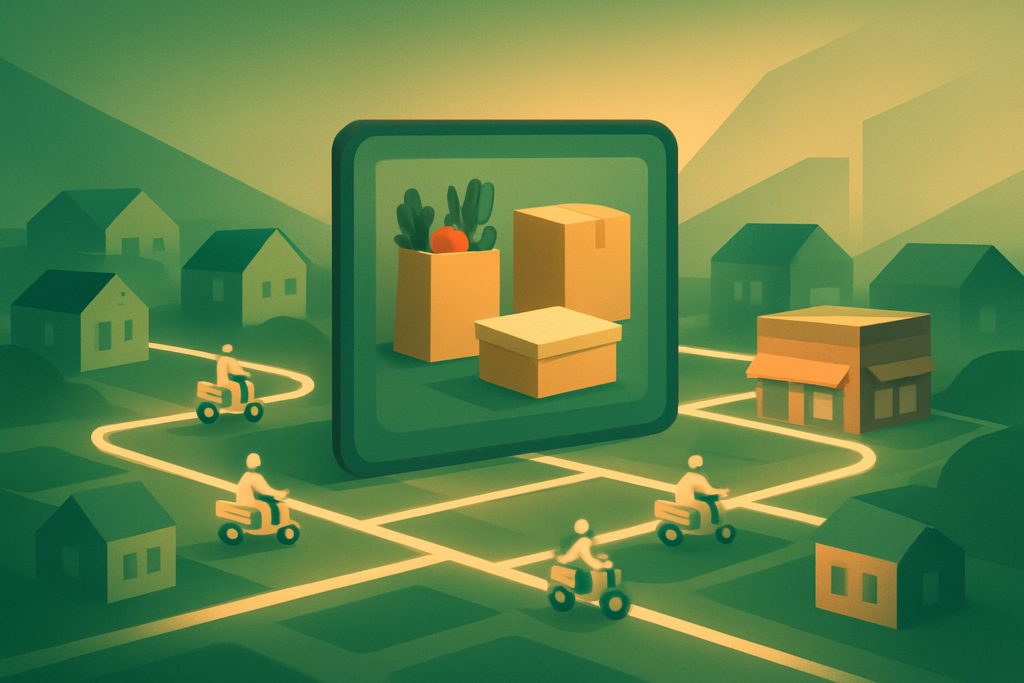
As of February 19, 2026, DoorDash, Inc. (NASDAQ: DASH) has evolved far beyond its origins as a third-party restaurant delivery service. Once viewed as a high-growth but profit-bleeding "gig economy" experiment, the company enters 2026 as the undisputed heavyweight of local commerce. With a dominant market share and a successful pivot into grocery, retail, and advertising, DoorDash has silenced critics who doubted the long-term viability of the delivery business model. Today, the company is increasingly viewed as a logistics and data powerhouse—the "operating system for local trade"—connecting millions of consumers with nearly any physical product in their zip code in under an hour.
Historical Background
Founded in 2013 by Stanford students Tony Xu, Stanley Tang, Andy Fang, and Evan Moore, DoorDash began as "Palo Alto Delivery." The founders personally delivered the first orders to understand the pain points of local merchants. By focusing on suburban markets that its early rival Grubhub ignored, DoorDash rapidly gained ground.
The company’s trajectory changed forever during the COVID-19 pandemic, which pulled forward years of consumer adoption. DoorDash went public in December 2020 in one of the year’s most anticipated IPOs. Since then, the company has pursued aggressive horizontal and geographic expansion. Key milestones include the $8 billion acquisition of Finnish delivery platform Wolt in 2022, which provided a European foothold, and the late 2025 acquisition of Deliveroo, which solidified its position as a global leader in the logistics space.
Business Model
DoorDash operates a three-sided marketplace consisting of consumers, merchants (restaurants, grocers, retailers), and "Dashers" (independent delivery couriers). Its revenue streams are diversified across four primary pillars:
- Marketplace Core: Commissions from merchants and service fees from consumers on every order.
- DashPass: A high-margin subscription service that provides members with $0 delivery fees. As of early 2026, DashPass remains a critical loyalty driver and a predictable recurring revenue stream.
- Advertising & Promotions: A burgeoning high-margin business where merchants pay for sponsored listings and "Featured" placement. This segment reached a $1 billion annual run-rate in late 2024 and continues to be a primary driver of EBITDA expansion.
- Drive (White-Label Logistics): DoorDash provides the fulfillment backbone for merchants’ own websites and apps, allowing brands like Chipotle or Macy’s to offer delivery without managing their own fleets.
Stock Performance Overview
The performance of DASH stock has been a story of resilience. After a volatile period following its 2020 IPO and a significant drawdown during the tech rout of 2022, the stock began a sustained recovery in 2023. Over the past five years, DoorDash has outperformed many of its pandemic-era peers.
In 2024 and 2025, the stock saw a massive re-rating as the company achieved GAAP profitability and demonstrated that its grocery and retail segments could scale efficiently. Year-over-year, the stock is up approximately 35%, reflecting investor confidence in management's ability to maintain high double-digit revenue growth while expanding margins.
Financial Performance
DoorDash’s financial profile has undergone a dramatic transformation. In fiscal year 2024, the company hit a historic milestone: its first full year of GAAP profitability, reporting a net income of $123 million.
As we look at the figures for 2025 and projections for 2026:
- Revenue: Reached $13.72 billion in 2025, a significant jump fueled by the Deliveroo acquisition and high "New Vertical" adoption. Analysts project revenue to approach $17.84 billion by the end of 2026.
- Adjusted EBITDA: Management has successfully optimized the cost of delivery. Adjusted EBITDA for 2025 hovered near $2.8 billion, with 2026 targets aiming for further expansion through automation.
- Free Cash Flow (FCF): The company generated $1.8 billion in FCF in 2025, providing a massive war chest for R&D and further M&A.
- Valuation: While still trading at a premium compared to traditional retail, its Price-to-Sales and EV/EBITDA multiples have stabilized as the "path to profit" is no longer a question, but a reality.
Leadership and Management
CEO Tony Xu has earned a reputation for disciplined execution and a long-term "founder-led" mindset. Unlike many tech CEOs who focused solely on growth at any cost, Xu transitioned the company toward operational efficiency ahead of the market curve in 2022.
The management team was further bolstered by the integration of Wolt CEO Miki Kuusi, who now oversees international operations. The board is recognized for its strong governance and focus on shareholder value, evidenced by strategic share buyback programs initiated in 2024-2025 to offset dilution from stock-based compensation.
Products, Services, and Innovations
Innovation in 2026 is centered on "The Everything Store." DoorDash has moved aggressively into:
- Grocery and Retail: Now the #1 third-party marketplace for U.S. grocery volume, partnering with giants like Kroger and Wegmans.
- AI Integration: In early 2026, DoorDash launched a ChatGPT-powered "Meal to Cart" feature, allowing users to plan a week of meals via AI and have the entire grocery list populated and delivered in one click.
- Autonomous Logistics: DoorDash is scaling its own autonomous delivery platform, using a hybrid of sidewalk robots for dense urban cores and drone delivery for suburban medicine and small-item retail, significantly lowering the "cost per drop."
Competitive Landscape
DoorDash maintains a dominant 67-68% share of the U.S. food delivery market. Its primary rival, Uber Eats (owned by Uber Technologies, Inc. (NYSE: UBER)), holds approximately 24% and competes fiercely through its "Uber One" cross-platform loyalty program.
Grubhub, once a leader, has seen its share dwindle to single digits (~8%) and was sold to Wonder Foods in early 2025 at a fraction of its former valuation. Meanwhile, Instacart (Maplebear Inc. (NASDAQ: CART)) remains the primary challenger in the grocery space, though DoorDash’s superior logistics density and larger user base have allowed it to capture significant market share from the grocery-first incumbent.
Industry and Market Trends
The "On-Demand Economy" has shifted from a luxury to a utility. Three key trends define the sector in 2026:
- Convenience as a Commodity: Consumers now expect sub-30-minute delivery for non-food items, ranging from hardware (Home Depot) to apparel (Old Navy).
- Ads-as-a-Service: Like Amazon, delivery platforms have become massive advertising networks, as brands realize the value of appearing at the "point of purchase" on a mobile device.
- Consolidation: The high cost of technology and logistics has led to a "winner-take-most" market, favoring players like DoorDash with the scale to amortize R&D costs.
Risks and Challenges
Despite its dominance, DoorDash faces significant hurdles:
- Labor Costs: Continuous upward pressure on gig worker wages in markets like New York City and Seattle threatens to compress margins.
- Consumer Sensitivity: In an environment of fluctuating macro conditions, higher service fees to offset regulatory costs can lead to "fee fatigue," resulting in lower order volumes.
- Execution Risk: Integrating large acquisitions like Deliveroo while simultaneously building a grocery business and an autonomous fleet is a massive operational undertaking.
Opportunities and Catalysts
- International Profitability: As Wolt and Deliveroo are fully integrated into the "Dash" tech stack, international margins are expected to catch up to North American levels.
- Advertising Upside: If DoorDash can increase its ad revenue to 4-5% of Gross Order Value (GOV), it would represent a massive high-margin windfall.
- Retail Partnerships: Deepening ties with big-box retailers for "last-mile-as-a-service" offers a revenue stream that doesn't depend on consumer-facing marketing spend.
Investor Sentiment and Analyst Coverage
Wall Street sentiment toward DASH is currently "Strong Buy" or "Outperform" across most major institutions. Analysts cite the company's clear leadership in the U.S. and its successful diversification into grocery as the primary reasons for optimism. Hedge fund activity in late 2025 showed increased positioning by growth-oriented funds, who view DoorDash not just as a delivery company, but as a dominant player in the broader e-commerce landscape.
Regulatory, Policy, and Geopolitical Factors
Regulation remains the primary "wild card." In 2024 and 2025, cities like Seattle and New York implemented aggressive minimum pay laws for delivery workers. In Seattle, this led to a $4.99 "Regulatory Response Fee," which briefly cooled demand.
At a national level, the debate over worker classification (1099 vs. W-2) continues to simmer, though DoorDash has successfully navigated this by advocating for "portable benefits" models that preserve flexibility while providing some security. Geopolitically, the expansion into Europe and Asia brings exposure to varying labor laws and digital services taxes.
Conclusion
As of early 2026, DoorDash has successfully transitioned from a specialized food delivery app into a diversified logistics titan. By dominating the U.S. market, achieving GAAP profitability, and aggressively expanding into grocery and advertising, the company has built a multi-layered moat that is difficult for competitors to breach.
Investors should watch for two key milestones in 2026: the successful integration of Deliveroo’s technology and the point at which the grocery segment becomes economic-profit positive. While regulatory headwinds and labor costs remain persistent threats, DoorDash's scale, technological edge, and leadership stability position it as a foundational stock in the modern digital economy.
This content is intended for informational purposes only and is not financial advice.