With a market cap of $1.5 trillion, Tesla, Inc. (TSLA) is a vertically integrated clean-energy and electric-vehicle company that designs, manufactures, and sells battery-electric vehicles, energy storage systems, and solar products. Headquartered in Texas, its automotive portfolio spans mass-market and premium segments, including the Model 3, Model Y, Model S, Model X, and Cybertruck, supported by proprietary powertrain, battery, and software stacks.
Companies worth more than $200 billion are generally labeled as “mega-cap” stocks, and Tesla fits this criterion perfectly. Tesla sets itself apart with a deeply integrated tech stack, spanning its Full Self-Driving (FSD) software, custom AI silicon, and a vast real-world driving dataset harvested from millions of vehicles, paired with a direct-to-consumer sales approach and a global fast-charging backbone (Supercharger). Beyond cars, its Energy arm extends the ecosystem into generation and storage through Megapack utility systems, Powerwall home batteries, and solar solutions, positioning Tesla as an end-to-end electrification and intelligent-grid platform rather than just an automaker.
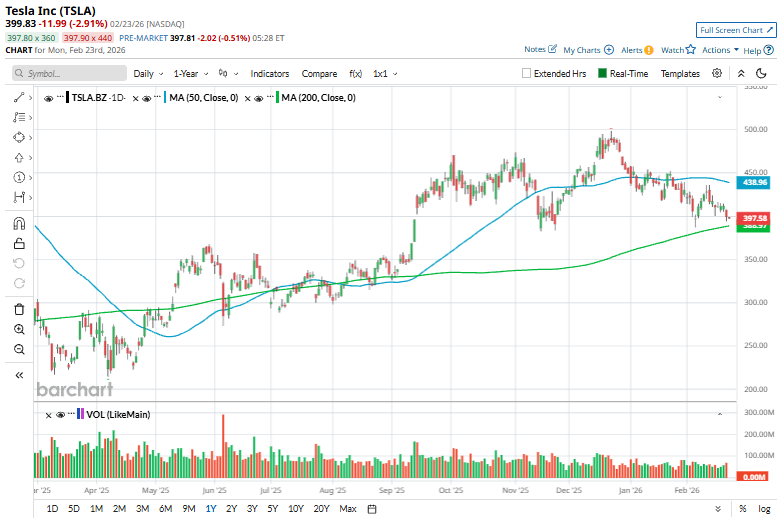
Despite the strengths, shares of the electric vehicle maker have declined 19.9% from its 52-week high of $498.83 recorded on Dec. 22. On the positive side, TSLA stock has increased 2.3% over the past three months, outpacing the State Street Consumer Discretionary Select Sector SPDR Fund’s (XLY) 2% uptick.
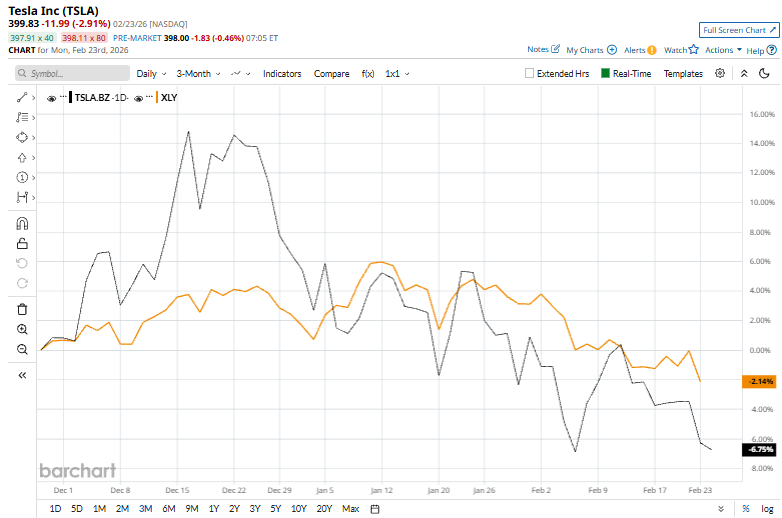
Longer term, shares of Tesla have returned 18.4% over the past 52 weeks, outpacing XLY’s 5.3% return over the same time frame. However, the stock is down 11.1% on a YTD basis, lagging behind XLY’s 3.7% rise.
While TSLA stock has been trading above its 200-day moving averages since early August 2025, it has dipped below the 50-day moving average since early January.
On Jan. 26, Tesla released its Q4 2025 earnings, and its shares dipped 3.1%. Its revenue declined 3% year over year to about $24.9 billion, with an 11% drop in automotive revenue, only partly offset by 25% growth in energy generation & storage and an 18% rise in services and other revenue. The quarter included 418,227 vehicle deliveries and a record 14.2 GWh energy-storage deployments, underscoring accelerating Megapack demand.
Nevertheless, rival General Motors Company (GM) has outpaced TSLA stock. GM stock has climbed 72.1% over the past 52 weeks and has dipped 2% on a YTD basis.
The stock has a consensus rating of “Hold” from 42 analysts in coverage, and the mean price target of $406.94 implies an upswing potential of 1.8% from the current market prices.
On the date of publication, Kritika Sarmah did not have (either directly or indirectly) positions in any of the securities mentioned in this article. All information and data in this article is solely for informational purposes. For more information please view the Barchart Disclosure Policy here.
More news from Barchart